
Deepfake Evolution: From Adversarial Matches to Diffusion Denoising
Deepfake generation and detection: A benchmark and survey
This paper provides a comprehensive survey and benchmark of Deepfake generation and detection, covering four key tasks: face swapping, face reenactment, talking-face generation, and facial attribute editing. It unifies task definitions and benchmarks representative methods, including the latest Diffusion-based and NeRF-integrated approaches, on widely adopted datasets like FF++ and VoxCeleb.
Executive Summary
TL;DR: This survey provides a masterful mapping of the Deepfake landscape, tracing the journey from traditional graphics to the "Diffusion era." It systematically deconstructs four generative pillars—Face Swapping, Reenactment, Talking Faces, and Attribute Editing—while simultaneously benchmarking the counter-measures in forgery detection.
Academic Positioning: This is a high-level "Map of the Field." It moves beyond mere list-making by providing a unified mathematical framework for generation and detection, positioning itself as the definitive guide for researchers navigating the transition from GAN-dominance to the high-fidelity world of Diffusion and NeRF.
Problem & Motivation: The Realism Arms Race
The core challenge in Deepfakes has always been the "Uncanny Valley"—the minute artifacts that signal to a human (or a classifier) that a face is synthetic. Prior work leaned heavily on GANs, which, while fast, often suffered from training instability and blurred textures under extreme poses.
The authors identify a critical gap: as generative models become "Generalists" (capable of swapping, reenacting, and editing simultaneously), detection systems must evolve from looking for simple pixel artifacts to understanding multimodal inconsistencies (e.g., does the lip movement match the audio's emotional tone?).
Methodology: The Generative Roadmap
The paper organizes the technological evolution into three distinct epochs:
- VAE Era: Introduced latent space interpolation but lacked sharp detail.
- GAN Era: Created a "boxing match" between generators and discriminators, leading to SOTA results like StyleGAN but struggling with temporal consistency.
- Diffusion/NeRF Era: The current frontier. Diffusion models treat generation as a "denoising" process, while NeRF allows for 3D-aware consistency.
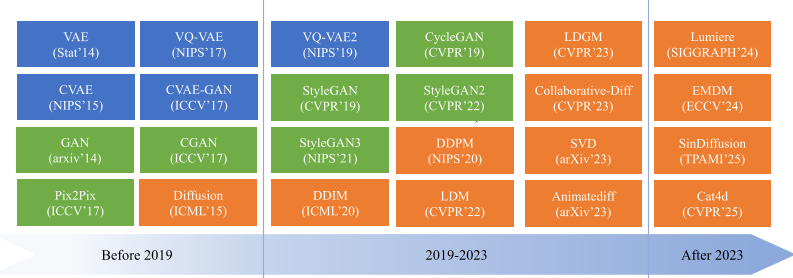 Fig 1: The chronological roadmap of VAE, GAN, and Diffusion technologies.
The Four Pillars of Generation
The authors define deepfake generation through a unified lens: . Whether the condition is a source identity (Swapping) or an audio clip (Talking Face), the goal is the same: maintain target attributes while injecting new information.
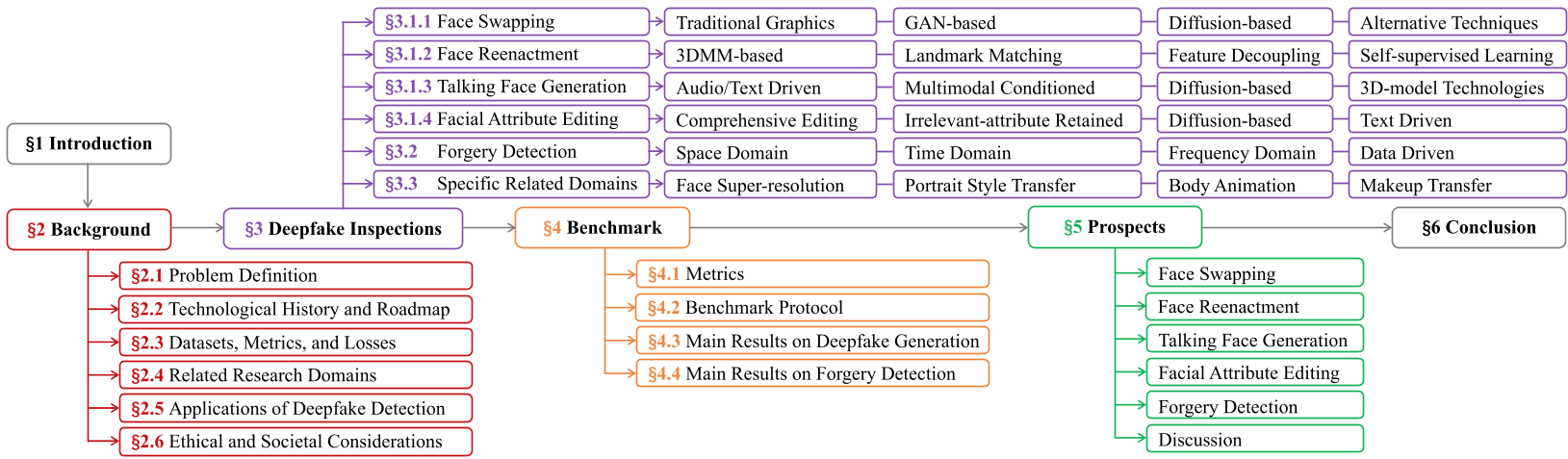 Fig 2: Intuitive objectives for various deepfake tasks and their manipulated facial components.
Experiments & Results: The Benchmark Battleground
The benchmark section highlights a critical shift: Generalization is the new SOTA.
- Face Swapping: Models like
WSC-SwapandDiffSwapare now reaching million-pixel resolutions with high ID retention (>90%), but "Expression Error" remains a challenge. - Detection: Frequency-domain analysis (using FFT or Wavelets) is proving more robust than spatial analysis. If a GAN leaves a "fingerprint" in the high-frequency spectrum, it’s easier to catch than by looking at the pixels themselves.
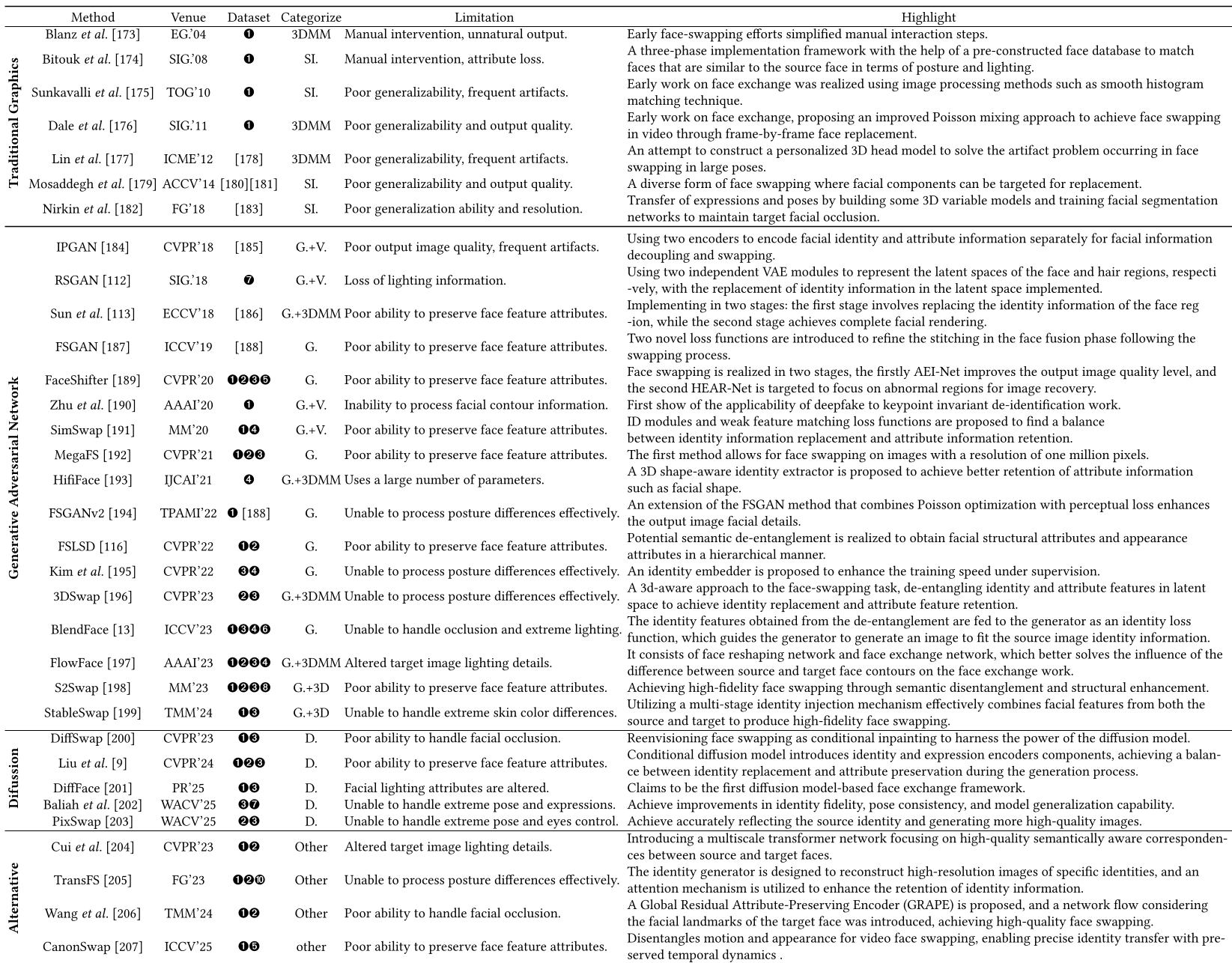 Table 1: Evolution and limitations of Face Swapping methods from traditional graphics to Diffusion.
Key Benchmarking Insight: In cross-dataset tests (training on FF++ and testing on Celeb-DF), almost all detectors see a significant drop in AUC. This suggests our detectors are still "overfitting" to the specific noise patterns of yesterday's generators.
Critical Analysis & Conclusion
Takeaway
We are entering the era of Multimodal Generalist Models. Future Deepfakes won't just be a face swap; they will be a 3D-consistent, emotionally expressive digital human driven by a single text prompt.
Limitations
Despite the progress, the survey notes that:
- Occlusion (a hand in front of the face) still breaks most models.
- Extreme Lighting causes generative artifacts.
- Unified Evaluation is still missing—researchers are "picking their favorite metrics," making direct comparisons difficult.
Future Outlook
The next frontier is Security-by-Design. Instead of a "cat and mouse" game of detect-and-generate, technologies like digital watermarking and provenance metadata (C2PA) will be essential for responsible AI deployment.