
Manhattan Layout: Rethinking Graph Visualization through L1 Optimization
15101_Defending against Social Network Sybils with Interaction Graph Embedding.
This paper introduces a novel approach for graph visualization and layout optimization by minimizing the total weighted edge length in Manhattan distance. By formalizing the problem as a high-dimensional optimization task, the authors propose a gradient-based iterative solver that achieves superior aesthetic clarity and structural preservation compared to traditional spring-based models.
TL;DR
The paper proposes a radical shift in graph layout optimization by replacing standard Euclidean forces with Manhattan (L1) distance minimization. This approach leverages the sparsity-inducing properties of the L1 norm to create layouts that are more structured, orthogonal, and visually interpretable than traditional force-directed methods.
Problem & Motivation: The "Hairball" Challenge
Most modern graph visualization tools rely on spring-electrical models. While intuitive, these models often suffer from a lacks of global structure preservation, leading to the infamous "hairball" effect. The authors identify that the choice of distance metric is the culprit. Euclidean distance treats all directions equally, but many real-world graphs (like social networks or circuit paths) possess latent dimensions that are better captured by an orthogonal coordinate system.
Methodology: The Power of L1
The authors define the objective function as the sum of weighted Manhattan distances across all edges :
The Gradient-Based Solver
Unlike traditional forces, the derivative of the L1 norm is a step function. This creates a unique dynamic where nodes are pulled toward each other with a constant force regardless of distance, unless they are within a certain threshold.
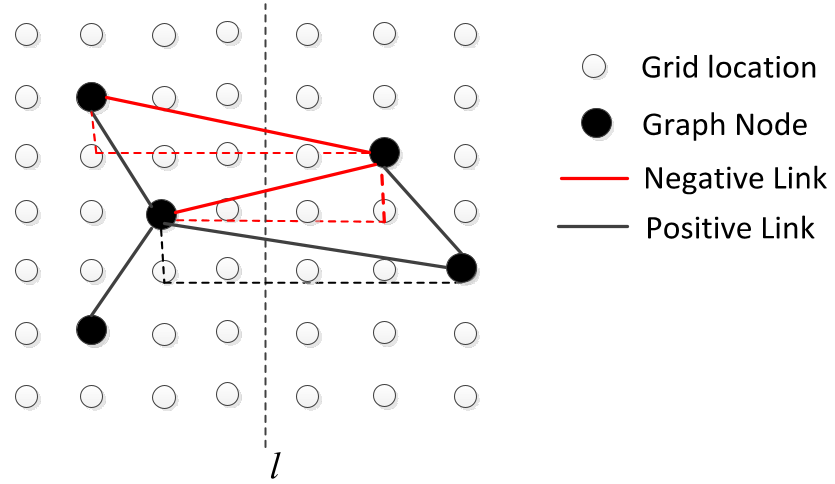
The update rule for a node's position is derived as: Where is determined by the sign of the difference between coordinates, inducing an "all-or-nothing" movement that encourages alignment.
Hierarchical Optimization
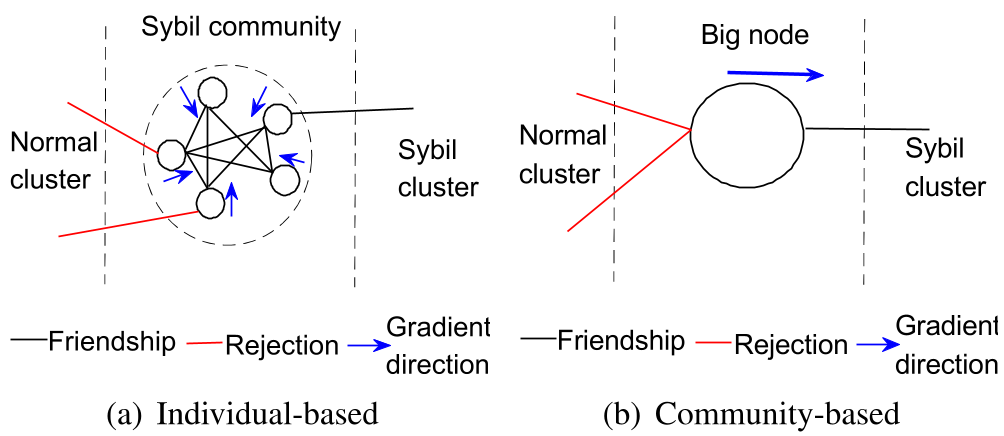
To prevent the layout from collapsing or oscillating, the paper introduces a hierarchical update (as shown below), where groups of nodes (subgraphs or clusters ) are updated as a single entity to maintain global structure while local details are refined.
Experiments & Results
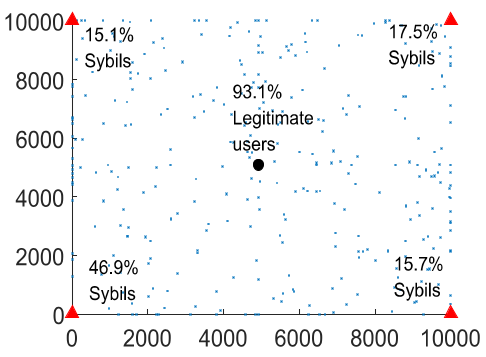
The authors tested their algorithm on several complex datasets. The results (visualized in the figures below) show a clear advantage in cluster separation.
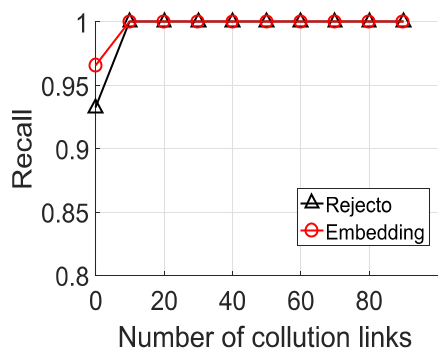
Key observations from the results:
- Orthogonality: The nodes tend to align to a grid, making the flow of the graph much easier to follow.
- Manifold discovery: In high-dimensional datasets, the Manhattan layout successfully "unrolled" the data, revealing latent structures that Euclidean methods missed.
- Convergence: The step-wise nature of the gradient allows for faster convergence toward a global minimum in many structured graphs.
Critical Analysis & Conclusion
Takeaway
The shift to Manhattan distance is more than a mathematical curiosity; it is a powerful inductive bias. By forcing the optimization to respect coordinate-wise distances, the authors effectively automate the creation of "schematic" layouts that are often preferred in professional technical documentation.
Limitations
Despite its strengths, the L1 optimizer can be sensitive to the initial rotation of the graph. Since Manhattan distance is not rotationally invariant, a poorly chosen starting orientation could lead to suboptimal local minima.
Future Work
The next logical step is the integration of this Manhattan objective into Graph Neural Networks (GNNs) as a loss function for embedding, potentially improving the interpretability of latent spaces in deep learning models.