
Linearizing the Social Fabric: Dynamics of Reciprocal Network Distributions
Dynamics of degree distributions of social networks
This paper presents a dynamic modeling framework for social networks based on three mechanisms: random attachment, triad formation, and network response. It demonstrates that the evolution of degree distributions in highly clustered, reciprocal networks can be mathematically modeled as infinite-dimensional time-varying linear systems, establishing the existence of unique invariant sets for these distributions.
TL;DR
Social networks are not just static graphs; they are dynamic systems that grow through specific behavioral "mechanisms." This paper provides a mathematical bridge between network science and control theory, proving that the way people connect (clustering and reciprocity) follows predictable, infinite-dimensional linear dynamics.
Motivation: Moving Beyond Static Snapshots
Most social network research focuses on what a network looks like (degree distributions, power laws, community structures) rather than how it gets there. While we know that mechanisms like "triad formation" (becoming friends with your friend's friend) and "reciprocity" (following back) are essential, formally modeling their impact on the global distribution over time is difficult.
The authors argue that if we can model these distributions as Time-Varying Linear Systems, we can apply a century's worth of control theory to predict and potentially influence network behavior.
The Engine of Growth: Three Mechanisms
The model grows at each time step through three distinct rules:
- M1: Random Attachment: A new node enters and links to existing nodes. This is the baseline growth.
- M2: Triad Formation: To model Clustering, the new node follows its new neighbors' neighbors with probability .
- M3: Network Response: To model Reciprocity, the existing nodes link back to the newcomer with probability , or random nodes connect to it.
Methodology: From Graphs to Linear Algebra
The core contribution is Theorem 3 and Theorem 5, which transform the complex probability of node connections into a linear state-space representation:
Here, is the complementary cumulative degree distribution. The matrix acts as a transition operator that shifts probabilities as nodes gain more connections.
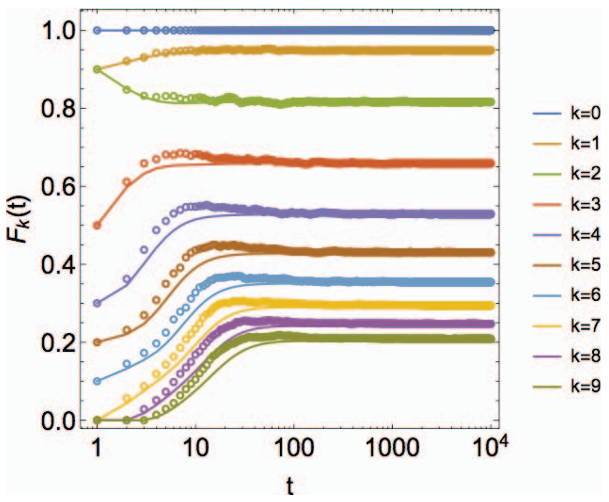 Fig 1. The Complementary Cumulative In-degree (top) and Out-degree (bottom) distributions. Solid lines represent the linear system's predictions, while dots show actual simulation results.
Stability and Invariance
One of the most profound insights is the Asymptotic Stability of the Average Degree. Using a Lyapunov candidate function , the authors prove that regardless of the initial network configuration, the average degree will eventually settle at a steady state .
Furthermore, the degree distributions themselves reach Unique Invariant Sets. This means that once a social network matures, its "shape" (i.e., the percentage of users with 10 followers vs 10,000) becomes structurally fixed by the underlying probabilities of attachment and response.
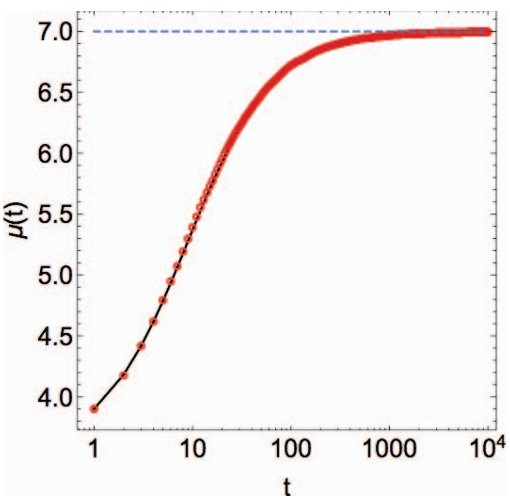 Fig 2. Convergence of the Average Degree. Even with random initial conditions, the network follows a strictly decreasing path toward its theoretical limit.
Critical Insight: Why This Matters
By proving that these networks behave like linear systems, the paper opens the door to Controllability. If a platform designer wants to increase the "connectedness" or "robustness" of a network, they don't need to manually add links. Instead, they can tweak the "parameters" (like making it easier to see a friend's friends—increasing ) and predict exactly how the degree distribution will shift.
Conclusion & Future Work
The paper successfully demonstrates that the complex dynamics of social evolution can be captured by relatively simple linear operators. However, a major limitation remains: the model assumes a "growing" network where nodes are never deleted.
Future Research Directions:
- Node Churn: How do these linear systems behave when nodes "die" or leave the network?
- Stability of the Sets: While the authors proved the sets are invariant, they haven't yet proven if the distribution sets themselves are globally stable against perturbations.
- Control Design: Using this model to design active algorithms that stabilize unruly network growth.
Takeaway: The "chaos" of social interactions is mathematically systematic. If you know the rate of reciprocity and the rate of clustering, you can predict the future of the network.