
DDA: Revolutionizing Image Retrieval with Speed and Democratic Feature Scaling
Democratic Diffusion Aggregation for Image Retrieval
The paper introduces Democratic Diffusion Aggregation (DDA), a novel method for content-based image retrieval (CBIR) that re-weights local features before sum-aggregation. By employing a graph diffusion process on a kernel matrix integrated with weak spatial context, DDA achieves SOTA retrieval accuracy with significant computational efficiency.
Executive Summary
TL;DR: The paper "Democratic Diffusion Aggregation for Image Retrieval" introduces DDA, a high-efficiency aggregation method that solves the "burstiness" problem in image retrieval. By using a closed-form graph diffusion solution instead of slow iterative optimization, DDA achieves a 14x speedup while delivering state-of-the-art (SOTA) accuracy on benchmark datasets like Oxford5K and Holidays.
Academic Positioning: This work bridges the gap between high-performance but computationally expensive "Democratic Aggregation" and the efficient but biased "Sum Aggregation." It is a significant optimization of the compact image representation pipeline (T-embedding/VLAD).
Problem & Motivation: The Tyranny of the Frequent
In large-scale image search, we aggregate thousands of local descriptors (like SIFT) into a single compact vector. The industry standard has long been Sum-Aggregation. However, this method relies on a flawed i.i.d. assumption: it treats every descriptor as equally important.
In reality, images often contain "visual bursts"—repetitive textures like leaves or brick walls—that produce many similar descriptors. In a simple sum, these frequent features drown out the rare, highly discriminative features that actually define the object's identity.
Prior Work (DA) attempted to "democratize" this by re-weighting features based on similarity, but calculating these weights required:
- Projecting descriptors into high-dimensional spaces.
- Iterative Sinkhorn Scaling optimization, which is excruciatingly slow for real-time applications.
Methodology: Fast Weights via Diffusion
The core innovation of DDA is two-fold: an efficient kernel construction and a non-iterative weight derivation.
1. Efficient Kernel Construction
Instead of using high-dimensional T-embedding vectors to calculate similarities, the authors prove that whitened RootSIFT (low-dimensional) preserves the necessary similarity metrics. They also introduce a Spatial Kernel (): This suppresses "artificial co-occurrences"—feature clusters that appear together simply because of the detector’s geometry rather than the image content.
2. The Diffusion Closed-Form Solution
Instead of iterating, DDA treats the descriptors as nodes in a graph and applies a diffusion process. The weights are found via: This allows the system to compute the "influence" of each descriptor in a single linear algebra step.
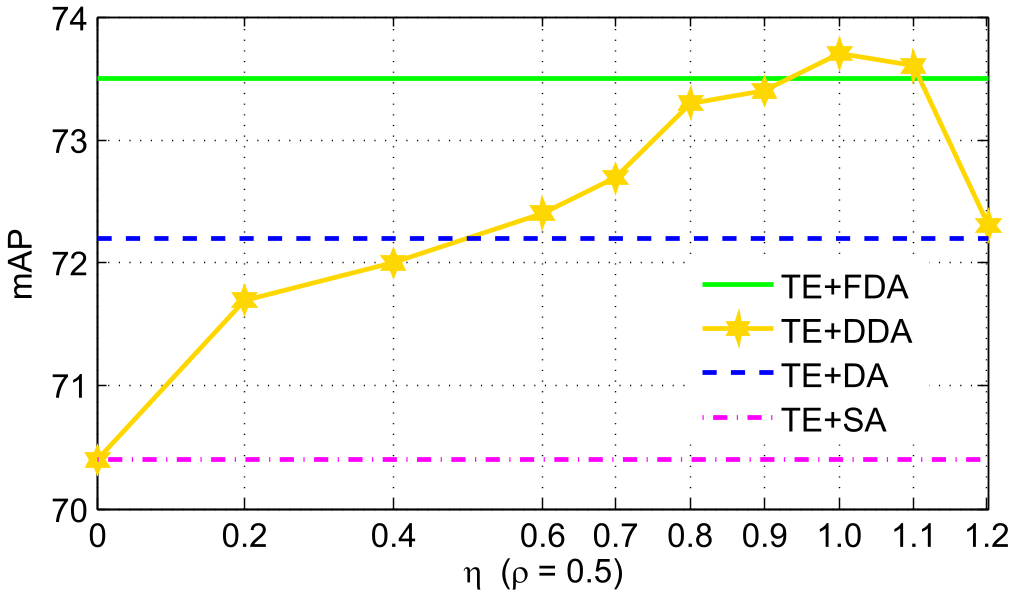 Figure: The DDA framework decouples the weighting process from the embedding step, allowing for massive parallelization and efficiency.
Experiments & Results
The authors tested DDA across several benchmarks against the original Democratic Aggregation (DA) and standard Sum-Aggregation (SA).
- Speed: DDA is 14x faster than the original DA.
- Accuracy: On Oxford5K, DDA achieved 69.5 mAP (with Rotation & Normalization), significantly higher than the 62.0 mAP of the original DA.
- Re-ranking: They introduced Query Fusion, which averages the query vector with top-ranked results. Because T-embedding is robust to false positives, this fusion significantly boosts performance without needing expensive geometric verification.
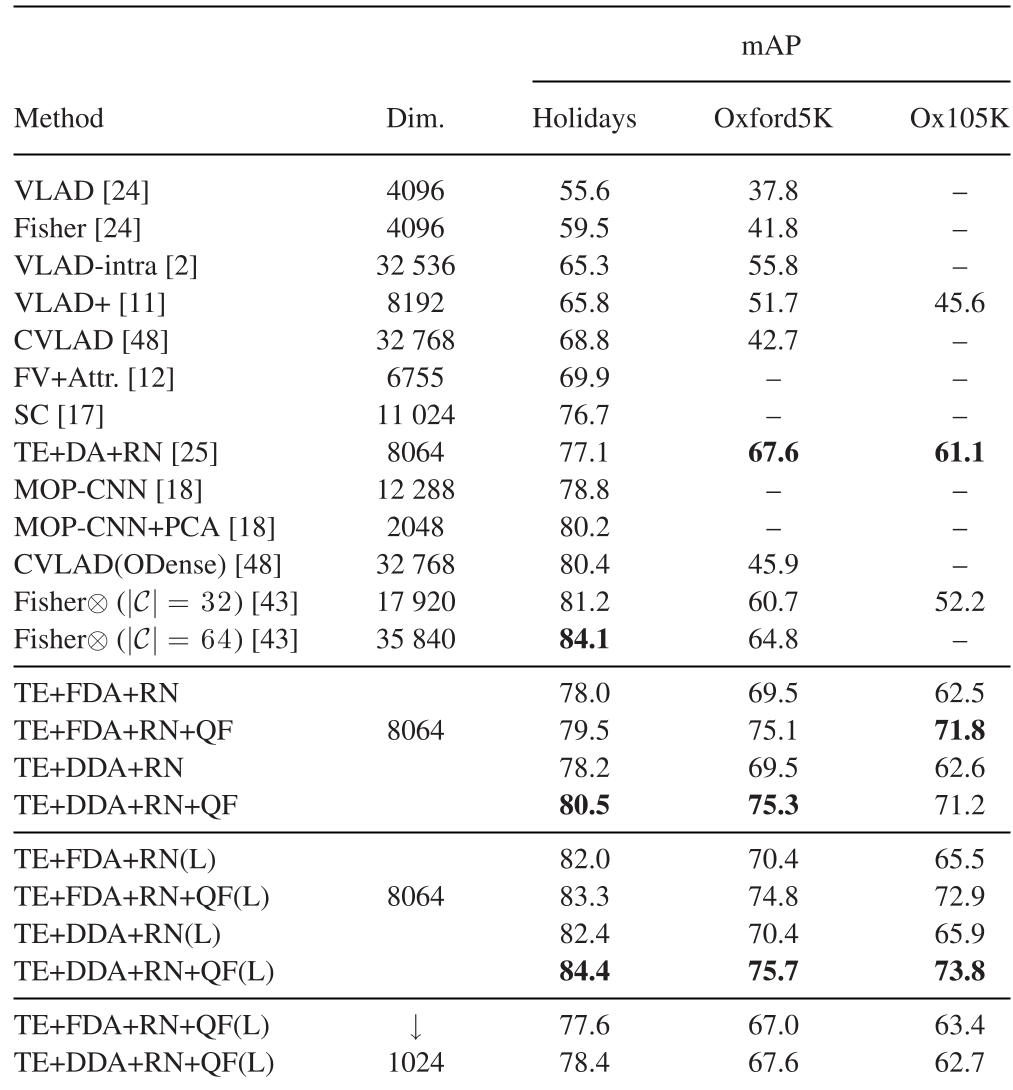 Table: Comparison showing DDA outperforming deep learning baselines (like MOP-CNN) and traditional encoding methods (VLAD/Fisher).
Critical Analysis & Conclusion
Takeaways
DDA proves that mathematical intuition (graph diffusion) can replace brute-force optimization (iterative scaling). The inclusion of weak spatial context is a clever way to bring back geometric awareness into compact vectors where spatial data is usually lost.
Limitations
While DDA is blindingly fast for traditional features, the authors note that the RN (Rotation and Normalization) operation struggles as the vocabulary size () grows beyond 128. Furthermore, constructing the kernel matrix for "dense" features (where is very large) remains a memory challenge.
Future Outlook
As we move toward hybrid systems combining SIFT with Deep Global Features, the DDA weighting mechanism offers a blueprint for how to handle "feature redundancy" in neural network latent spaces.