
Democratizing Networking Research: Turning Campus Networks into AI Powerhouses
An Effort to Democratize Networking Research in the Era of AI/ML
This paper proposes a framework to democratize networking research by repurposing university campus networks as real-world production data sources and testbeds for AI/ML. It introduces a roadmap for developing, validating, and deploying explainable AI (XAI) models using programmable data planes like P4.
TL;DR
Artificial Intelligence is revolutionizing networking, but academic researchers are hitting a wall: they don't have the data. While industry titans like Google and Amazon have "infinite" telemetry, academia relies on synthetic datasets. This paper proposes a radical but practical solution—treating the ubiquitous university campus network as a production-grade AI/ML laboratory.
The "Digital Divide" in Networking
In fields like Computer Vision, open datasets like ImageNet sparked a revolution. In Autonomous Driving, nuScenes allowed researchers to simulate urban environments without owning a fleet of Teslas.
Networking research has no such "North Star." Academic researchers often spend 90% of their time on ad-hoc data collection and 10% on actual AI innovation. Furthermore, network operators—the "gatekeepers" of production environments—rarely trust "black-box" AI models. This creates a vicious cycle where academic models are never "road-tested," and operators never see proof of their reliability.
The Vision: Campus Networks as a Dual-Role Asset
The authors argue that campus networks are uniquely positioned to solve this. They are large enough to be complex (diverse users, security threats, high traffic) but small enough to be instrumented at a reasonable cost.
1. The Campus as a Data Source
The proposal suggests deploying monitoring solutions that perform continuous, lossless, full-packet capture (at speeds up to 100 Gbps). Unlike previous "bottom-up" approaches where data is an afterthought, this "top-down" approach creates a comprehensive data store containing:
- Raw packet-level data.
- Metadata (server logs, configuration files, events).
- Ground truth labels for feature engineering.
2. The Campus as a Testbed
Beyond just gathering data, the network serves as an evaluation ground. Using Programmable Data Planes (like P4 and Barefoot Tofino), researchers can compile their AI models directly into hardware to see how they perform in real-time under real stress.
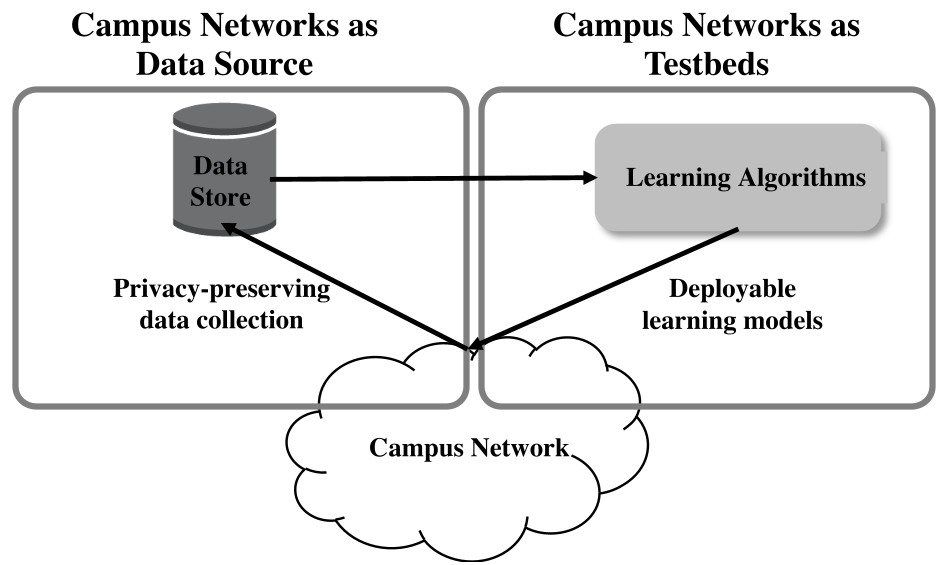 Figure 1: The dual role of campus networks: raw data ingestion for the "offline" loop and real-time inference for the "online" control loop.
Methodology: The Road to Deployment
How do we go from a messy neural network to a trusted production tool? The paper outlines a four-step "White-Box" roadmap:
- Offline Development: Train complex, high-accuracy models using the campus data store.
- Model Extraction/XAI: Use Explainable AI techniques to extract "interpretable" or "lightweight" versions of the model.
- Hardware Compilation: Translate these models into P4 programs for programmable switches.
- Operator Validation: Present the model's logic to human operators. If the operator sees that the AI's logic matches their expert intuition, trust is established.
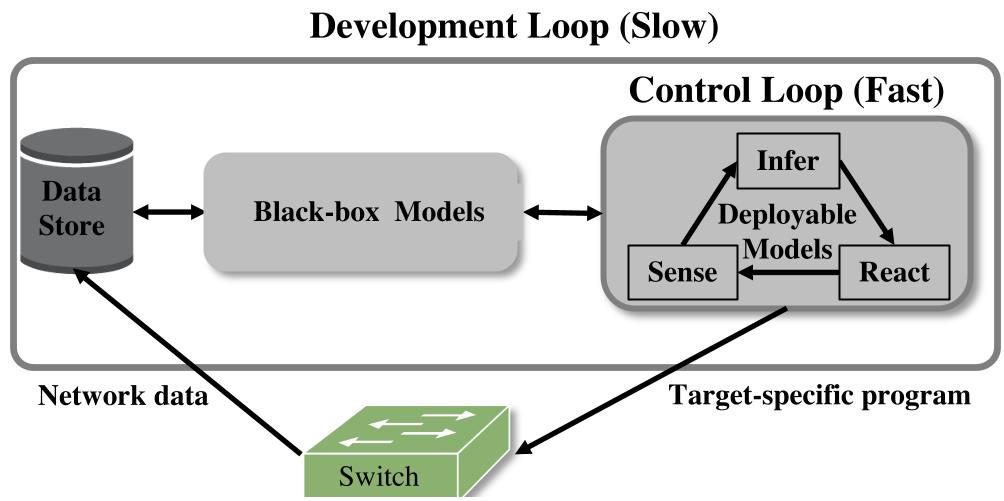 Figure 2: The bridge between academic "slow loops" (offline training) and industrial "fast loops" (real-time mitigation).
Critical Insight: Solving the Privacy Paradox
One of the boldest claims in the paper is that networking data stores should not necessarily be public. Due to privacy laws (GDPR, FERPA), sharing raw payloads between universities is a legal nightmare.
The solution? Open-source the algorithms, not the data. By running the same open-source algorithm on different campus networks, researchers can achieve "reproducibility" without ever exchanging sensitive user packets. If a model works at UCSB, MIT, and Stanford independently, it is likely robust enough for a Tier-1 ISP.
Conclusion & Future Outlook
This paper isn't just about technology; it's about culture. It calls for a "New Deal" between university IT departments and CS faculty. By hiring professional staff to run the campus network "as a lab," universities can:
- Produce a workforce skilled in "Data-Driven Networking."
- Accelerate the deployment of self-driving networks.
- Bridge the gap between academic theory and industrial reality.
The "toy" network of a university might just be the most important weapon academic researchers have in the era of AI.