
D-BNCF: Mastering the "Friends-of-Friends" Logic to Solve Recommender Sparsity
Densifying a behavioral recommender system by social networks link prediction methods
The paper introduces D-BNCF (Densified Behavioral Network Collaborative Filtering), a hybrid recommender system that models user relationships through navigational patterns. By applying social network link prediction methods (e.g., Jaccard, Adamic/Adar), it densifies the user-similarity graph to combat data sparsity and improve recommendation accuracy.
TL;DR
Recommender systems often hit a "sparsity wall" where users haven't interacted enough for the system to find similarities. This paper introduces D-BNCF, a framework that transforms user browsing habits into a Behavioral Network and uses social network link prediction (like Jaccard and Adamic/Adar) to calculate similarities between users who have never seen the same page. The result? A 34% boost in high-prediction accuracy over classical methods.
The Problem: The Sparse Reality of Explicit Feedback
Most Collaborative Filtering (CF) systems are "rating-hungry." They need you to click stars to understand you. However, in the real world:
- Data is Sparse: Most users rate nothing.
- Ratings are Biased: Your "4 stars" might be another person's "2 stars."
- The Matrix is Empty: If User A and User B haven't co-rated an item, CCF assumes their similarity is zero, even if they have identical interests.
The authors argue that navigational patterns (the sequence in which you browse) are a goldmine of implicit interest that can bridge these gaps.
Methodology: From Browsing to Graph Topology
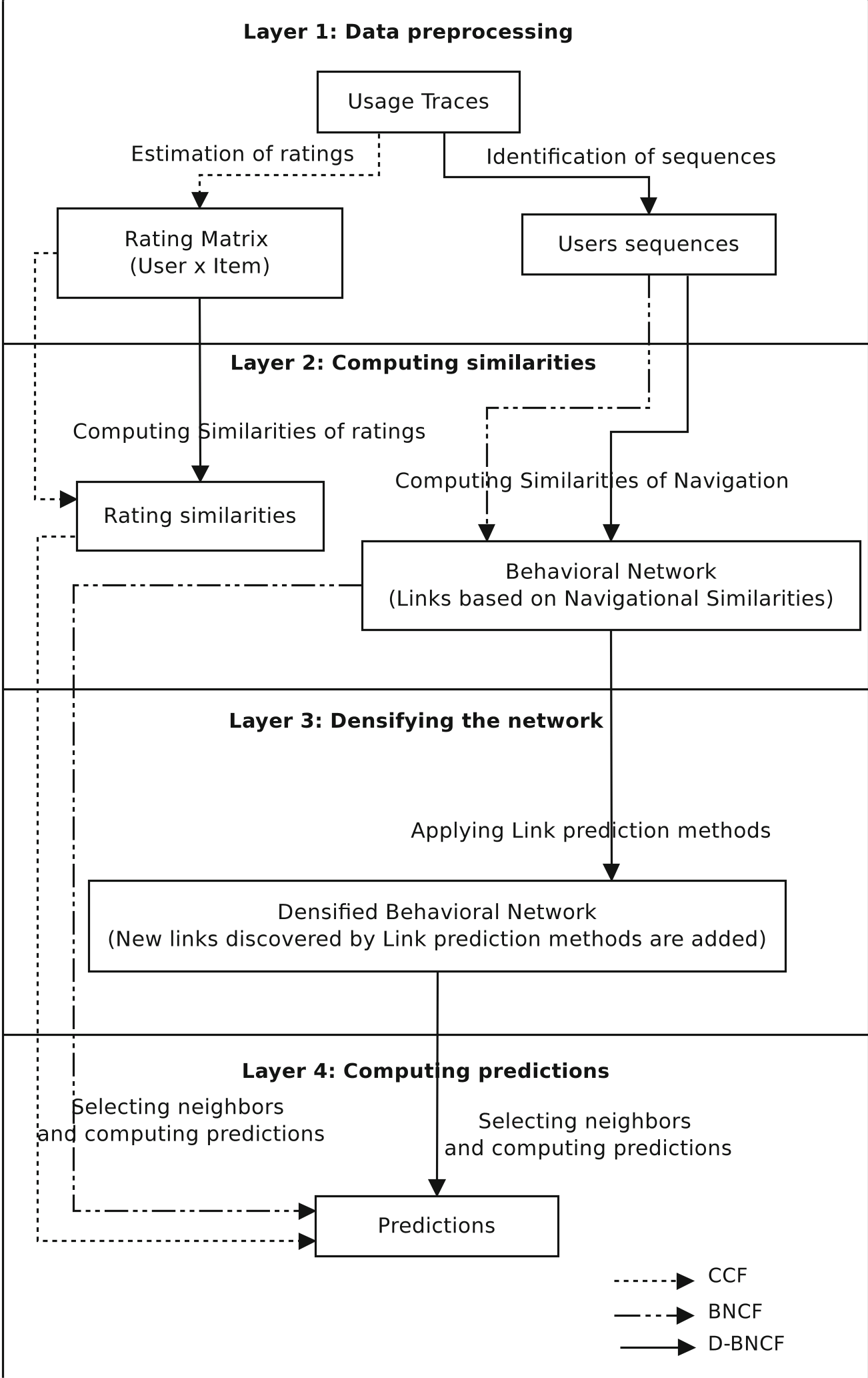
The D-BNCF approach operates through a four-layer architecture, moving from raw logs to densified intelligence.
1. Behavioral Network Construction
Instead of a rating matrix, the system extracts user sequences. If User A followed the path i1 -> i3 -> i5 and User B followed i3 -> i5 -> i18, they share a common pattern i3 -> i5. The similarity is calculated based on the Maximum Length of Common Patterns (LKmax) relative to their session length.
2. The Secret Sauce: Link Prediction
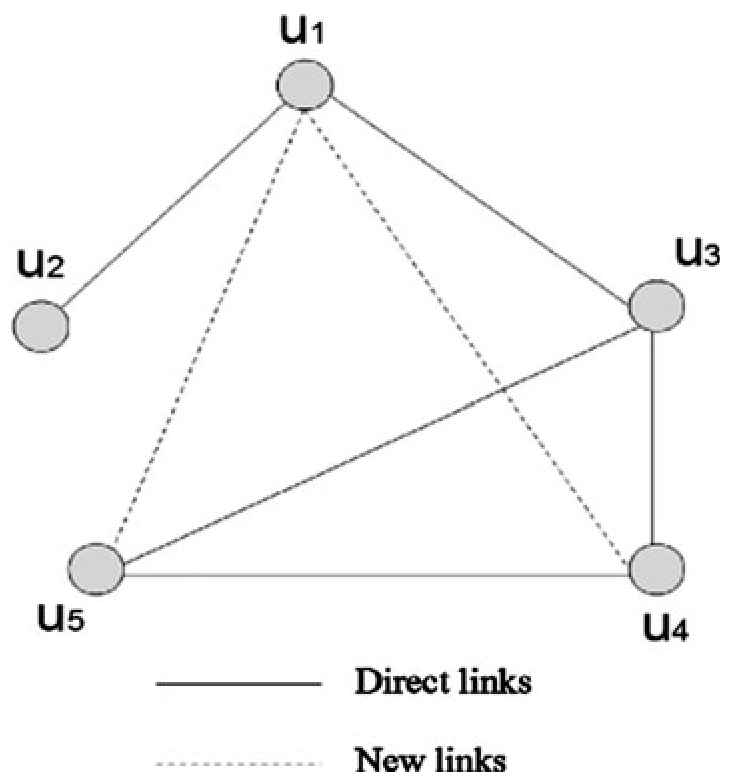
This is the core innovation. Once a graph of "navigational neighbors" is built, the authors apply social network logic: "The friends of my friends are my friends."
The authors tested several "densification" methods:
- Adamic/Adar: Gives more weight to "rare" common neighbors. If you and I both follow an obscure tech blog, we are more similar than if we both follow Google.
- Jaccard Coefficient: Measures common neighbors relative to the total number of neighbors.
- Graph Distance: Uses shortest paths to find transitive similarities.
Experimental Results: Precision Where It Matters
The researchers tested D-BNCF on a real-world dataset from the Credit Agricole Banking Group.
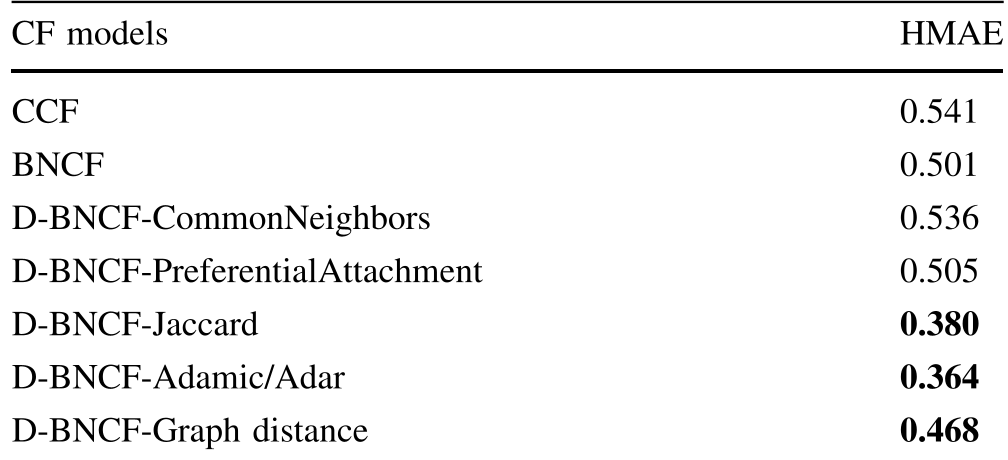
High-Value Accuracy (HMAE)
The most striking result wasn't just overall error reduction, but the accuracy of high-value predictions (the items the system actually recommends).
- Adamic/Adar improved accuracy by 27% over the basic behavioral model.
- Jaccard followed closely with a 24% improvement.
- The Combined Model (Jaccard + Adamic/Adar) outperformed classical rating-based CF by a staggering 34%.
Depth Insight: Why Link Prediction Works
Why does looking at "neighbors of neighbors" work better than looking at the items themselves? It's about manifold learning and graph topology. In a sparse space, direct overlaps are coincidental. However, the structure of the network—how users cluster around specific hubs of information—reveals the latent "community" interest. Link prediction acts as a low-pass filter that smooths out the noise of individual sessions to reveal the structural intent of the user base.
Conclusion & Future Outlook
D-BNCF proves that you don't need a "Like" button to build a world-class recommender. By treating browsing behavior as a social graph and using link prediction to fill in the blanks, systems can overcome extreme sparsity.
Looking ahead, the next step is likely moving toward Temporal Graph Networks, where the order and timing of these links evolve dynamically, potentially increasing precision even further for real-time news or stock-market watchers.