
DGCD: Bridging the Gap Between Social Ties and Physical Proximity
Density-based Community Detection in Geo-Social Networks
This paper introduces the Density-based Geo-Community Detection (DGCD) model, designed to identify user communities in geo-social networks that exhibit both social and spatial cohesiveness. By integrating Euclidean distance with structural graph similarity, the DGCD algorithm achieves superior community quality compared to traditional methods like SCAN or DBSCAN.
Executive Summary
TL;DR: The paper "Density-based Community Detection in Geo-Social Networks" introduces DGCD, a clustering framework that ensures detected communities are not just friends on paper, but neighbors in reality. By refining the concept of structural similarity with spatial constraints, the authors solve the "spatially sparse" problem found in traditional graph clustering.
Context: This work resides at the intersection of Spatial Databases (like DBSCAN) and Graph Mining (like SCAN). It moves beyond simple social graphs to address the needs of Location-Based Social Networks (LBSNs).
The Problem: The "Long-Distance Friend" Dilemma
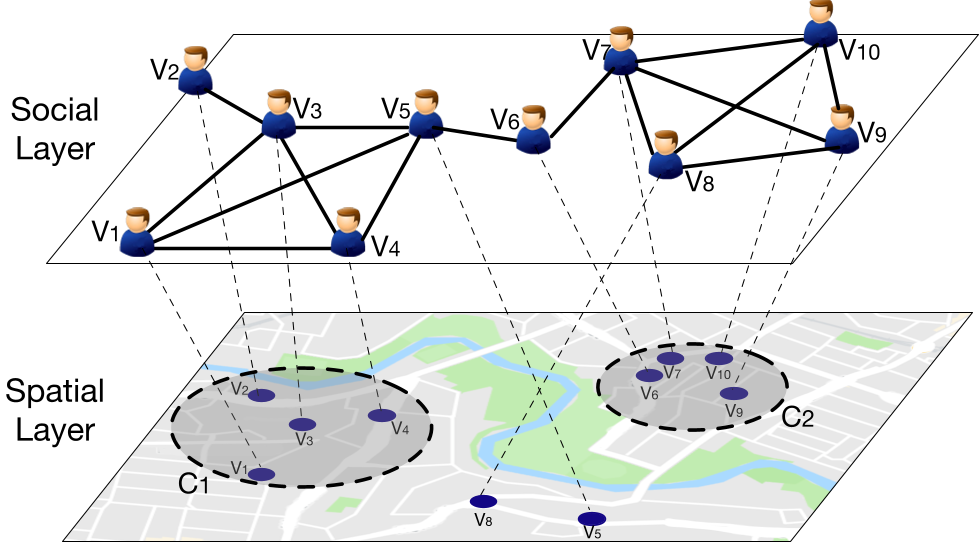
In modern social networks, you might have hundreds of "friends" across the globe. Traditional community detection (e.g., SCAN, Louvain) would lump you into a community with them. However, for applications like event recommendation or spatial crowdsourcing, a community that spans three continents is useless.
Conversely, spatial clustering (DBSCAN) might group people standing in the same mall who have absolutely no social connection. The challenge is: How do we find groups that are both socially dense AND spatially compact?
Methodology: The Geo-Social Structural Similarity
The authors' core insight is to redefine the "neighborhood" of a user. In DGCD, a neighbor is only considered if they satisfy two conditions:
- Social Connection: They are linked in the social graph.
- Spatial Proximity: They are within a distance of the user.
1. The Metric
The similarity is calculated as the intersection of these "Geo-Social Neighborhoods," normalized by their size. This ensures that a "Core User" is someone who acts as a local hub for a group of people who are both friends and neighbors.
2. The Algorithm
The DGCD algorithm works by:
- Identifying Core Users who have at least similar neighbors within their geo-social sphere.
- Expanding communities by transitively reaching all "Geo-Socially Reachable" users.
- Labeling isolated users as outliers or hubs.
Experiments: Why DGCD Wins
The authors compared DGCD against SCAN (social only), DBSCAN (spatial only), and CNGM (modularity-based).
Visual Evidence
As seen in the Dallas dataset visualization, DGCD produces compact, meaningful clusters. In contrast, SCAN results in groups that are all over the map, and DBSCAN produces "mega-clusters" that lack social context.
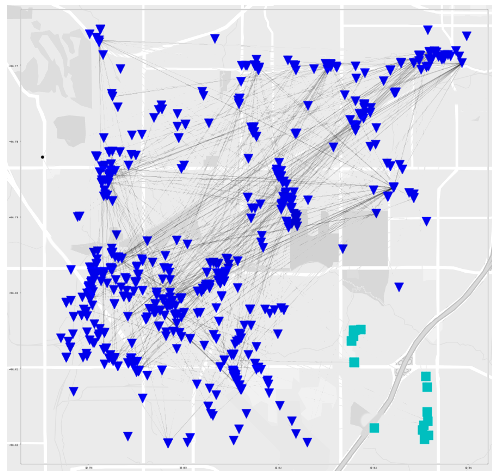 (Note: Referencing the visual difference where DGCD (a) shows localized colors vs SCAN (c) showing dispersed points of the same color.)
Quantitative Edge
- Spatial Cohesiveness: DGCD's average community radius is significantly smaller than its competitors.
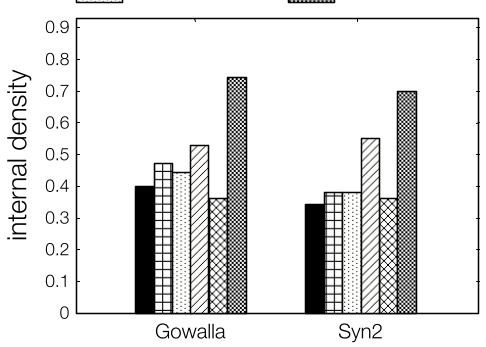
- Social Quality: DGCD maintains an "Internal Density" and "Conductance" nearly as good as algorithms that only optimize for social ties, proving that adding spatial constraints doesn't "break" the social logic of the community.
Critical Analysis & Conclusion
Takeaway
DGCD is a robust solution for LBSN platforms. It effectively filters out the "noise" of global social connections to find actionable, local sub-structures.
Limitations & Future Work
The algorithm currently uses a static snapshot of locations. As the authors suggest, the next frontier is Temporal Geo-Social Networks—tracking how these communities form and dissolve as people move throughout the day. Furthermore, the complexity of might require distributed processing (e.g., GraphX/Spark) for billion-node scales.
Final Thought: In an increasingly digital world, DGCD reminds us that physical proximity remains a primary driver of meaningful human interaction.