
Decoding the Language of Depression: A Regression Approach to Social Media Behavior
Depressive Emotion Recognition Based on Behavioral Data
This study presents a depression recognition model using behavioral data from Sina Weibo users. By leveraging the Gaussian Process Regression (GPR) algorithm with a specialized PUK kernel and linguistic features extracted via a modified LIWC dictionary, the researchers achieved a Pearson Correlation Coefficient (PCC) of 0.5189 in predicting depression levels.
TL;DR
Researchers from the Chinese Academy of Sciences have developed a machine learning model capable of quantifying depression levels by analyzing Sina Weibo posts. By moving beyond simple "yes/no" classification and using Gaussian Process Regression (GPR) with a specialized PUK kernel, the model achieved a correlation of 0.5189 with clinical scales, identifying key linguistic markers like pronoun usage and verb tenses as core predictors of mental distress.
Background: From Binary Labels to Continuous Monitoring
Depression affects over 300 million people globally, yet early detection remains a hurdle. While social media has long been viewed as a "digital phenotype" for mental health, most existing models treat depression as a binary state. This study shifts the paradigm toward regression modeling, seeking to predict the severity of depression (CES-D scores) rather than just its presence.
The Problem & Research Intuition
The challenge with behavioral data is noise. Social media language is casual, uses emojis, and changes rapidly. Previous efforts often relied on long-term data which can "dilute" acute depressive episodes.
The authors hypothesized that:
- A one-week window of posts provides the most accurate reflection of a user's current mental state.
- Specific linguistic categories (e.g., negative words, self-references) carry more weight than overall sentiment.
- Non-linear regression models (like GPR) can better capture the complex relationship between language and psychology than standard linear models.
Methodology: The GPR-PUK Architecture
The workflow involved collecting data from 2,163 valid participants, merging clinical CES-D scores with their authorized Weibo history.
1. Feature Engineering
Instead of raw text, the authors used a specialized Simplified Chinese psychological linguistic analysis dictionary. This expanded the standard LIWC (Linguistic Inquiry and Word Count) set to include Weibo-specific popular words, emojis, and punctuation, resulting in 102 initial categories.
2. Model Selection and Kernel Magic
The core of the methodology is the use of Gaussian Process Regression (GPR). Unlike typical neural networks, GPR provides a probabilistic approach to regression. The breakthrough came from replacing the standard Radial Basis Function (RBF) kernel with the PUK (Pearson VII Universal Kernel).
 Figure 1: Conceptual framework of linguistic feature extraction from social media.
3. Feature Selection: Forward-Backward Search
Instead of using PCA (which can make features uninterpretable), the team used a Forward-Backward search. This iterative process trimmed the 102 features down to the 40 most impactful ones, including exclamation marks, auxiliary verbs, and "love" related words.
Experiments & Results
The study compared multiple configurations. The results were clear: Gaussian Process Regression + PUK Kernel + Forward-Backward Search = SOTA performance for this dataset.
| Model Configuration | Correlation Coefficient (PCC) | Root Mean Squared Error (RMSE) |
|---|---|---|
| Linear Regression | 0.3639 | 12.5066 |
| GPR (Default RBF) | 0.4334 | 11.9721 |
| GPR (PUK Kernel) + Selected Features | 0.5189 | 11.3442 |
Key Behavioral Insights:
The experiment highlighted that certain features are highly correlated with depression:
- Pronouns: High usage of specific personal pronouns.
- Tense: Past and present tense usage shifts significantly in depressed individuals.
- Negative Words: An obvious but consistent predictor.
- Fillers/Exclamations: Changes in sentence structure and punctuation usage.
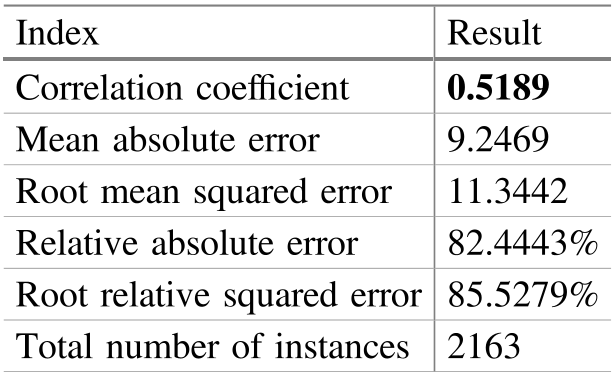 Table 8: Final model performance showing the 0.5189 correlation.
Critical Analysis & Takeaways
Why it matters
The correlation of 0.5189 is a significant achievement in psychological modeling. In a field where human behavior is notoriously "noisy," reaching a medium-to-high correlation means this tool could realistically assist clinicians in early screening.
Limitations
- Temporal Window: While the one-week window captures current state, it might miss the "chronic" vs "episodic" nature of the disorder.
- Platform Specificity: The linguistic dictionary is highly optimized for Weibo/Chinese; adapting this to English/Twitter would require localized linguistic feature mapping.
Conclusion
This research demonstrates that our digital footprints are deeply expressive of our internal mental health. By applying advanced regression techniques and meticulous feature selection, we can move closer to a future where mental health support is proactive, data-driven, and accessible to anyone with a smartphone.