
From Weblogs to Business Wins: A Blueprint for Marketing Intelligence
Deriving marketing intelligence from online discussion
This paper presents a comprehensive commercial system for deriving marketing intelligence from online discussions (Weblogs, Message Boards, and Usenet). It combines large-scale crawling, NLP-based sentiment analysis, and an interactive "drill-down" environment to transform unsolicited consumer feedback into actionable business insights.
TL;DR
Long before the era of LLMs, this paper (KDD 2005) established a robust architecture for "listening" to the internet. By combining automated crawlers, machine learning classifiers, and a sophisticated linguistic engine, the authors created a system that doesn't just count mentions—it understands sentiment and identifies the root causes of consumer dissatisfaction.
Background: Tuning into the Public Voice
In 2005, the "blogosphere" was the frontier of public opinion. Unlike structured surveys, online discussions offer unsolicited—and therefore more honest—feedback. However, the sheer volume and messy format of weblogs and message boards made it a nightmare for brand managers to track. The authors positioned this work as a bridge between raw data mining and strategic business decision-making.
Motivation: Why Simple Search Isn't Enough
The authors argue that a simple keyword search ("What are people saying about Dell?") is insufficient. Why?
- Ambiguity: Is "Shell" an oil company or a sea shell?
- Context: A positive message about a brand doesn't mean the consumer likes the display specifically.
- Noise: Signatures and quotes (reposts) often skew frequency counts if not handled by proper document analysis.
Methodology: The Three-Pillar Architecture
The system is divided into three functional layers: Content, Production, and Analysis.
1. The Content System (The Harvesters)
Harvesting data from 2005-era weblogs was a challenge of "reverse engineering" semi-structured HTML. The system uses:
- Weblog Segmentation: Identifying dates via xpaths and heuristics to extract clean posts.
- BoardPulse: An intelligent crawler for message boards that only downloads pages if the "post count" has changed, minimizing server impact.
2. The Production System (The Brains)
Once the raw text is in, the system applies several layers of NLP:
- Document Analysis: Disentangles quotes (e.g., the
>symbol in Usenet) and removes signature blocks to ensure the analysis focuses on new content. - Topic Classification: Uses a Winnow classifier to categorize posts into themes like "Customer Service" or "Price."
- Polarity Engine: Instead of simple word-counting, it uses a shallow parser and semantic rules to handle negation (e.g., "not good") and modality ("might like").
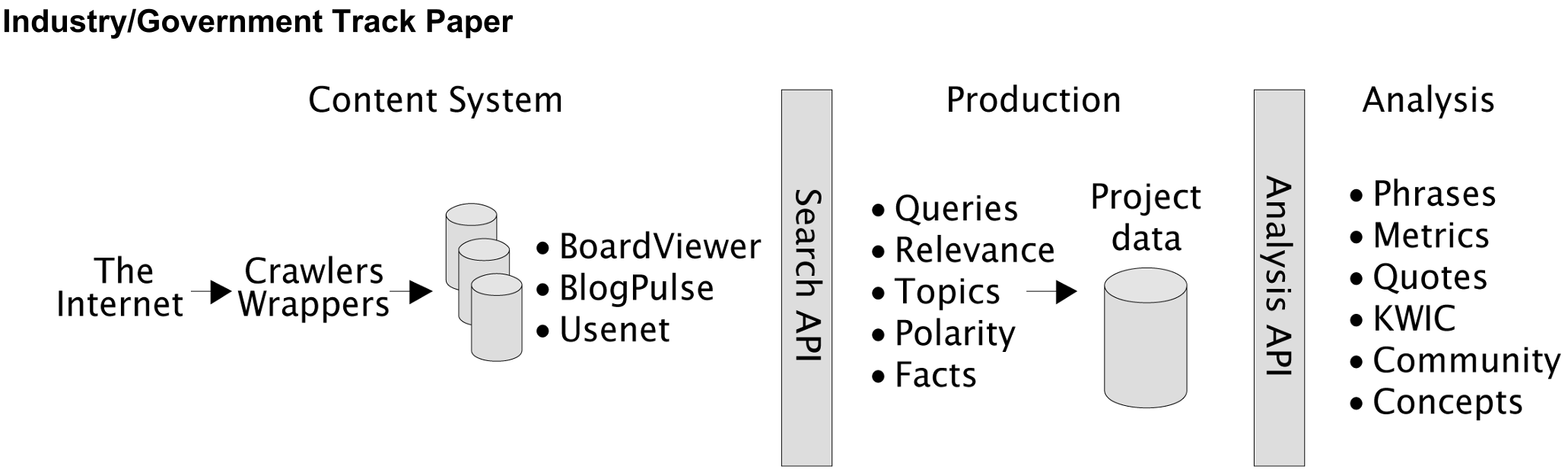 Figure: The end-to-end flow from web crawling to the interactive UI.
3. Interactive Analysis (The User Interface)
The "Secret Sauce" is the interactive tool. It allows users to perform Top-Down Analysis (starting with a low polarity score and drilling into the phrases that caused it) or Bottom-Up Analysis (using social network graphs to find influential clusters of disgruntled users).
Experiments: The Case of the Dell Axim
The authors showcased the system's power through a case study on handheld computers. While the Dell Axim had the highest "Buzz Count" (12% of discussion), its Polarity score was a dismal 3.4.
By clicking into the negative sentiment cluster, the system automatically identified "SD cards," "ROM," and "incompatible" as the key phrases driving the negativity. This allowed managers to pinpoint a specific technical fault—sub-par audio and IR ports—rather than guessing.
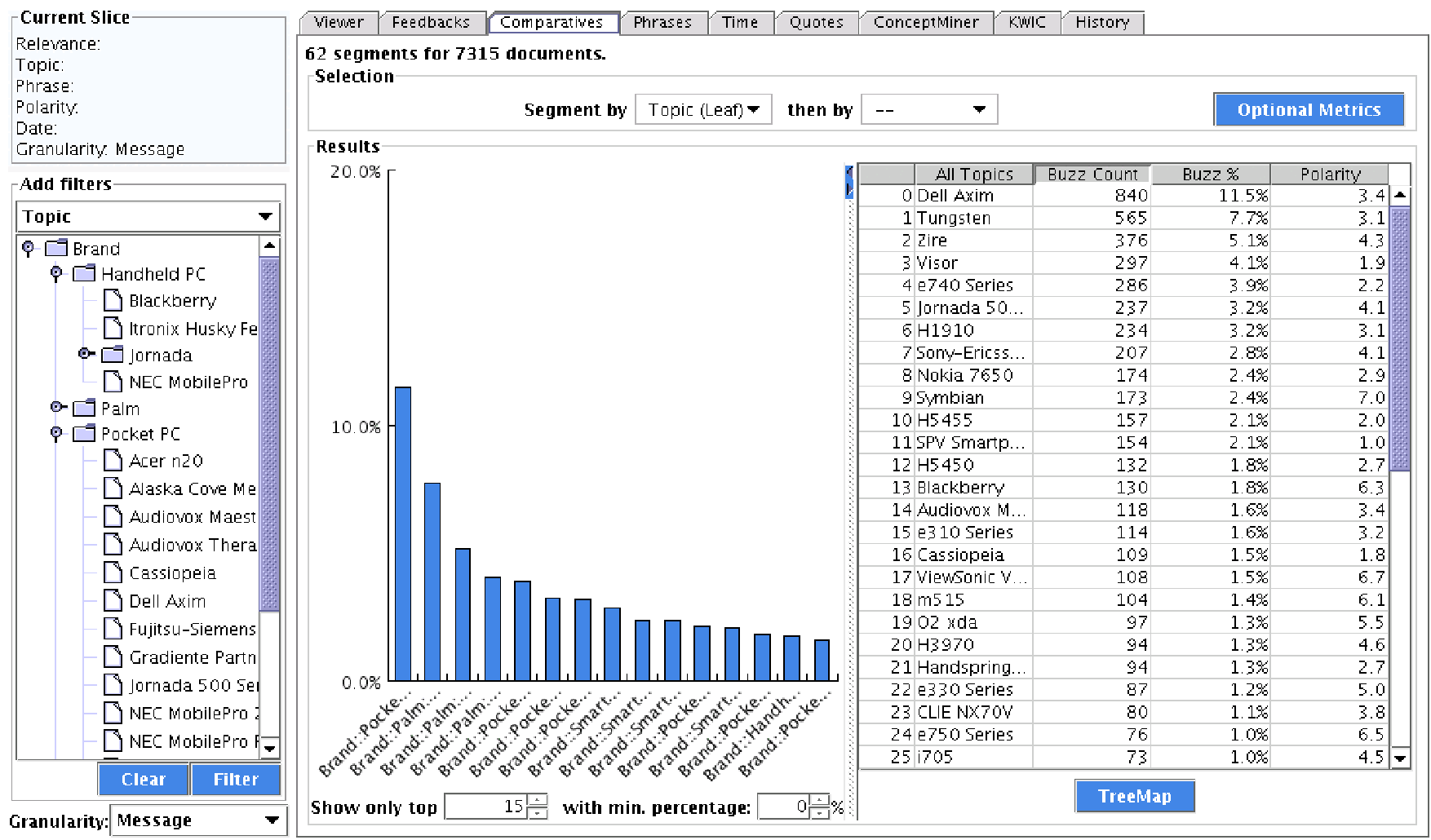 Figure: The metrics dashboard showing the disconnect between popularity (Buzz) and sentiment (Polarity).
Critical Insight: The Value of "Unsolicited" Data
The core achievement here is the formalization of Sentiment Mining as a business tool. By valuing the social context (who is talking to whom) and the linguistic nuance (how they say it), the authors moved beyond "Buzz Tracking" into true "Marketing Intelligence."
Limitations
- Language: The model-based segmentation struggled with non-English date formats.
- Entity Normalization: While rules worked for known brands, the system was less flexible at discovering entirely new, unknown entities without manual rule-writing.
Conclusion
This paper serves as a foundational text for modern social listening tools. It reminds us that even with the most powerful classifiers, the ultimate goal is to provide a human analyst with the tools to validate and test hypotheses in real-time.