
Bridging the Generational Digital Divide: A Solar-Inspired Social Platform for Elders
Design and Development a Social Networks Platform for Older People
The paper presents a dedicated social network platform tailored for older people, integrating VoIP and instant messaging to bridge the intergenerational gap. It employs a "solar-inspired" visualization system to provide biofeedback on social engagement, demonstrating high user acceptance through the Technology Acceptance Model (TAM).
TL;DR
Social isolation significantly impacts the health of the elderly. This research develops a novel social networking platform that bridges the communication gap between tech-savvy youth and traditional-leaning elders. By integrating synchronous VoIP with asynchronous messaging and using a metaphorical "Solar System" display to visualize social support, the study demonstrates how "Perceived Friendliness" can drive technology adoption among older populations.
Background & Motivation: The Invisible Gap
As populations age, social disengagement becomes a critical healthcare challenge. While social networks like Facebook or WhatsApp exist, they often fail the elderly due to two primary barriers:
- Information Literacy Gap: Younger generations live on instant messaging (IM), while elders are often more comfortable with traditional telephone or face-to-face interactions.
- Culture Gap: Digital "social anxiety" affects how generations express care. Young people may find direct calls intrusive, while elders may find text messages impersonal.
The authors revisit the work of Morris (2005), which first used "Social Indexes" to visualize interactions. However, Morris's model relied heavily on wearable sensors and failed to account for the cross-generational need to converge different communication media.
Methodology: The "Solar" Interface and Media Integration
To solve these issues, the researchers proposed a platform that acts as a communication hub.
1. Media Convergence
The platform allows a younger user to send an MSN message or email, which the elder receives in a simplified, large-font interface on a tablet or laptop. Conversely, the elder can initiate a VoIP call (Skype-based) with a single touch, removing the friction of dialing or navigating complex menus.
2. The Solar System Metaphor
Instead of abstract lists or notifications, social health is visualized through an astronomical metaphor:
- Planets: Represent friends or family members.
- Planet Size: Dynamically grows when that specific friend actively reaches out or shows concern.
- Shining Stars: Appear as more interactions occur, providing a "gamified" sense of social belonging.
 Fig 1: The Solar System display where planet size indicates the level of active concern from social ties.
Assessing Acceptance: Beyond Ease of Use
The study applied an expanded Technology Acceptance Model (TAM). Interestingly, the results challenged some common assumptions in UI/UX for the elderly.
Key Experimental Insights:
- The Power of "Perceived Friendliness": The study found that "Perceived Friendliness"—the feeling of being cared for through the interface—was a significant driver of a positive attitude toward the system (β=0.372).
- Ease of Use is Not Enough: Surprisingly, Perceived Ease of Use (PEOU) did not significantly impact the attitude toward using the system. This suggests that for elders, a system being "easy" is a baseline requirement, but the "emotional value" is what actually makes them want to use it.
- Utility Drives Intention: Perceived Usefulness (PU) remained the strongest predictor for the actual intention to use the platform in the future (β=0.526).
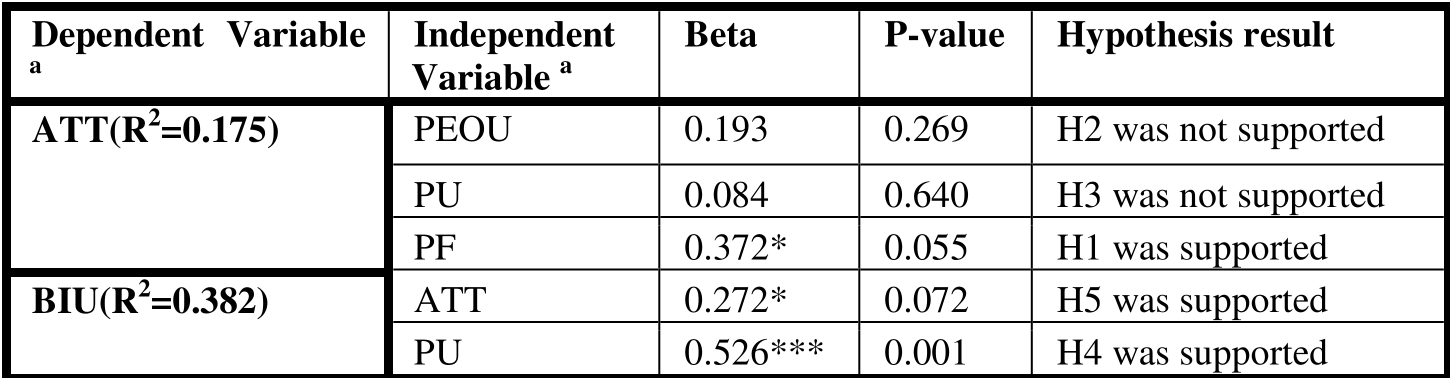 Table 1: Regression analysis showing the factors influencing behavioral intentions.
Conclusion & Future Outlook
This paper shifts the focus of elderly-oriented tech from "monitoring" to "connecting." By translating digital interactions into tangible visual metaphors (the Solar System), the platform provides immediate emotional feedback.
Takeaway for Developers: When building for older adults, prioritize Emotional Feedback (Friendliness) and Intergenerational Compatibility. A tool that only works for the elder—but isn't adopted by their grandchildren—is destined to fail. The future of Age-Tech lies in systems that "converge" different interaction cultures into a single, cohesive experience.
Limitations
The study's sample consisted of 32 students (simulating or evaluating the framework) rather than a long-term clinical trial with the elderly. Future work should validate these physiological and psychological benefits through direct, long-term deployments in senior living communities.