
SAPERE: Harmonizing Physical Proximity with Social Trust in Pervasive Computing
Design and implementation of a socially-enhanced pervasive middleware
This paper introduces the SAPERE middleware, a "socially-enhanced" pervasive framework that integrates social network graphs (e.g., Facebook) with spatial proximity to govern interactions. It enables devices and services to self-organize through "eco-laws" within a distributed ecosystem, ensuring that data sharing and service orchestration respect both physical location and social trust boundaries.
TL;DR
The SAPERE middleware bridges the gap between the physical and social worlds. Unlike traditional systems that connect any devices within radio range, SAPERE uses social network graphs (like Facebook) to filter interactions. By combining spatial awareness with social trust, it creates a self-organizing ecosystem of services that is both adaptive and privacy-conscious.
Motivation: The "Stranger Danger" of Pervasive Systems
Imagine walking into a crowded exhibition. Traditional pervasive middleware would allow your smartphone to connect with every other device in the room. Why should you share your location or data with a complete stranger just because they are standing two meters away?
Existing solutions have historically fallen into two extremes:
- Purely Spatial: Ignoring social context entirely, leading to privacy leaks.
- Purely Social: Ignoring physical proximity, resulting in services that aren't "situated" in the user's immediate environment.
The authors identify a critical missing link: Context-aware services must be both physically near and socially relevant.
Methodology: The Socially-Aware Ecosystem
SAPERE (Self-aware Pervasive Service Environments) models the pervasive world as a computational ecosystem.
1. The Tuple Space & LSAs
At the heart of every node (smartphone or public display) is a Local Tuple Space. Every service, device, or piece of data is represented as a Live Semantic Annotation (LSA).
- Eco-laws: These are "virtual chemical reactions" that dictate how LSAs interact. When two LSAs match certain criteria, they "bond," triggering service composition or data exchange.
2. Dual-Layer Topology Management
The Network Topology Manager is the gatekeeper. It runs two concurrent analyzers:
- Network Analyzer: Scans for physical neighbors via Bluetooth or Wi-Fi.
- Social Network Analyzer: Accesses social graphs (e.g., Facebook API) to verify friendship or group membership.
Interaction only occurs if a node is physically close AND socially connected.
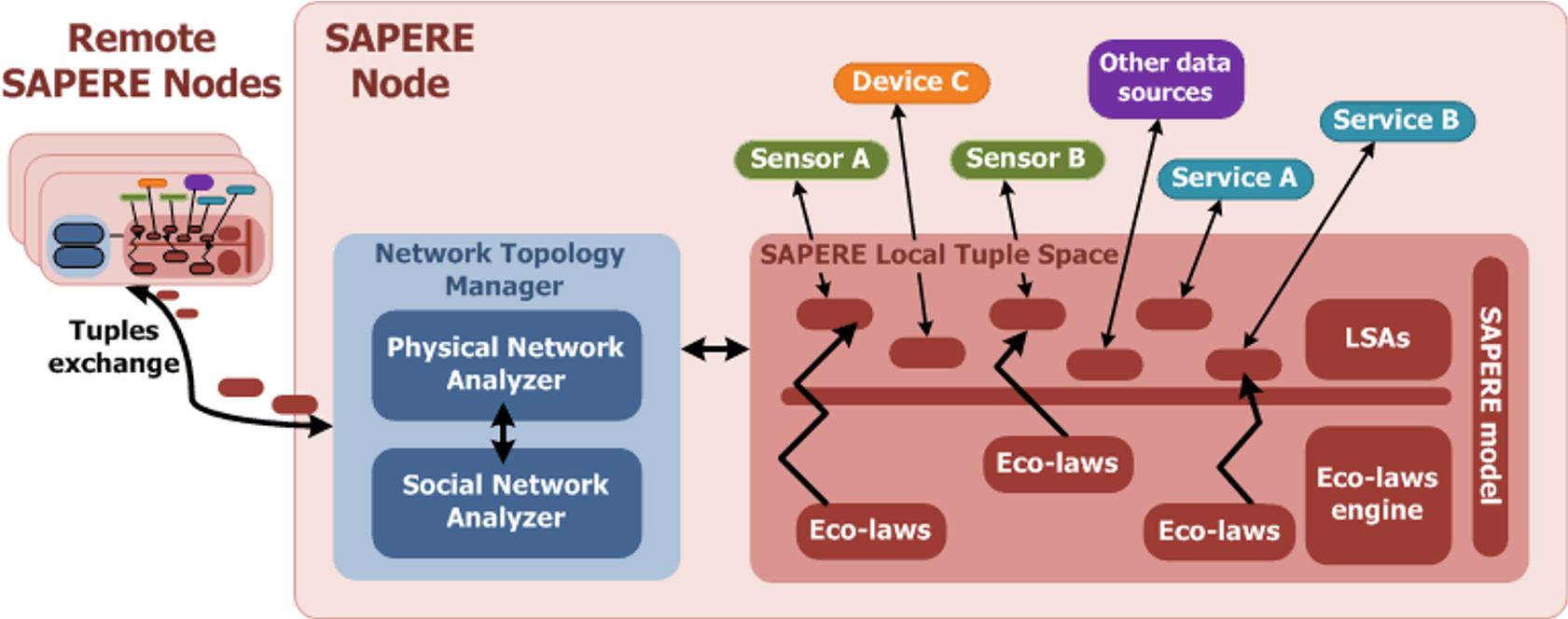 Figure 1: The internal architecture of a SAPERE node, highlighting the interaction between the Tuple Space and the Topology Manager.
Orchestrating Interaction: Peers and Infrastructure
The paper defines three primary interaction modes facilitated by this social-spatial intersection:
- Ad-hoc (User-to-User): Two friends' phones detect each other. The middleware checks their Facebook link and sharing permissions, allowing them to exchange "Current Location" or "Active Task" LSAs automatically.
- Infrastructure (User-to-Place): A public display is modeled as a "Facebook Group." When a user enters the room and belongs to that group, the display's tuple space becomes a "shared wall" for interaction.
- Logical Relations (Place-to-Place): Groups can "subscribe" to other groups. If Group A represents Room 1 and Group B represents Room 2, a social link between these groups allows data to flow across physical boundaries, modeling logical proximity.
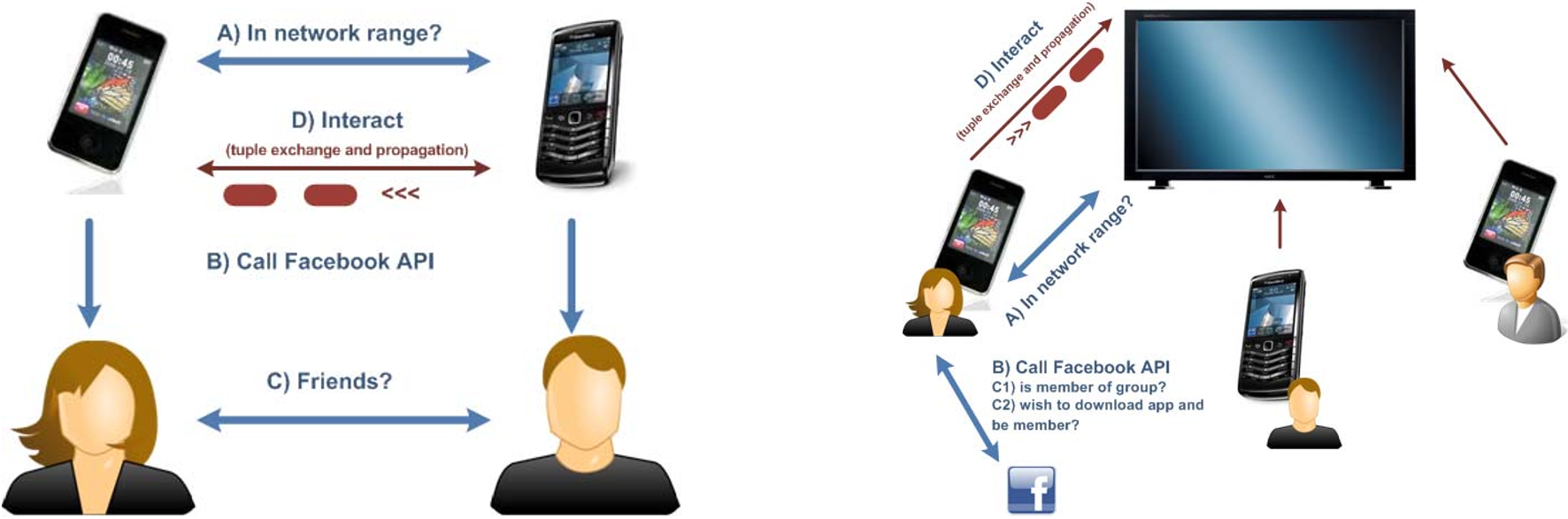 Figure 2: Top - Ad-hoc interaction between friends; Bottom - Interaction via an infrastructural group profile.
Implementation and Results
The authors developed the middleware for Android, proving its feasibility on resource-constrained mobile hardware. By using the Facebook API and TUCSON (a coordination technology), they demonstrated that LSAs could be injected and shared dynamically.
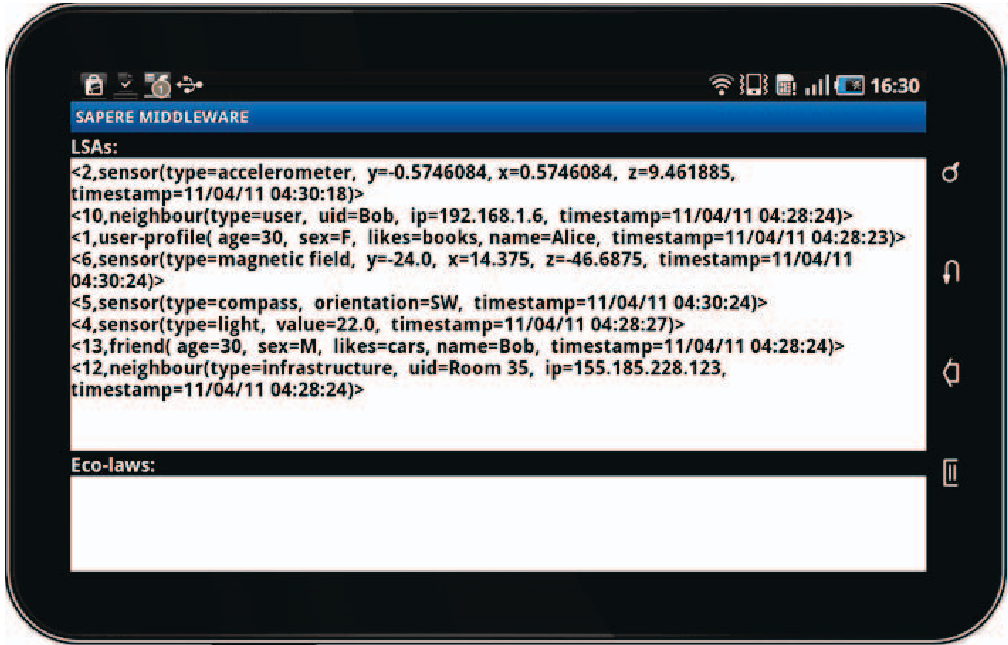 Figure 3: A screenshot of the SAPERE middleware on a Samsung Galaxy Tab, showing active LSAs for sensors, user profiles, and detected "Neighbor" entities.
Key Insights:
- Privacy by Design: Users manage privacy through familiar social network settings rather than complex middleware configurations.
- Adaptive Discovery: In a dense crowd, the social filter drastically reduces the "noise" of service discovery, focusing only on relevant entities.
Critical Analysis & Future Outlook
The SAPERE approach was visionary in its attempt to treat social networks as a utility for the physical world. However, it faces two main challenges in the modern era:
- API Dependency: As social media platforms become "walled gardens" (restricting API access), relying solely on Facebook is a risk. Future iterations would likely require decentralized social protocols.
- Dynamics vs. Latency: Fetching social graphs in real-time can be slower than the fast-paced movement of users in a physical space.
Despite these hurdles, SAPERE provides a foundational blueprint for Socially-Aware IoT. It moves us away from a world of "connected things" toward a world of "socially-situated services."