
Optimized Social Network Architecture: Achieving Low Latency via Multi-Tier Load Balancing
Design of social network architecture: a new approach.
This paper proposes an advanced distributed architecture for Social Networks (SN) that integrates a multi-layered selection manager and load balancing module. By decoupling the interface, web selection, and data processing layers, the system achieves significantly lower latency and higher reliability compared to traditional monolithic SN architectures.
TL;DR
Social networks are massive data-consuming ecosystems where milliseconds of latency can impact user retention. This paper introduces a redesigned distributed architecture that utilizes a Selection Manager, a specialized Load Balancer, and an Index Controller to optimize data flow. The result is a staggering reduction in average response time (dropping by ~70%) and a significant boost in fault tolerance.
Problem & Motivation: The Scalability Wall
Most traditional Social Network (SN) architectures suffer from a "direct-hit" problem: user queries are often thrown directly at web servers with minimal pre-processing or intelligent routing. As user bases grow into the millions:
- Data Failure: External disturbances or server crashes lead to immediate data loss for the user.
- Congestion: Without a buffering layer, data servers become overwhelmed during peak traffic.
- Latency: Searching directly in the main database without a robust indexing and caching strategy increases the response time for every "Wall" update or friend request.
The authors’ research intuition was to insert intelligent buffers at every transition point—between the user and the web server, and between the web server and the database.
Methodology: The Three-Unit Strategy
The core of the proposed work revolves around a simplified 6-step communication flow (compared to the traditional 8 steps), achieved by grouping components into three functional units:
- Interface & Selection Manager: Authenticates users and monitors web server health via a Hash Table Cache. It doesn't just pass the query; it selects the best available server based on real-time busy-reports.
- Load Balancer & Data Server: Acts as a buffer to control precisely when and how a query hits the data server, preventing spikes from crashing the backend.
- Index Controller & Cache: This layer sits before the database. It prioritizes searching the Cache Module first; if the data is missing, it fetches it from the Database and replicates it to the Cache for future use.
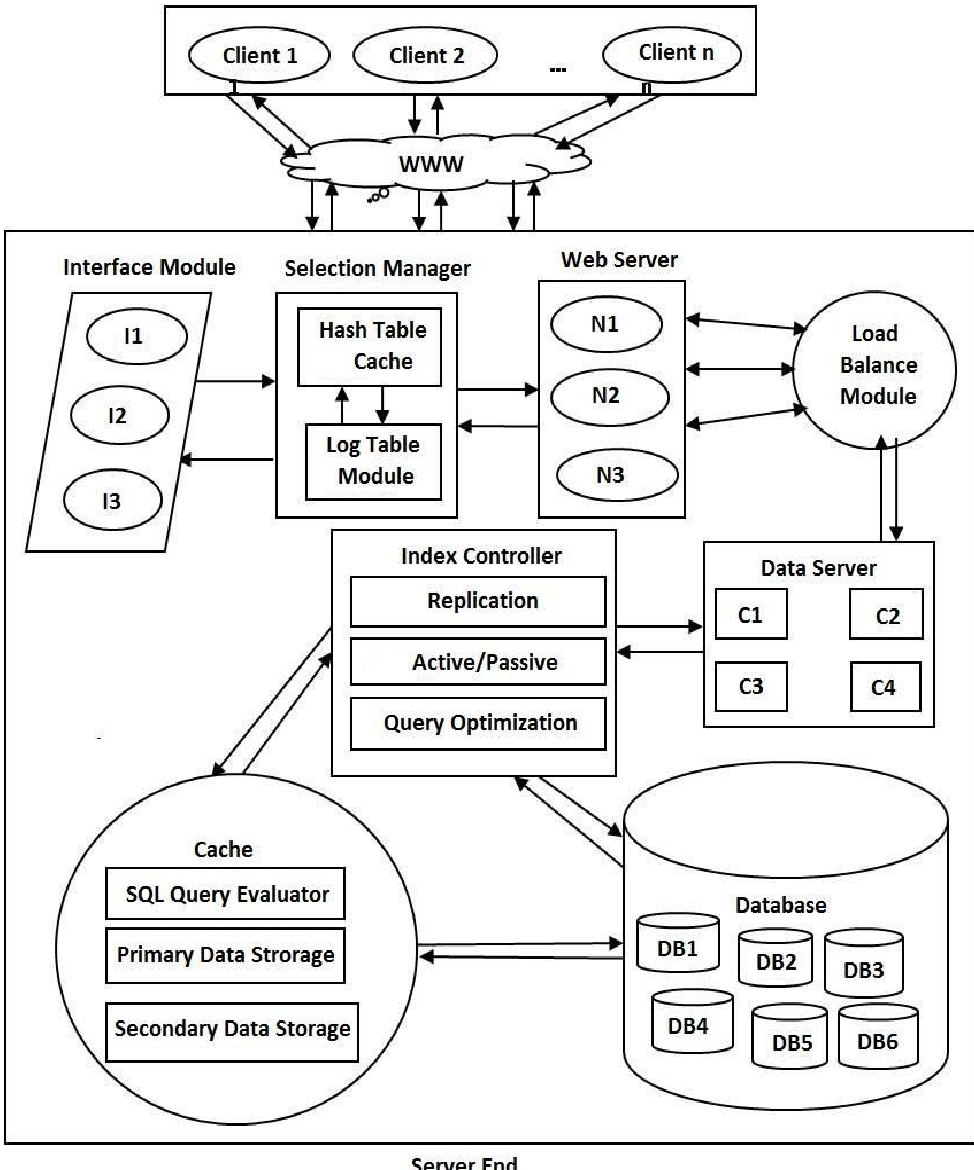 Figure 1: The proposed multi-layered architecture showing the flow from user to database.
Experiments: Dramatic Performance Gains
The authors tested their architecture using 100 servers and compared it against standard scheduling algorithms like First-Come-First-Served (FCFS), Shortest Job First (SJF), and Round Robin (RR).
Key Metrics:
- Response Time: For RR scheduling, the response time plummeted from 13.3ms to 3.6ms.
- Turnaround Time: Under Priority scheduling, the time taken for a complete task execution dropped from 34.6ms to 12.9ms.
 Table 2: Comparisons showing the proposed approach outperforming legacy systems across all scheduling types.
The data suggests that the "Selection Manager" effectively eliminates the "busy server" bottleneck by distributing the load before the execution starts.
Critical Analysis & Conclusion
Takeaway
The study proves that the bottleneck in social networks isn't necessarily the database speed, but the architectural logic leading up to the database. By reducing the communication steps from 8 to 6 and implementing "Selection" and "Index" controllers, the system handles concurrency much better.
Limitations
As a short paper, it primarily focuses on architectural flow. It does not go into deep detail about the consistency protocols used when data is replicated across the distributed hash tables, which is a common challenge in distributed systems (CAP theorem).
Future Outlook
This architecture provides a blueprint for "Self-Healing" networks. Future work could integrate AI-driven predictive load balancing, where the Selection Manager anticipates traffic spikes based on social media trends before they even happen.