
StakeNet: Decoding the DNA of Stock Markets through Stakeholder Social Networks
Designing, Analyzing and Exploiting Stake-Based Social Networks
The paper introduces StakeNet, a novel directed, weighted, and dynamic social network framework constructed from public stakeholder data. It models the complex interrelations between companies and individuals in the Taiwan stock market, achieving state-of-the-art results in corporate clustering (0.97 NMI).
TL;DR
This paper introduces StakeNet, a heterogeneous social network built from stakeholder data. By mapping the "who-owns-whom" and "who-manages-what" relationships, the authors move beyond simple stock charts to a systematic analysis of market power. Utilizing methods like Weighted PageRank and Edge Betweenness, they achieve a near-perfect 0.97 NMI score in identifying business groups, outperforming traditional heuristics.
Background & Motivation: Beyond the Balance Sheet
In the financial world, data is abundant but insights are scarce. While individual company reports are available, the hidden "connective tissue" of the market—how companies are grouped, who truly pulls the levers of power, and how capital flows between entities—is often obscured.
The authors identify a critical gap: existing investor tools fail to handle the dynamic and interrelated nature of stakeholder data. Their intuition is that the stock market is essentially a social network where influence and risk propagate through edges of ownership and management.
Methodology: Engineering the StakeNet
StakeNet is not a simple graph. It is a Directed, Weighted, Dynamic, and Heterogeneous network.
1. Network Topology
The graph consists of:
- Vertices (V): Typed as either Person or Company.
- Edges (E): Representing three distinct actions:
- Hold: (Person/Company → Company) Weighted by market value.
- Manage: (Person → Company) Weight zero.
- Transfer: (Person → Person) Weighted by transfer value.
2. Architecture and Logic
The authors categorize the interactions to reflect real-world financial maneuvers. For instance, the "Transfer" edge between persons is crucial for identifying potential "insider" shifts or succession planning within major conglomerates.
 Table 1: The logic of edges in StakeNet, defining how different entities interact.
Structural Insights: The Non-Power Law Reality
Standard social networks (like Twitter or Facebook) typically follow a Power Law distribution, where a few "hubs" have a massive number of connections. However, StakeNet revealed a unique phenomenon: The in-degree distribution of companies does NOT follow a power law.
The Insight: In the Taiwan stock market, regulatory and structural realities mean companies are rarely held by a single entity. Most have 10-15 significant stakeholders, creating a more "distributed" ownership profile than the winner-take-all dynamics of digital social media.
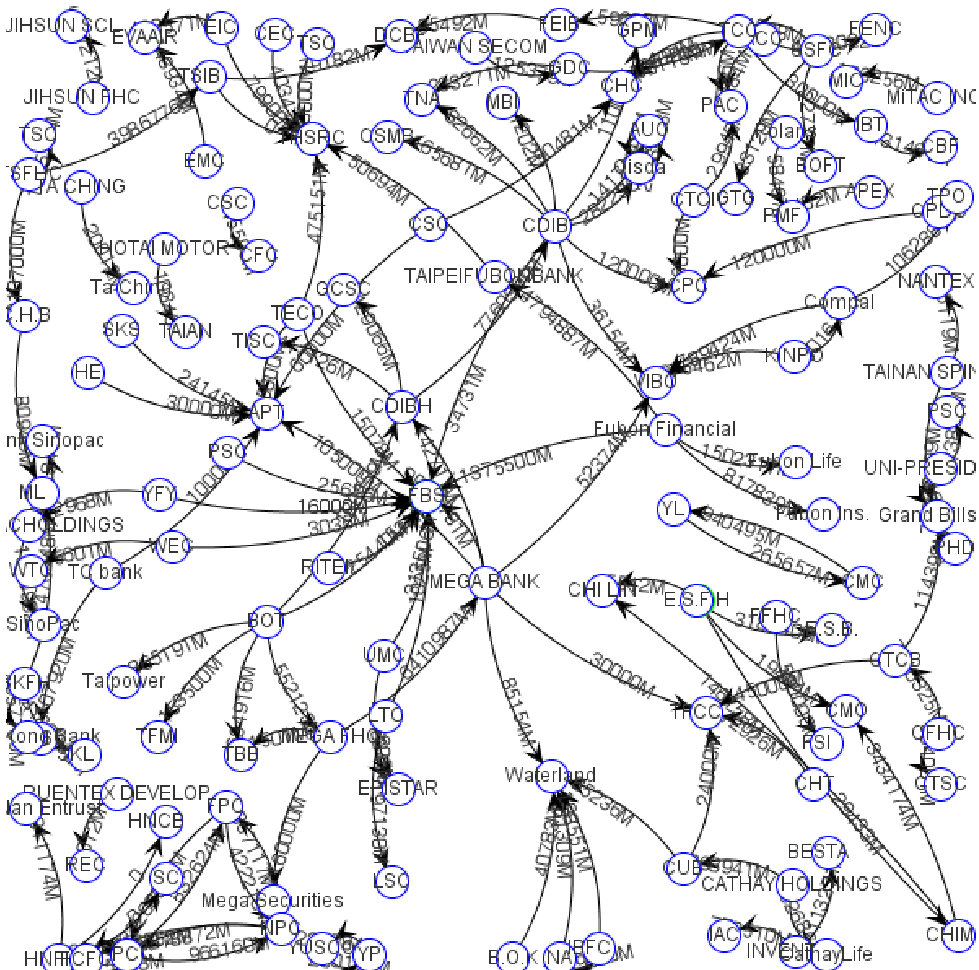 Figure 1: Global visualization of the Taiwan market (2008-2009). The clustering reveals massive industry titan clusters.
Experimental Validation: Grouping and Ranking
The researchers tested StakeNet on two primary tasks:
- Corporate Ranking: Using Weighted PageRank, they identified industry leaders. The results were highly intuitive—top-ranked nodes were predominantly major banks and insurance firms, the literal "backbone" of capital.
- Community Detection: They applied Edge Betweenness Clustering (EBC) to group companies.
- Baseline (Greedy): Grouped companies sharing at least one stakeholder (NMI: 0.70).
- StakeNet (EBC): Utilized global topological information (NMI: 0.97).
The jump from 0.70 to 0.97 NMI demonstrates that the global structure of the network contains far more information than local, pairwise connections.
Critical Analysis & Future Outlook
Takeaway: StakeNet proves that stakeholder data is a goldmine for systematic risk assessment and business group identification. The mapping of "hidden" relationships provides a competitive edge for institutional investors.
Limitations:
- Data Lag: The study relies on monthly updates; high-frequency trading shifts might be missed.
- Data Completeness: As the authors noted, the exclusion of retail investors (due to data availability) shifts the weight distribution toward a log-normal curve.
Future Work: The authors suggest moving into Link Prediction (predicting future acquisitions or board changes) and Anomaly Detection (identifying the "footprints" of insider trading). As ESG and transparency requirements grow globally, StakeNet-like architectures will likely become the standard for modern financial intelligence.