
Argo: Elevating Crowdsourcing Quality via Consensus-Driven Task Design
Designing Crowdsourcing Tasks with Consensus Constraints
The paper introduces Argo, a crowdsourcing system that formalizes task design through explicit consensus constraints. It enables requesters to configure task types, worker reputation thresholds, and quorum-based agreement mechanisms to ensure high-quality data collection in scenarios like resource labeling.
TL;DR
The Argo system moves beyond simple majority voting by treating consensus as a design-time constraint. By balancing worker reputation with strict quorum requirements and a unique "Balance-of-Power" check, Argo ensures that crowdsourced results are not just popular, but reliable. In real-world trials, it achieved a 94.2% consensus rate for complex semantic labeling tasks.
Background Positioning: From Post-Processing to Proactive Design
In the world of crowdsourcing (think Amazon Mechanical Turk), the "Gold Standard" for quality has traditionally been post-hoc—researchers collect a mountain of noise and then use statistical wizardry to find the signal. Argo pivots this approach. It positions itself as a Task-Design Framework where quality is "baked in" before the first worker even sees the task.
The Problem: The Consensus Vacuum
The authors identify a critical gap: existing systems treat consensus as an emergent property. The downside? These systems often ignore the Inductive Bias of the task itself. A creative task (writing a story) needs different guardrails than a binary classification task. Without explicit constraints on Trustworthiness and Quorum, results often skew toward either the "noisy average" or the "loudest expert."
Methodology: The Argo Engine
The core of Argo's innovation lies in its two-step design process: Feature Specification (What is the task?) and Execution Specification (How is it governed?).
1. Multi-Dimensional Parameters
Argo supports two primary consensus modes:
- Equivalence: Popularity-based, where the most frequent answer wins.
- Statistics: Compromise-based, calculation of means or deviations.
2. The Mechanics of Supermajority
To enforce quality, Argo utilizes a Weighted Supermajority mechanism. This isn't just "one person, one vote." It's "one person X reputation."
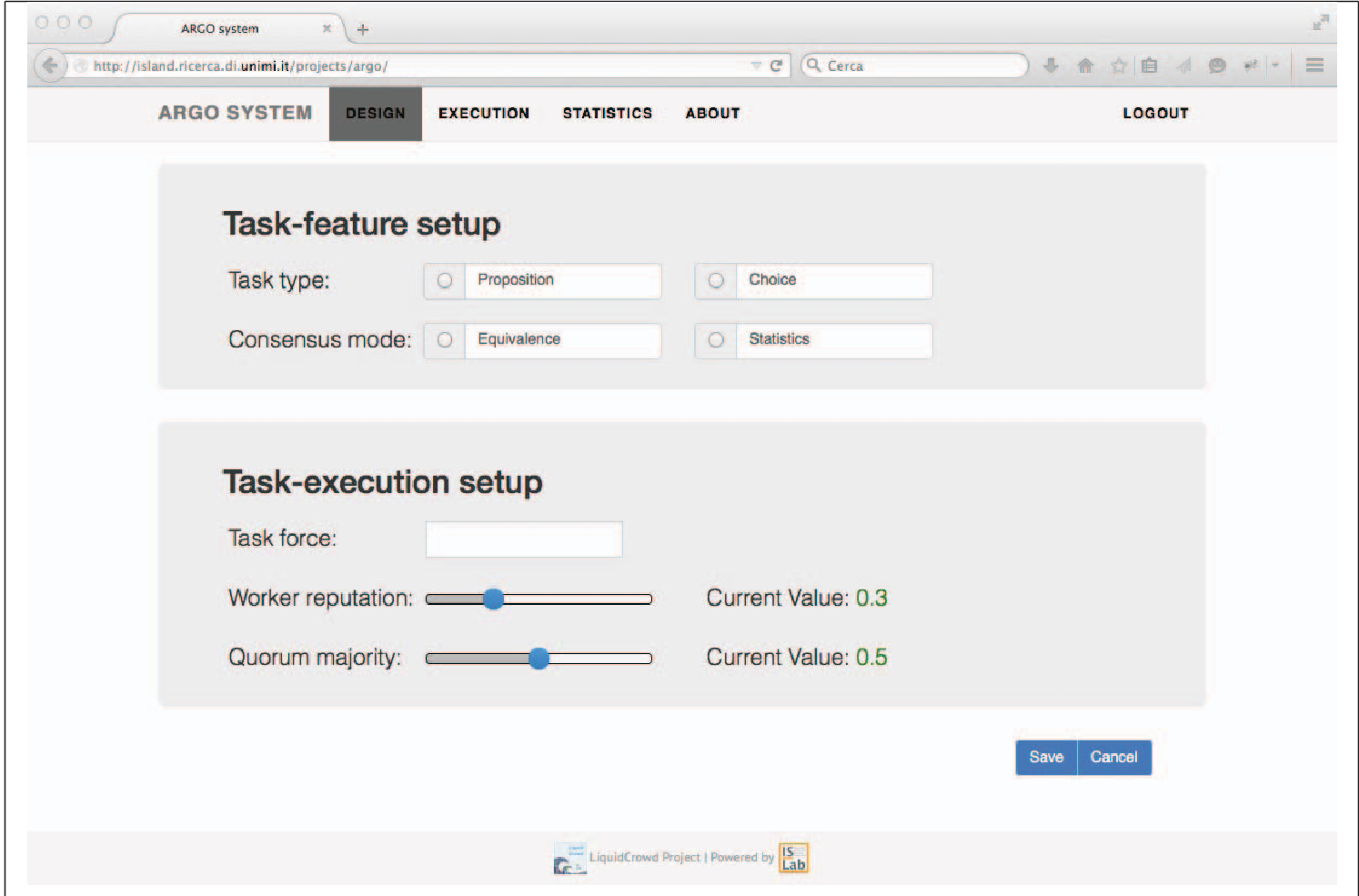
The system relies on two mathematical pillars:
- Q-Constraint (Quorum): The sum of trustworthiness of the supporters of the top answer must exceed a specific percentage of the total group's trust.
- Bop-Constraint (Balance-of-Power): A safety valve. It ensures that even if you have a "super-expert" in the room, they cannot determine the result alone if the second-best answer is close. It forces a broader agreement.
Experience and Experimental Results
The authors tested Argo on a Web-Resource Labeling task (book-labeling). This was a "Crowd-Voting" pattern requiring high trustworthiness () and a high quorum ().
SOTA Comparison and Insights
Unlike traditional platforms where worker fatigue leads to lower quality, Argo found an interesting psychological correlation: The high-quorum requirement actually filtered for motivation.
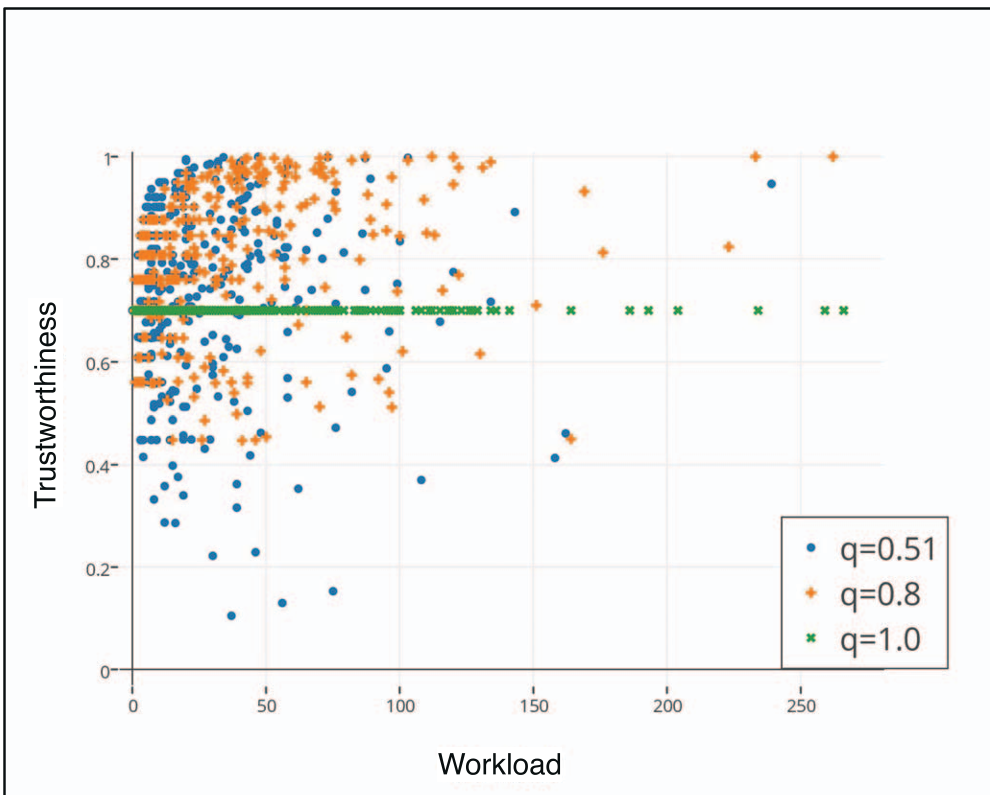
As shown in the graph, as the quorum () increases to 1.0, the workers who stick around (high workload) almost universally show high trustworthiness. Low-trust workers, unable to reach the strict consensus, likely "drop out," effectively self-cleansing the worker pool.
Critical Analysis & Conclusion
Takeaway
Argo succeeds because it formalizes the Intuition that not all "agreements" are created equal. By quantifying "Balance of Power," it prevents the "tyranny of the expert" while using high quorums to maintain a high bar for truth.
Limitations
- Cold Start: The system relies heavily on worker reputation (). For new workers, the initial value is a critical variable that may require more sophisticated "gold questions" than the paper currently details.
- Latency: High quorum constraints ( or ) naturally lead to more "uncommitted" tasks, requiring re-execution and potentially slowing down total throughput.
Future Outlook
The next frontier for Argo is Articulated Processes—linking different patterns (e.g., a "Crowd-Creation" task feeding into a "Crowd-Voting" task) to handle end-to-end complex workflows like software design or legal analysis.