
Decoding the Movement of the Mind: Fine-Grained Digital Biomarkers for Mood Monitoring
Designing Effective Movement Digital Biomarkers for Unobtrusive Emotional State Mobile Monitoring
This paper introduces a set of novel mobility-based digital biomarkers designed to unobtrusively monitor emotional states (activeness, happiness, and stress) using smartphone GPS data. By employing fine-grained spatio-temporal analysis such as tile sequences and displacement entropy, the authors achieve statistically significant correlations (up to ρ=0.6) with user-reported moods.
TL;DR
Researchers from University College London have developed a new way to "read" your emotional state—not by what you say, but by how you move through the world. By analyzing fine-grained GPS patterns (digital biomarkers) like the sequence of places you visit and the "predictability" of your travel, they can significantly correlate smartphone data with levels of stress, happiness, and energy.
Contextualizing Digital Mental Health
In the landscape of mobile sensing, we have moved past simple step-counting. While early research proved that "being active" correlates with better mental health, it lacked the resolution to understand why or how specific behavioral shifts signal a depressive episode or a spike in stress. This paper positions itself as a refinement of the "Sensing-to-Inference" pipeline, arguing that the structure of our movement matters more than the volume.
The Problem with Averages
The authors identify a critical flaw in current SOTA (State of the Art) mental health monitoring: The Smoothing Effect.
- Averaging Emotion: If you are extremely stressed in the morning but relaxed in the evening, your "daily average" looks neutral, hiding the clinical significance of that stress spike.
- Coarse Mobility: Knowing someone traveled 10km is useless if you don't know if that 10km was a routine commute or a frantic, erratic journey to five new locations.
Methodology: The Spatio-Temporal "Fingerprint"
The core of this work lies in five metrics that represent a shift from 1D statistics to 2D/3D behavioral modeling.
1. Tile & Place Sequences
Instead of viewing location as coordinates, the authors treat a user's day as a string of characters. Each "tile" (a grid cell) or "significant place" (a cluster) is a letter.
- The Logic: By using String-Edit Distance (Levenshtein Distance), the system measures how much today’s "story" differs from yesterday’s. A high distance might signal a break in routine caused by—or causing—an emotional shift.
2. Displacement Entropy
This captures the "stochasticity" of movement. Does the user move in regular bursts, or is their movement unpredictable?
- Ablation View: The researchers optimized the time windows () to find the "sweet spot" where movement cycles align with human behavioral rhythm.
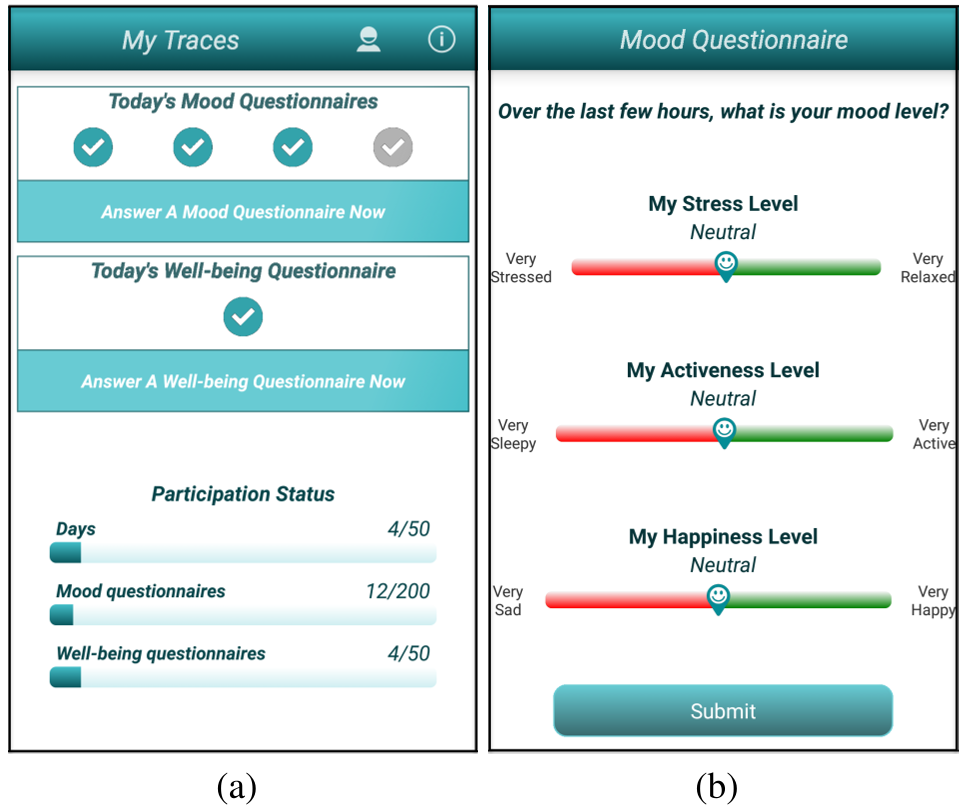 Figure 1: The MyTraces App interface used for Experience Sampling Method (ESM) and background sensing.
Key Insights from the Data
The study’s findings provide a roadmap for future "Emotion-Aware" systems:
- Weekdays vs. Weekends: The correlation between movement and mood is significantly stronger on weekdays. Why? Because weekdays have an Inductive Bias—the "Work Routine." When our movements deviate from this routine, it is a high-confidence signal of an internal state change. Weekends are naturally chaotic, making the "signal-to-noise" ratio too low for accurate inference.
- The Power of Extremes: The biomarkers correlated much more strongly with the "Strongest Emotional State" of the day than the average. This suggests that movement is a lagging indicator of our most intense feelings.
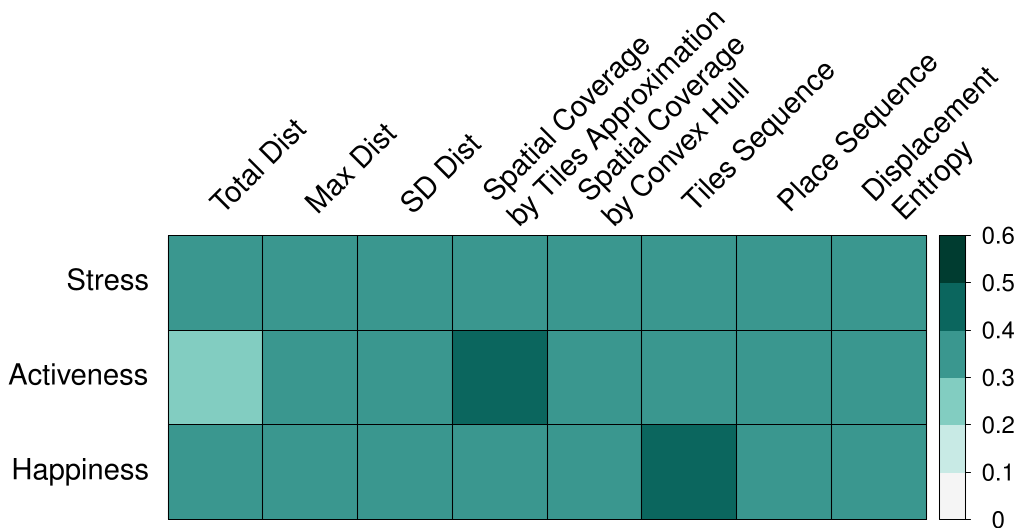 Figure 2: Correlation coefficients () showing that proposed biomarkers (like Tile Sequence and Displacement Entropy) outperform basic mobility features.
Critical Analysis & The Path Ahead
Strengths: The shift to sequence-based analysis is a major step forward. It treats human behavior as a language rather than just a set of variables.
Limitations:
- Sample Size: With only 22 participants, the results are a "proof of concept" rather than a universal law.
- Battery & Privacy: Continuous GPS sensing remains a "heavy" task for mobile devices. The authors mention "adaptive sensing," but the trade-off between battery life and biomarker accuracy is a hurdle for commercial deployment.
The Takeaway for Developers: If you are building health apps, don't just track how far users go. Track the entropy and the sequence. The most valuable mental health insights are hidden in the deviations from our daily rhythms.