
Architecting Participation: UI Strategies for the Crowdsourcing Era
Designing Effective User Interfaces for Crowdsourcing: An Exploratory Study
The paper presents a taxonomy of crowdsourcing initiatives based on task structure, interdependence, and commitment, while identifying five UI/UX best practices. It analyzes successful platforms like Amazon Mechanical Turk, Waze, and InnoCentive to define how interface design drives user engagement and task efficiency.
TL;DR
Crowdsourcing is not a monolithic concept. This exploratory study by Nakatsu and Grossman decomposes crowdsourcing into a strategic taxonomy based on task complexity and interdependence. By analyzing industry leaders like Waze and InnoCentive, the authors pinpoint the UI features—from adaptive learning to social credentialing—that transform a simple "open call" into a sustainable digital ecosystem.
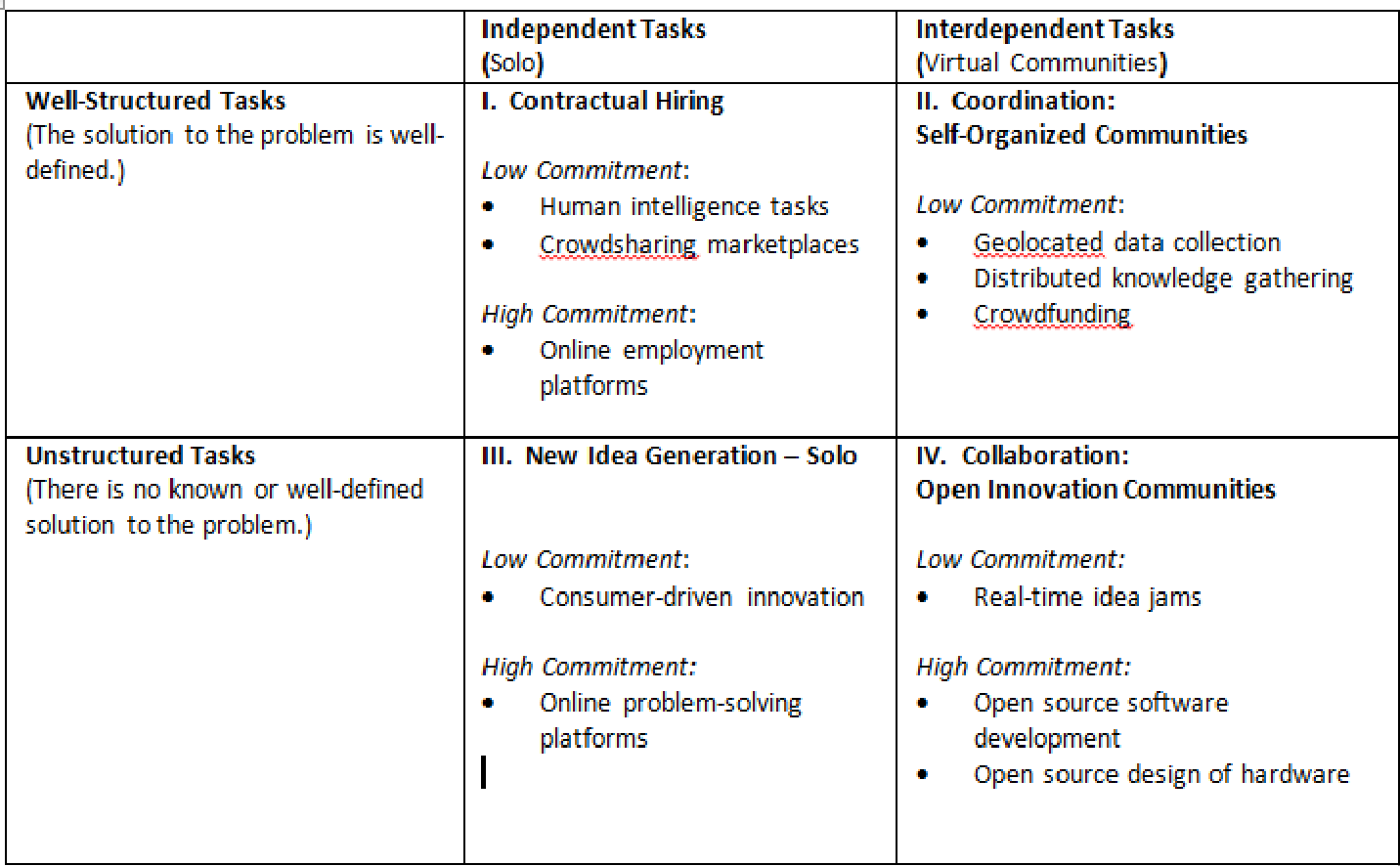
The Taxonomy of the Crowd
The fundamental contribution of this work is the classification of crowdsourcing into four quadrants (plus a commitment dimension). The researchers argue that a "one-size-fits-all" interface is a recipe for failure.
- Independent Tasks (Solo): Range from micro-tasks (Mechanical Turk) to expert problem-solving (InnoCentive).
- Interdependent Tasks (Communities): Range from geolocated data aggregation (Waze) to complex open-source collaboration (Linux).
Identifying the Friction Points
The authors identify a core tension: as tasks move from "Well-Structured" (low commitment) to "Unstructured" (high commitment), the cognitive load on the user increases exponentially. Prior platforms often failed because they did not provide the necessary Searchability and Categorization tools to help users find relevant "Human Intelligence Tasks" (HITs) among hundreds of thousands of entries.
Methodology: UI Best Practices
The paper highlights five critical pillars for designing effective crowd interfaces:
1. From Search to Discovery
For platforms like Amazon Mechanical Turk, success hinges on how workers filter tasks. Sorting by reward amount, task title, and expiration date allows for a frictionless "Contractual Hiring" experience.
2. Mobile-First Simplicity
In the "Coordination" quadrant, apps like Waze showcase the power of two-click reporting. When users are driving, the UI must be invisible. The integration of a "Map Issue" icon allows the crowd to correct the system's underlying data in real-time, creating a self-healing map.
3. Verification & Credentialing
In high-stakes environments like Elance (now Upwork), trust is the primary currency. The researchers highlight "Credentialing" through over 300 online skill tests. This serves as an Inductive Bias for the seeker, reducing the risk of the open call.
4. The Sticky Social Loop
Why do users return? The authors point to:
- Dashboards: Tracking earnings and status (Mechanical Turk Masters).
- Voting Mechanisms: Allowing the community to curate "My Starbucks Idea" submissions.
- Adaptive UIs: Systems that learn from the crowd's history to provide tailored advice.
Critical Insight: The "Adaptive" Frontier
The most forward-looking aspect of this study is the concept of Adaptive User Interfaces. The authors argue that a successful platform doesn't just display data; it learns from the aggregate behavior of the crowd to dynamically generate insights—much like Waze uses driver velocity to predict traffic flow.
Conclusion & Future Outlook
While this paper focuses on established models, it sets the stage for a critical question: How do we support Quadrant IV (Collaborative High-Commitment tasks)? The authors suggest that moving from "Solo" to "Collaborative" will require more than just voting—it will require robust version control, wiki-style documentation, and shared IP management tools.
As we move toward more complex open-innovation models, the UI will be the deciding factor in whether a crowd remains a disorganized mass or becomes a coherent solving engine.