
GLAsE: Decoding the Analyst's Mind Through Hierarchical Learner Modeling
Designing a Learner Model for Use in Training Analysts in a Social Media Practice Environment
The paper introduces the GTRI Learner Assessment Engine (GLAsE), a curriculum overlay learner model designed for training social media analysts in specialized practice environments. It achieves state-of-the-art learner state representation by mapping low-level user actions to high-level expert plans and curriculum-aligned proficiency scores.
TL;DR
The GTRI Learner Assessment Engine (GLAsE) is a sophisticated learner model designed to train social media analysts. By treating the learner's state as an "overlay" on an expert curriculum and using complex plan recognition to evaluate open-ended actions, it bridges the gap between raw user logs and high-level analytical proficiency.
Background: The Challenge of Training Human Analysts
Training a social media analyst is fundamentally different from teaching basic mathematics. Analysis is often non-linear, open-ended, and involves identifying patterns amidst a sea of noise. Conventional Intelligent Tutoring Systems (ITS) often fail here because they cannot handle the "fuzzy" logic of human investigation.
The authors identified that existing systems lacked a way to map low-level technical actions (like clicking a specific data feed) to high-level cognitive skills (like "Recognizing gray-zone influence").
Methodology: The Overlay Architecture
The GLAsE system is built on two pillars: the Curriculum Model and the Learner Model.
1. The Curriculum Overlay
The system uses an overlay model, meaning the learner’s knowledge is represented as a percentage of the "expert" knowledge. The curriculum is structured hierarchically into four main categories:
- Analysis Approach
- Tool Training
- Concepts (Fundamental knowledge)
- Compound Tasks (Applied skills)
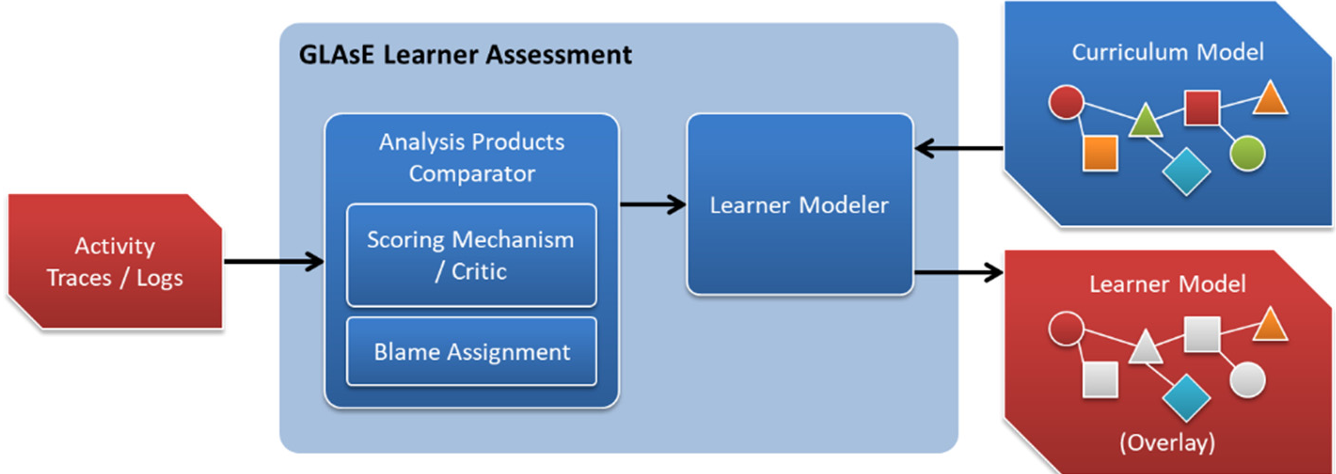 Figure 1: The GLAsE system components showing the interplay between the Practice Environment and the Learner Modeler.
2. Plan Recognition & "Buggy" Plans
The most innovative part of GLAsE is the Analysis Products Comparator. Since analysts might reach a solution through various paths, the system doesn't look for a single "right" answer. Instead, it compares the user's sequence of actions against a Plan Library.
- Expert Plans: The gold standard.
- Correct (but non-expert) Plans: Valid but inefficient paths.
- Buggy Plans: Known paths that indicate specific misconceptions.
By identifying "buggy" plans, the system can perform Blame Assignment, specifically pinpointing exactly where a student’s logic failed.
Proficiency Scoring: Measuring Growth and Decay
GLAsE doesn't just look at a cumulative score. It utilizes a recency-weighted algorithm. The model tracks the "coverage percentage" of a concept.
- Initial Seed: A baseline based on prior experience.
- Rolling Window: Only the most recent 100 points of coverage are used for current assessment, allowing the system to account for both learning gains and knowledge decay (forgetting).
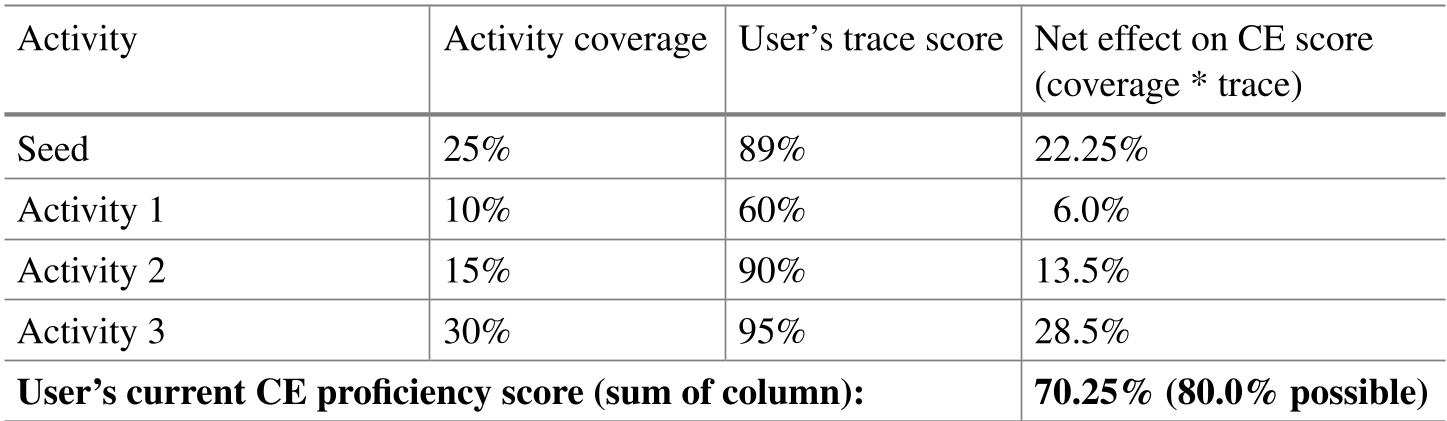 Table 1: Example of how discrete activities accumulate to a final proficiency score of 70.25%.
Critical Insights & Future Outlook
The power of GLAsE lies in its hierarchical inference. While a student performs a "leaf node" task (e.g., using a specific social media filtering tool), the system automatically propagates that evidence up the tree to update their mastery of "Social Media Data Analysis" as a whole.
Limitations: Currently, the system relies on a pre-defined library of plans. In highly dynamic scenarios where entirely new analytical techniques emerge, the system might struggle to recognize novel but valid strategies.
Takeaway: This work proves that domain-specific training for complex roles like intelligence analysis requires a shift from "state-based" modeling to "intent-based" modeling through plan recognition.