
Bridging the Generational Gap: Why QQ Farm Conquered the Chinese Family Unit
Designing online games for real-life relationships: examining QQ farm in intergenerational play
This study investigates intergenerational play between older parents and adult children through the lens of "QQ Farm," a popular Chinese social networking game. By analyzing its mechanics, the authors identify key design features—such as low entry barriers and asynchronous play—that effectively bridge the generational gap and maintain real-life family ties.
TL;DR
Can a simple game about planting virtual vegetables save the modern family’s declining interaction? This study dives into QQ Farm, exploring how its "low-stakes" design allowed Chinese parents and their migrating adult children to maintain real-world emotional bonds through digital play. By prioritizing asynchronous cooperation and cultural resonance, QQ Farm transformed "gaming" from a social taboo into a platform for filial piety.
Problem & Motivation: The "Internet Opium" Stigma
In many Western contexts, gaming is a hobby; in China, it has historically been described by parents as "poisonous opium" that destroys a child's future. This creates a massive barrier for intergenerational play.
Furthermore, the "Expertise Gap" (younger players being more tech-savvy) and the "Responsibility Gap" (busy careers vs. retirement) usually mean that the two generations simply cannot find a common ground in the digital space. The authors sought to understand how QQ Farm—a game once played by millions daily—managed to overcome these social and technical hurdles.
Methodology: Listening to the Pairs
The researchers didn't just look at data logs; they interviewed nine pairs of parents (ages 47-66) and children (ages 18-42). This included families living together in China and those separated by the Pacific Ocean. They focused on why these pairs started playing and how the game adjusted to their real-life relationships.
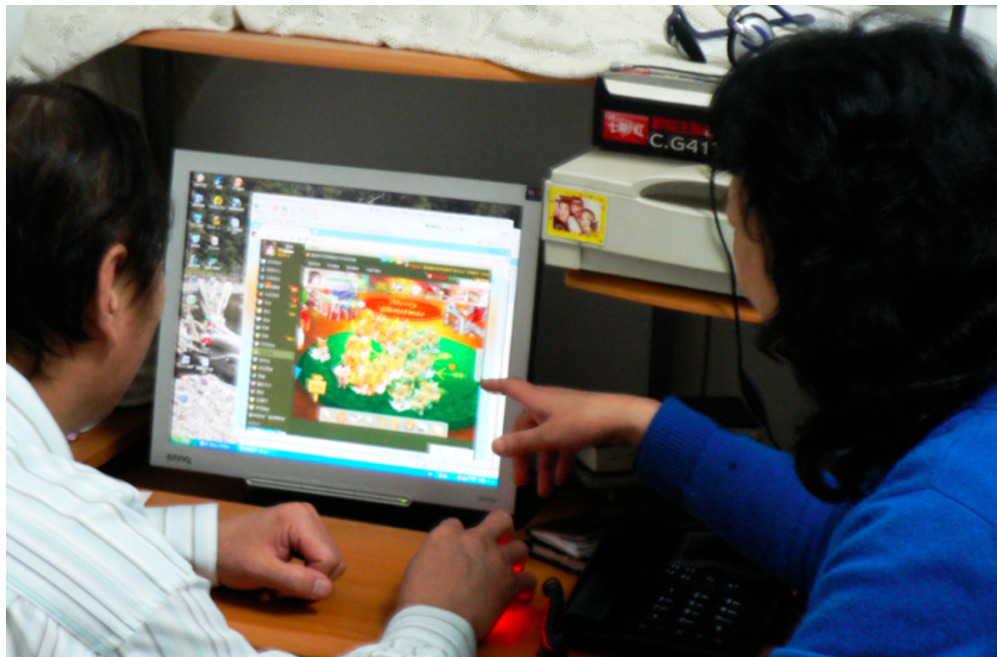
The Core Mechanics of Intergenerational Design
The study identifies five design "secrets" that make QQ Farm a masterclass in inclusive design:
- Low Entry Barrier: By mirroring real-world farming (seed, water, harvest), the game removed the "Intimidation Factor" for elders who were novice computer users.
- Cultural Resonance: In a society that only recently transitioned from rural to urban, the "farming" theme felt respectable and relaxing to parents, unlike "violent" or "fantasy" games.
- Digital Caring (The "Stealing" Paradox): Interestingly, the "Stealing Crops" feature—designed to be mischievous—was used as a token of affection. Children would "allow" parents to steal their crops to help them level up faster.
- Low Time Commitment: The game doesn't demand hours of focus; you can check it once a day. This fits the "Senior Official" schedule and the "Busy Student" schedule alike.
- Asynchronous Play (The Time-Zone Bridge): Since the game doesn't require both parties to be online simultaneously, a son in the US could harvest his mother’s crops while she slept in China, creating a 24-hour cycle of mutual aid.
Experiments & Results: Beyond the Scoreboard
The qualitative results showed that for these families, the "Level" or "Score" was secondary. The primary outcome was the extension of domestic roles.
- Parents as Caretakers: Parents often managed their children's farms while the children were at work, extending their real-world caretaking into the digital realm.
- Intimacy through Interaction: The message board in the game became a low-pressure social check-in, reducing the "burden" of a formal phone call while still signaling presence.
Critical Analysis & Future Outlook
The power of QQ Farm wasn't in its graphical fidelity or complex AI; it was in its social elasticity. It allowed families to map their existing hierarchies and affection onto digital "farming."
Limitations: Since this study focused on a specific cultural context (China), some mechanics—like the tolerance for "stealing"—might not translate perfectly to cultures with more individualistic or strictly competitive views of property.
Takeaway for Today's Developers: As our society ages, the "Casual Game" market is no longer just for kids. The future of social gaming lies in Lightweight Interactivity—designs that foster connection without demanding constant attention or high dexterity. The goal isn't to make parents "gamers"; it's to make the game a bridge back to the family dinner table.