
Semi-Automatic Ontology Engineering: Bridging XML Data Mining and the Semantic Web
9392_Designing the Ontology of XML Documents Semi-automatically.
This paper introduces a semi-automatic framework for constructing domain ontologies from XML documents using data mining techniques. By leveraging association rules and the XML Topic Map (XTM) standard, the authors automate the discovery of conceptual relationships and organize them into a hierarchical knowledge structure for semantic information retrieval.
TL;DR
The explosion of XML-based web documentation has created a massive need for structured knowledge, yet manual ontology creation remains a bottleneck. This paper proposes a semi-automatic pipeline that uses Association Rule Mining to extract conceptual relationships from XML tags and maps them directly to XML Topic Maps (XTM), enabling more precise semantic search with minimal human intervention.
Context & Motivation: The XML Opportunity
In the evolution of the Semantic Web, the transition from "strings to things" requires a robust ontology. While text-based ontology learning has been widely studied, the authors argue that the structured nature of XML—already rich with hierarchical meta-data—is an underutilized gold mine.
Current SOTA methods for text documents often struggle with high noise and the lack of explicit structure. By shifting the focus to XML, we can exploit tag hierarchies as an initial "taxonomy blueprint," significantly reducing the cost and time of building domain-specific knowledge bases.
Methodology: From Tag Distribution to Conceptual Hierarchy
The core innovation lies in the transformation of raw XML tags into meaningful ontological associations.
1. Data Preprocessing & Alignment
The authors use XGenerator to transform web data into XML and employ WordNet to normalize tags with similar meanings. This ensures that synonyms (e.g., "Hotel Name" and "Accommodation") are recognized as related entities before mining begins.
2. Mining Association Rules
By treating each XML document as a transaction and its tags as items, the system applies association rule algorithms to find frequent patterns. For instance, if the tag <area> frequently co-occurs with <tour site>, a conceptual link is hypothesized.
3. Pruning via Subsumption
A critical step in maintaining a clean ontology is the Pruning Process. The authors propose a generalized hierarchy logic: if a specific relation pair (e.g., Jejudo, Jeju Pacific Hotel) has low support but its parent categories (Domestic Area, Hotel) have high support, the system prunes the specific link in favor of the more generalized, statistically significant relationship.
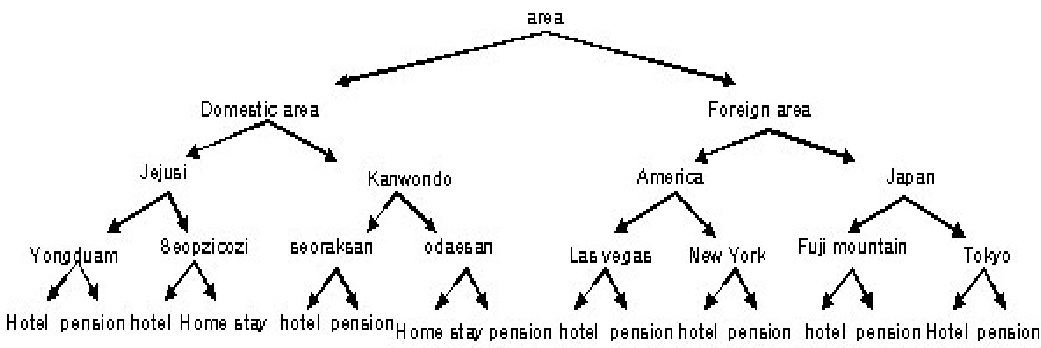 Figure 1: The structural hierarchy used as the basis for mining.
Implementation: The XTM Pipeline
Once relations are filtered, they are converted into XML Topic Maps (XTM). The architecture utilizes:
- TM4J (Topic Map Engine): To manage topic objects and storage wrappers.
- Onmigator: For validating the graphical structure of the generated ontology.
- Hibernate: To map the complex object-relational ontology into a persistent database.
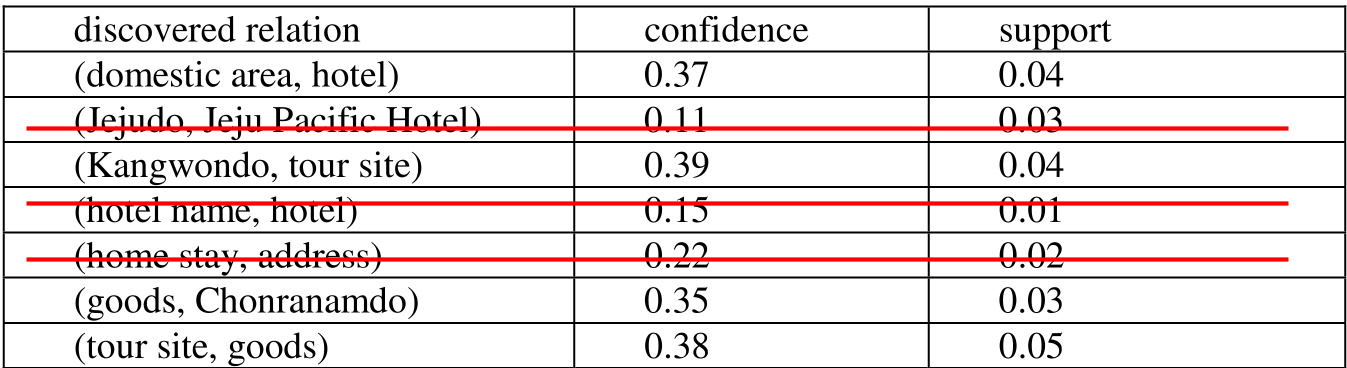 Table 1: Experimental results showing how confidence and support scores determine which relations are kept or pruned (red lines in the original text).
Experimental Insights
The system was tested on a "Tour Information" domain. The experiment revealed that:
- Automatic Taxonomy Generation: Using the DOM parser, the system could extract 2,500+ tags and organize them into sub-nodes (e.g.,
Tour_info -> Domestic Area -> Jejudo). - Semantic Precision: Unlike standard keyword search, the ontology-based engine allowed users to query specific attributes (e.g., "accommodations within Yongduam") and get results filtered through the defined conceptual associations.
 Figure 2: The final user interface demonstrating semantic navigation through the mined ontology.
Critical Analysis & Conclusion
This work provides a pragmatic bridge between data mining and knowledge engineering. By using Association Rules, it moves away from the "all-or-nothing" manual approach to a "filter-and-refine" model.
Limitations:
- The method relies heavily on the quality of the initial XML structure. If the source XML is poorly designed, the resulting ontology will inherit its flaws.
- The use of WordNet for alignment is helpful but might struggle with highly specialized technical jargon not present in general linguistics databases.
Future Outlook: The authors suggest that the next frontier is incorporating the content of the XML tags, not just the tags themselves. In the modern era, integrating these statistical mining methods with Neural Relation Extraction could lead to even more robust and fully autonomous ontology generation.