
Poli: Reconstructing the Digital Public Sphere for Political Deliberation
Designing Political Deliberation Environments to Support Interactions in the Public Sphere
This paper explores how citizens navigate a "sprawling" online public sphere across multiple social media platforms for political deliberation. The authors identify key interaction challenges through qualitative studies and propose Poli, an integrated social media environment designed to aggregate diverse viewpoints and support information seeking, dissemination, and rational discourse.
TL;DR
Social media has turned political discussion into a minefield of polarization and social risk. In this paper, researchers from Syracuse, UC Irvine, and Hawaii analyze how citizens "hack" together multiple platforms to stay informed. To solve the fragmentation, they introduced Poli, an integrated system that aggregates diverse viewpoints, allows for anonymous engagement to lower social barriers, and uses structured filtering to replace the chaos of the traditional newsfeed with a reasoned deliberation space.
The "Sprawling" Public Sphere: Why Current Tools Fail
According to the Habermas theory of the public sphere, democracy requires a domain where public opinion is formed through reasoned debate. However, the authors argue that today's public sphere is "sprawling"—spread across Facebook's personal networks, Twitter's real-time feeds, and Reddit's anonymous forums.
The researchers identified three primary friction points:
- The Social Cost of Truth: On platforms like Facebook, sharing a "counter-attitudinal" post can lead to unfriending or real-world social friction.
- Context Collapse: In places like Twitter, political statements often appear without context, leading to "flaming" rather than "reasoning."
- The Echo Chamber Effect: Users often unconsciously curate networks that only reflect their own views, missing out on the diverse information necessary for a healthy democracy.
Methodology: Listening to the "Political Junkies"
The team conducted a longitudinal study involving 29 US citizens and 17 in-lab "talk-aloud" sessions. They observed how "expert" users used tools like Tweetdeck to organize feeds by "political slant" (right- vs. left-leaning). These insights led to the creation of Poli.
Architectural Insight: The Poli Methodology
Poli is designed to be more than just an aggregator; it is an environment that nudges users toward serendipitous exposure to different ideas.
1. Integrated Architecture
Poli acts as a backend that pulls data from Facebook, Twitter, and YouTube, presenting them in a unified "tiled" format. This removes the "Network Effect" barrier where users only see what their friends share.
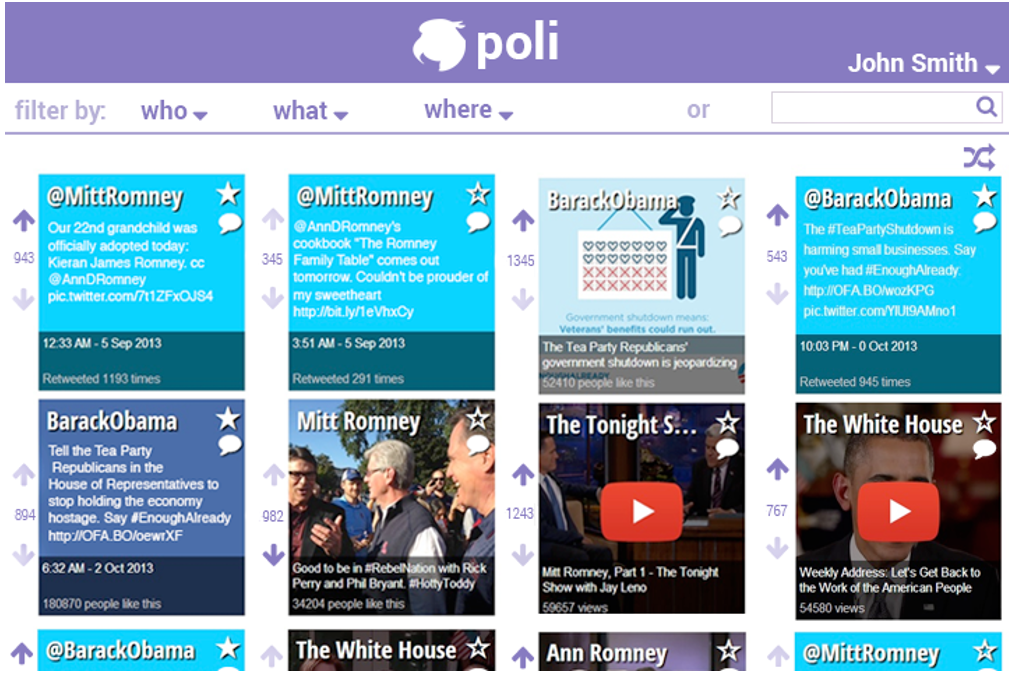 Figure 1: The Poli interface focuses on variety, showing content from candidates, media, and citizens side-by-side.
2. Structured Information Browsing
Instead of a simple search bar, Poli uses a drop-down browser strategy. This allows users to filter information by:
- Who: Specific politicians or parties.
- What: Topics like "Gun Control" or "Economy."
- Where: Geographic location.
- Sentiment: Seeing how different groups feel about an issue.
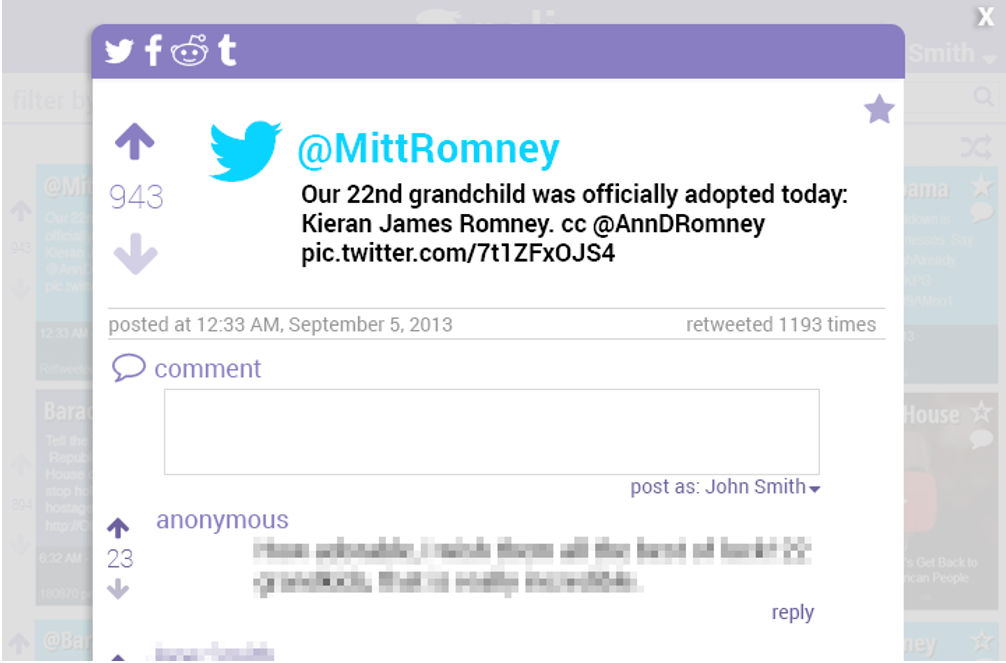 Figure 2: The UI for structured search, designed to reduce the "cognitive overhead" of finding multi-perspective data.
3. Identity Management and Anonymity
One of the most profound insights was the need for identity switching. Poli allows users to post to their social networks either with their real names or anonymously. This anonymity acts as a "low-barrier to entry," allowing users who don't feel like "experts" to ask questions and learn without fear of public judgment.
Findings and Impact
The study highlights that self-efficacy (a user's belief in their ability to participate) is a major hurdle. By using a Reddit-like up-voting system, Poli provides a "feedback loop" where users receive peer recognition for constructive posts. This shifts the motivation from "shouting into the void" to "reputation building."
Key Results:
- Depolarization: By removing the reliance on existing social networks, users were exposed to significantly more diverse info.
- Contextualization: Threaded conversations across platforms helped users understand the "history" of a political argument, reducing misunderstandings.
Critical Analysis & Future Work
While Poli is a powerful prototype, the authors admit several limitations:
- Sentiment Difficulty: Modern social media relies heavily on sarcasm and memes, which current automated sentiment tools (like LIWC) struggle to categorize accurately.
- Selection Bias: The study focused on "highly motivated" users; whether uninterested citizens would use Poli remains a question.
Conclusion: The Future of Civic Space
The paper concludes that the public sphere is no longer a physical place or a single website—it is a technological experience. By designing for "deliberation" rather than just "engagement," tools like Poli can help transition political participation from a "chore" to a meaningful community activity.
Takeaway for Designers: If you want to reduce polarization, don't just show "the other side"—give users a safe way to interact with that side without risking their social capital.