
Engineering Delight: Advanced Interventions for Positive Affect in UX
Designing for Positive Emotional Responses in Users of Interactive Digital Technologies: A Systematic Literature Review
This paper presents a Systematic Literature Review (SLR) that identifies specific interventions to evoke positive emotional responses (affect) in users of interactive digital technologies. By synthesizing 20 core studies, the authors establish a framework comprising four primary intervention categories: Aesthetics, Affective Computing, Need Fulfillment, and Novel Interaction Techniques.
TL;DR
Functionality is the baseline; emotion is the differentiator. This study systematically reviews 30 years of HCI research to provide a toolkit for designers. It categorizes how Aesthetics, Affective Computing, Need Fulfillment, and Novel Interactions can be leveraged to move users from mere "satisfaction" to genuine "delight."
Beyond Utility: The Hedonic Imperative
In the early days of software engineering, "usable" was the gold standard. If a user could complete a task without an error, the design was a success. However, as the digital landscape has matured, the Pragmatic/Hedonic model tells a different story. While pragmatic attributes (usability) are necessary, it is the hedonic attributes (emotions, self-expression, and pleasure) that dictate long-term user appeal and loyalty.
The motivation for this research stems from a gap in practitioner knowledge: we know that emotions matter, but how do we systematically design for them?
The Core Framework: Four Pillars of Emotional Design
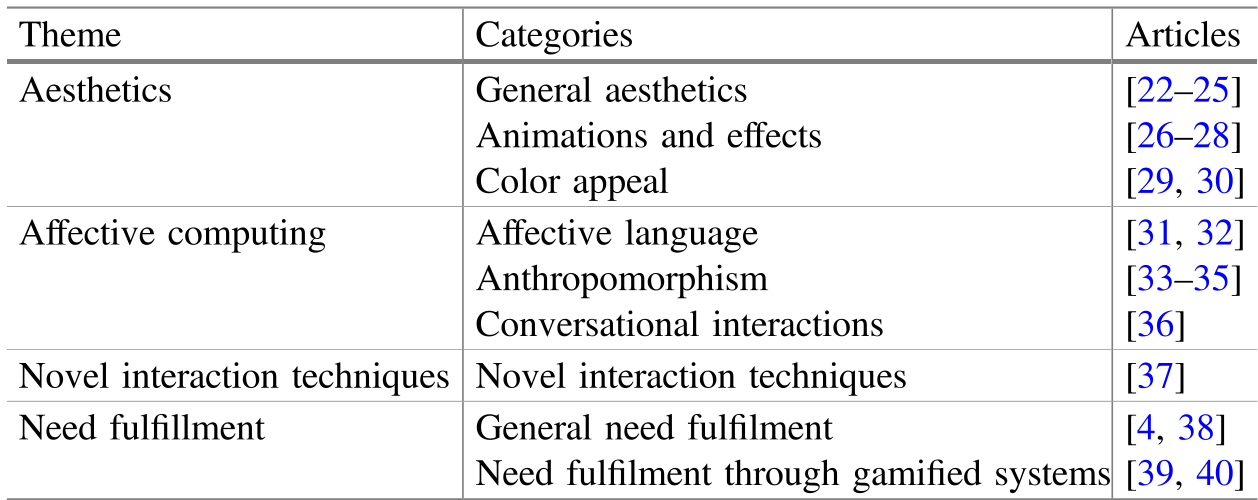
The authors identified four distinct domains where designers can intervene to "pulse" the user's affective state.
1. Aesthetics (The Visual Trigger)
Aesthetics is the most heavily researched area, divided into classical (symmetry, clarity) and expressive (originality, creativity) categories.
- Classical Aesthetics: Directly correlates with the "Pleasure" dimension of the PAD model.
- Expressive Aesthetics: Correlates with "Arousal."
- Key Insight: Visual complexity has a positive correlation with arousal, meaning "minimalism" isn't always the answer if the goal is to excite the user.
2. Affective Computing (The Human Connection)
This involves making technology feel more social and empathetic.
- Affective Language: Using apologetic messages during errors (e.g., "We're so sorry about this") significantly reduces user frustration compared to neutral technical logs.
- Anthropomorphism: Implementing laughing virtual characters or human-like voice qualities increases "likability" and future intent to use.
3. Need Fulfillment (Psychological Satisfaction)
Drawing from the work of Sheldon and Hassenzahl, this pillar suggests that UX is positive when it satisfies fundamental human needs like Autonomy, Competence, and Relatedness.
- Gamification: Points, badges, and levels are not just "fun"—they are tools that satisfy the need for competence.
4. Novel Interaction (The "Cool" Factor)
Even small changes in interaction, such as replacing a click with a swipe gesture, have been shown to increase perceived enjoyment and the "vividness" of an interface.
Evidence-Based Results
The study highlights a clear trajectory in research:
- Aesthetics dominance: 9 out of 20 papers focus here, proving it is the most reliable "quick win" for practitioners.
- Geographic Shift: Research is heavily concentrated in Asia, North America, and Europe, suggesting a potential cultural bias in what is perceived as "delightful" color appeal or language.
- Quantifiable Impact: Studies show that "beautiful" pages evoke physiological responses similar to pleasant photography, while "ugly" pages trigger the same negative affect as unpleasant imagery.

Critical Insight: The Practitioner's Verdict
The most striking takeaway from this review is that emotion is a programmable variable. By choosing specific color palettes, utilizing apologetic error handling, and satisfying the need for competence through feedback loops, we can mathematically improve the hedonic quality of a product.
Limitations: The review notes a significant lack of research in the "Novel Interaction" category and a total absence of data from the African and Middle Eastern regions. Furthermore, the findings on "flattery" and "anthropomorphism" may have a shelf life—as users become more tech-savvy, they may perceive these as manipulative rather than delightful.
Conclusion
To design for the future, we must stop treating "delight" as a happy accident. By focusing on the four identified themes, UX practitioners can move beyond basic human-centered design toward emotion-centered design, ensuring that digital tools do not just serve us, but also make us feel better.