
Beyond the Search Bar: Revolutionizing Tourism with User Personalised Content (UPC)
Destination Marketing through User Personalised Content (UPC)
This paper introduces User Personalised Content (UPC) as a Web 2.0 framework for destination marketing, leveraging customizable widgets and content aggregators. It proposes the Open Global Destination Marketing System (OGDMS) to provide highly tailored information access for travelers while enabling small-scale tourism entities to compete globally.
TL;DR
Information overload is the silent killer of vacation planning. This paper proposes a transition from static websites to User Personalised Content (UPC)—an ecosystem of portable, customizable "widgets" that travel with the user. By integrating these into an Open Global Destination Marketing System (OGDMS), the study suggests we can solve the "Long Tail" problem, giving small, niche destinations the same marketing potency as global hotspots.
Background: The Information Overload Crisis
In the digital age, planning a trip often feels more like a chore than a getaway. While the internet provides access to a wealth of data, travelers struggle to filter relevant signals from the noise. Destination Marketing Organisations (DMOs) find themselves at a crossroads: they have complex, multi-stakeholder products but lack the agile technical tools to reach the right consumer at the right time.
The "Widget" Insight: Small Tools, Big Impact
The authors identify widgets—small, portable bundles of software—as the core of a new marketing paradigm. Unlike traditional ads that "push" unwanted content, widgets represent a "pull" strategy.
The personalization happens in three distinct layers:
- Interface Customization: Choosing the aggregator (like iGoogle or MyYahoo).
- Selection: Downloading only the widgets that matter (e.g., specific weather or niche restaurant finders).
- Specific Preferences: Configuring the individual widget (e.g., setting the currency for a converter).
Methodology & Architecture
The research utilized a qualitative online exploratory study of 170 travel-related widgets, categorizing them by purpose, provider, and functionality. A critical finding was the lack of DMO presence in the widget space, leading the authors to conceptualize a more robust system: the OGDMS.
The OGDMS Framework
To solve the fragmentation of current widget offerings, the paper proposes a centralized, open-source database where even the smallest tourism enterprises can upload their profiles.
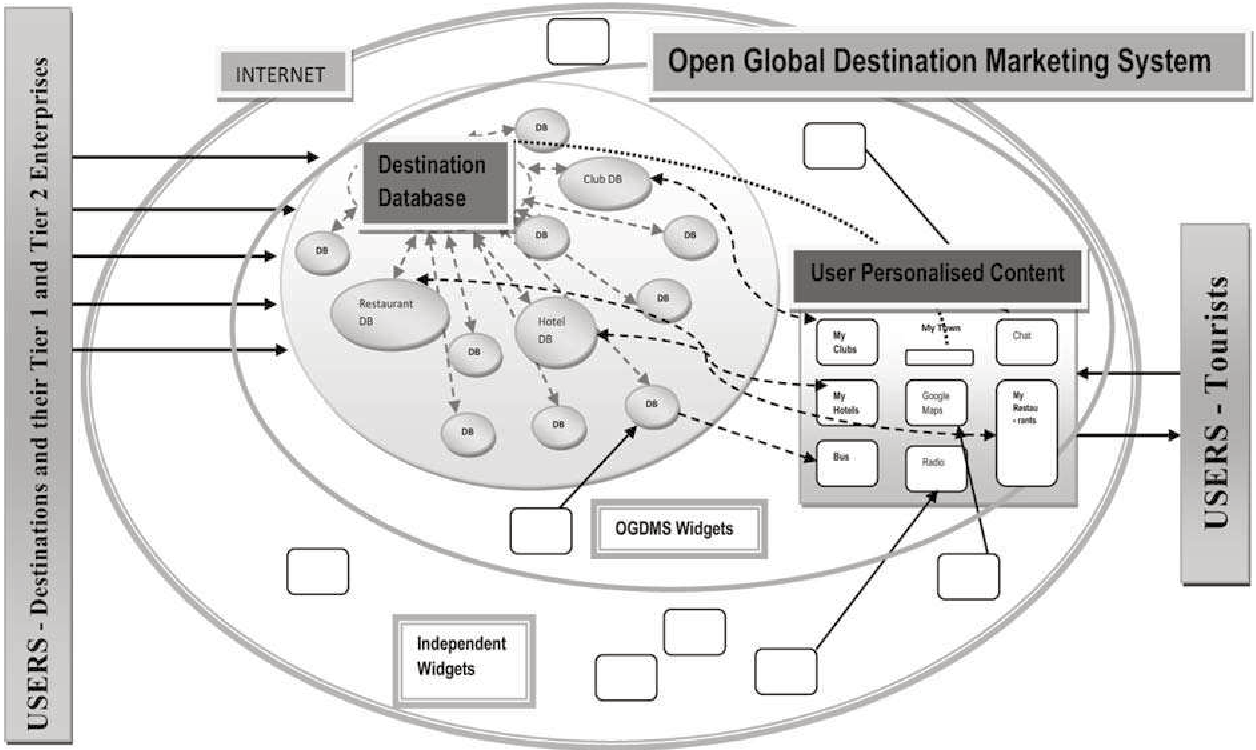
The "Secret Sauce" of this architecture is the Master Widget. Instead of manually updating every widget for a new trip, the Master Widget acts as a synchronization layer. Change your destination in the Master Widget, and every other tool—from restaurant finders to local transport maps—automatically updates its context.
Key Results: Bridging the Long Tail
The study highlights that most existing widgets are built by major Online Travel Agencies (OTAs) focusing on "Short Head" (mass market) destinations.
- The Gap: Smaller "Long Tail" destinations are virtually invisible in the current widget economy.
- The Potential: By using UPC, niche destinations can leverage viral sharing (e.g., TripAdvisor's ‘Cities I’ve Visited’ widget reached 7.8 million users).
- Full Lifecycle Support: The findings show that UPC isn't just for booking (pre-consumption); it’s vital for navigation and "dynamic packaging" while on-site (consumption) and for sharing experiences afterwards (post-consumption).
Critical Analysis & Conclusion
This paper serves as a visionary blueprint for the "widgetization" of the web. While the specific technologies mentioned (like iGoogle) have evolved into mobile apps and ecosystem-specific widgets (iOS/Android), the underlying logic remains highly relevant.
Takeaway: The future of destination marketing isn't a better website; it's a better data exchange.
Limitations: The study correctly identifies that the creation of a truly "Open Global" database is a massive coordination challenge. Without a clear ROI for the tech giants (like Google) to host this for free, small DMOs may still struggle to gain traction against the proprietary databases of OTAs.
Future Outlook: As we move toward AI-driven travel assistants, the "widget" concept will likely evolve into API-driven micro-services. The OGDMS vision provides the early theoretical groundwork for how these services can be aggregated to empower the traveler while protecting their privacy.