
Decoding Coopetition: The Topology of Local Entrepreneurial Networks
The Detailed Structure of Local Entrepreneurial Networks: Experimental Economic Study
This paper explores the structural differences between geographically localized entrepreneurial networks, specifically "Production Clusters" and "Cooperative Communities." Using experimental economics and Social Network Analysis (SNA), the authors demonstrate that community networks are significantly more random and flexible than production networks, which exhibit rigid, non-random supply chain structures.
TL;DR
Not all business networks are created equal. New research suggests that while Cooperative Communities operate like flexible, near-random social webs, Production Clusters form rigid, highly centralized hierarchies. By applying Social Network Analysis (SNA) to experimental economic data, this study quantifies the "hidden architecture" of how entrepreneurs collaborate and compete simultaneously—a phenomenon known as Coopetition.
Problem & Motivation: The Science of Cooperation
While classic economics has mastered the mathematics of "perfect competition," the mechanics of cooperation remain under-theorized. In the last 40 years, the global economy has shifted toward coopetition, yet we lack a clear understanding of how these networks actually "look" under a microscope.
The researchers identified a major hurdle: Data Privacy. Bank statements—the "DNA" of economic networks—are trade secrets. To bypass this, the authors used experimental economics to build five localized networks from scratch, simulating real-time trading of goods and services among entrepreneurs in Russia.
Methodology: Mapping the Economic Web
The study compared two distinct flavors of localized networks:
- Production Clusters: Geographically concentrated entities focused on a complex product (e.g., a municipal economy or a tourism camp lifecycle).
- Cooperative Communities: Local agents primarily interested in meeting internal demands through complementary currencies.
To determine if these networks were "intentional" or just "random," the authors compared them to Bernoulli Graphs (randomly generated networks of the same size and density).
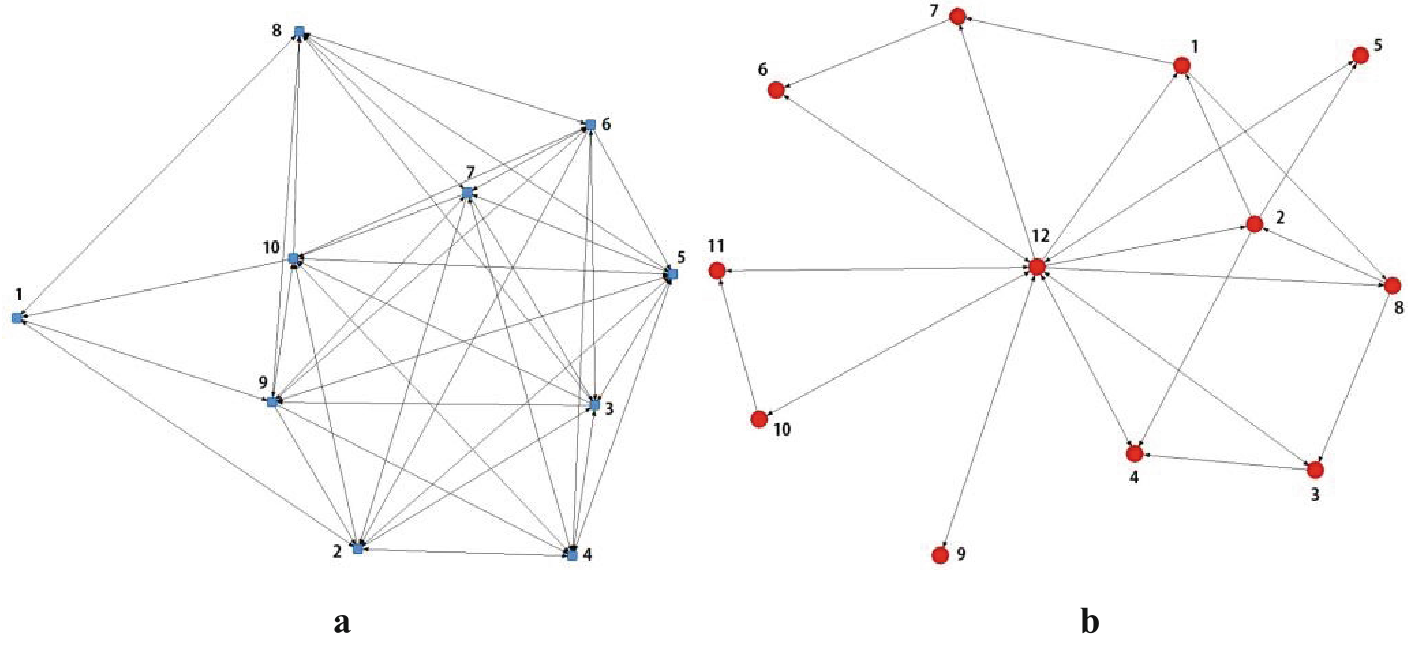 Fig 1: Visual representation of a Community Network (left) versus a Production Network (right), illustrating the difference in connectivity density.
Key Performance Indicators
The researchers utilized several SNA metrics to quantify the "shape" of business:
- In-degree/Out-degree Centrality: Measuring prestige and expansivity.
- Reciprocity (Re): The percentage of mutual ties.
- Clustering Coefficient (CC): The "cohesiveness" or "cliquishness" of the network.
Results: Rigid Chains vs. Fluid Hubs
The findings revealed a stark structural divide:
- Production Networks are Non-Random: Their structures are dictated by strict B2B supply chains. They showed a Betweenness Centralization (BCenz) relative deviation of 4.3, meaning a few key "brokers" control nearly all flow—much higher than a random model would predict.
- Community Networks are Flexible: These networks were much "noisier" and closer to random Bernoulli graphs. They focused on B2C communications, featuring a higher variety of products (Var) but lower average transaction costs.
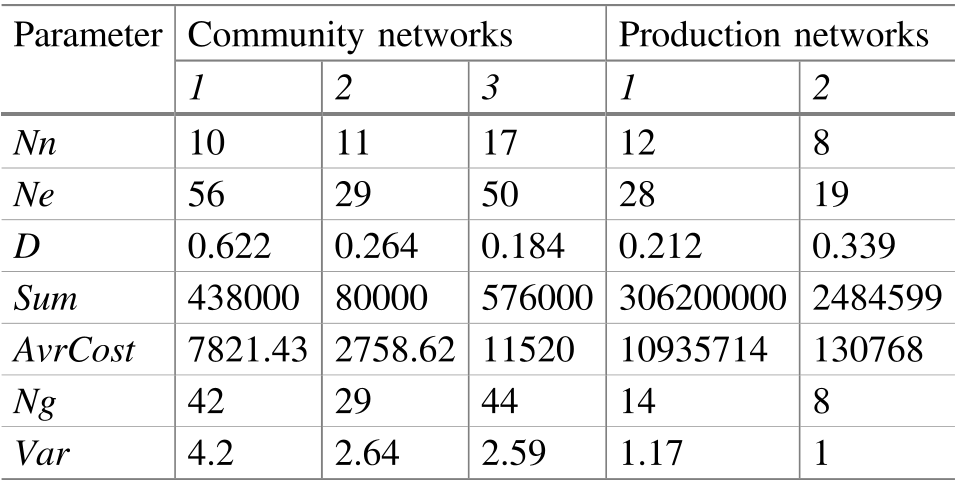 Table 1: Comparative data showing that while communities have more product variety, production networks handle significantly larger capital volumes.
Critical Analysis & Takeaways
The most striking takeaway is that form follows function. In a production environment, efficiency demands a "limited range of products" and "large volumes," leading to a rigid, centralized network structure. In a community, "variety and flexibility" are king, leading to a decentralized, more organic (almost random) structure.
Limitations & Future Work
The study relies on experimental and simulated data rather than real-world massive datasets due to data sensitivity. Future research involves scaling these models to larger volumes of real-world "local payment system" data to see if these structural signatures hold true across different cultures and digital economies.
Conclusion: If you are building a production-based ecosystem, expect a hierarchy. If you are building a community, embrace the randomness. Understanding these "topological constraints" is essential for any policymaker or entrepreneur trying to foster local growth in the age of coopetition.