
DAAC: Mapping the Friend-or-Foe Landscape of Social Media
Detecting Antagonistic and Allied Communities on Social Media
The paper introduces DAAC (Detecting Antagonistic and Allied Communities), a framework that jointly models social interactions and inter-user attitudes to identify communities and their complex relations (antagonism or alliance). Validated on three political Twitter datasets, DAAC achieves SOTA performance in community detection while accurately uncovering inter-group relationships.
Total community detection isn't just about finding clusters; it’s about understanding the "geopolitics" between those clusters. While standard algorithms can tell us that two groups exist, they rarely tell us if those groups are at war or in a strategic alliance. The DAAC (Detecting Antagonistic and Allied Communities) framework changes this by looking beyond the graph structure into the sentiment of the conversation.
TL;DR
Researchers from Arizona State University have developed a framework that uses sentiment analysis and retweet networks to not only find communities but also label their relationships. By validating that social media attitudes mirror real-world sociological intergroup behavior, they’ve created a model that outperforms traditional methods like Louvain and InfoMap, specifically in polarizing domains like politics.
The Missing Dimension: Why Structure Isn't Enough
Classic community detection (e.g., Modularity maximization) operates on a "birds of a feather flock together" logic. It identifies dense subgraphs where users interact frequently. However, this approach has two fatal flaws for modern social analysis:
- Social interactions are often positive-only: On Twitter, a retweet usually implies endorsement, but what about the "mentions" where users argue?
- Inter-group Dynamics: If Community A and Community B never interact, are they neutral, or are they mutually boycotting each other?
Previous attempts to solve this required "Signed Networks" (where links are explicitly marked as or ). Since most platforms don't have a "dislike" or "distrust" button, these models were practically useless for mainstream social media.
Methodology: Fusing Sentiment with Topology
The DAAC framework operates on a dual-input system: a Social Interaction Matrix () and an Attitude Matrix ().
1. The Attitude Hypothesis
Based on Tajfel’s Social Identity Theory, the authors hypothesized that attitudes are shaped by membership. They used SentiStrength to quantify the sentiment of mentions. Crucially, they filtered out negative sentiments between friends (retweeters) to avoid misidentifying banter or "friendly fire" as antagonism.
2. The Joint Objective Function
The model minimizes a combined loss function that balances two goals:
- Attitude Modeling: Approximating the attitude matrix using , where is the membership and captures the inter-community temperature.
- Structural Modeling: Maximizing the "trace" of the interaction matrix, effectively performing a relaxed normalized cut to ensure communities are structurally sound.
 The objective function: acts as the bridge between sentiment (left term) and structure (right term).
Experimental Battleground: US, UK, and Australia
The authors tested DAAC on three high-stakes political datasets. The results were telling:
Performance vs. Baselines
DAAC didn't just find relations; it found better communities. In the US dataset, DAAC's NMI (Normalized Mutual Information) was 28% higher than Label Propagation. This suggests that sentiment provides a clarifying signal that resolves structural ambiguities.

Uncovering the "Coalition"
The Australia dataset provided a unique test case: it contained a "Coalition" (allies) and several antagonistic pairs. DAAC successfully mapped the positive values between the Liberal, National, and Liberal National parties, while assigning negative values to their relations with the Labor and Green parties.
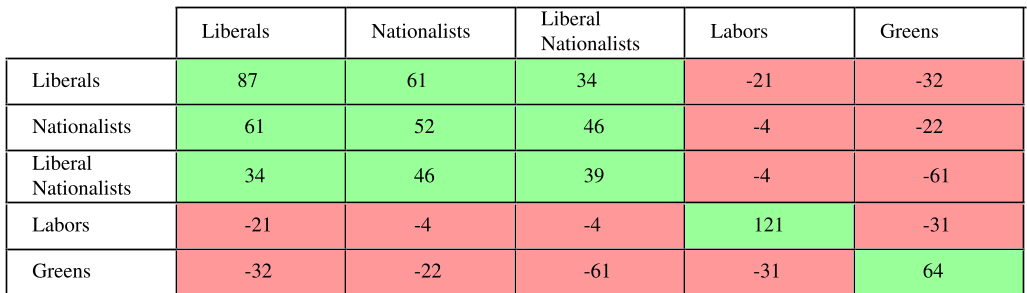 Table V: Note the positive values (alliances) in the top-left 3x3 block compared to the negative values (antagonisms) elsewhere.
Critical Insight: The Regularization Balance
A fascinating finding in the paper’s sensitivity analysis is that DAAC performs best when is very high (). This tells us that social structure (retweets) is the skeleton, but sentiment (attitudes) is the flesh. You cannot identify a relationship between groups until you have identified the groups correctly using structure.
Conclusion & Future Directions
DAAC proves that we can extract deep socio-political insights from "noisy" social media text without needing explicit trust/distrust labels.
- Limitation: The reliance on SentiStrength (a lexicon-based tool) might struggle with sarcasm or complex political slang.
- Evolution: The authors point toward studying the dynamics of these relations—watching an alliance crumble or an antagonism form in real-time as an election approaches.
For practitioners in social listening and computational sociology, DAAC offers a robust blueprint for moving from simple clustering to complex relational mapping.