
MAT: Real-Time Pain and Demeanor Detection for Emergency Healthcare
Detecting demeanor for healthcare with machine learning
The paper introduces a prototype system for real-time patient demeanor and pain detection using the Intel RealSense camera and Support Vector Machines (SVM). By mapping 78 facial landmark points to recognized clinical scales, the system achieves a 90% accuracy in classifying four intensities of pain (None, Mild, Moderate, Severe).
TL;DR
Researchers have developed a prototype system capable of "reading" a patient's pain through facial expressions in real-time. By combining the Intel RealSense 3D camera with Support Vector Machines (SVM), the system categorizes pain levels with 90% accuracy, aiming to assist first responders in triage situations where patients cannot communicate verbally.
Background & Motivation
In emergency medicine, the first few minutes are critical. Paramedics often use the AVPU scale (Alert, Verbal, Painful, Unresponsive) to assess consciousness. However, objective pain measurement is notoriously difficult. If a patient is unconscious, a young child, or in extreme shock, they cannot "rate their pain from 1 to 10."
The authors identify a gap: while facial recognition is common, using it to detect pathological demeanor (agitation, pain intensity, physiological responsiveness) in a mobile, 5G-ready format is a burgeoning frontier in eHealth.
Methodology: The Core Mechanism
The system, termed the Mobile Agitation Tracker (MAT), moves beyond simple 2D image analysis by leveraging depth sensing.
1. 3D Landmark Tracking
Using the Intel RealSense camera's IR projector and VGA depth resolution, the system tracks 78 facial landmark points. These include the eyebrows, eyes, nose, mouth, and jawline.
- The Specific Insight: Instead of using absolute coordinates (which change if the patient moves), MAT calculates the distances between every landmark point. This creates a geometric signature of the face that is invariant to how close the patient is to the camera.
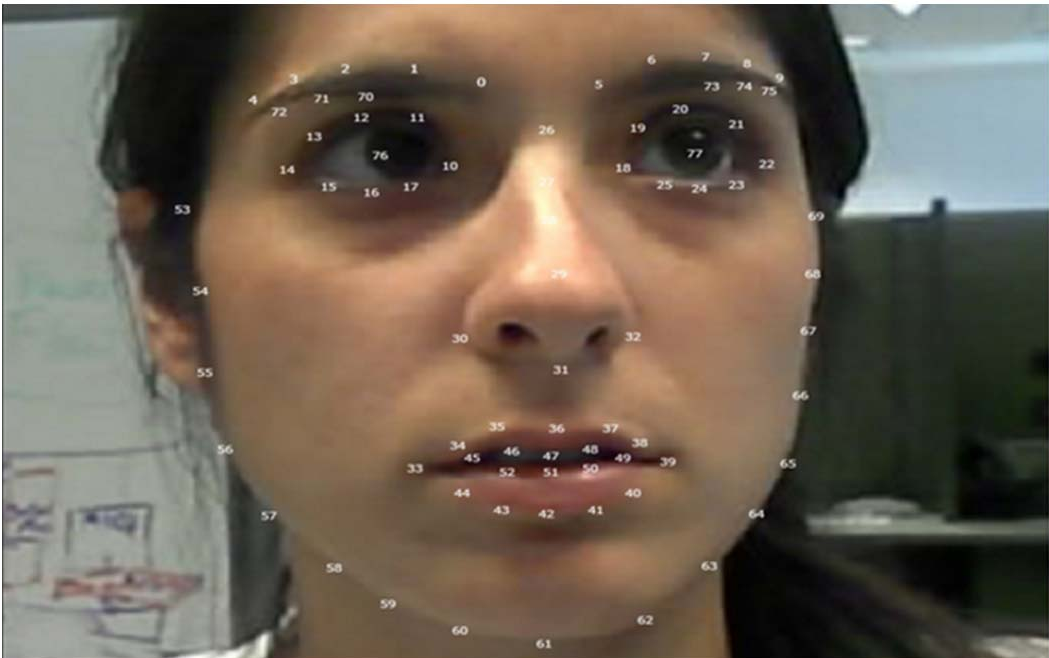 Figure 1: The 78-point landmark system used to map facial deformation.
2. Pain Categorization (SVM)
The system was trained on the UNBC-McMaster shoulder pain archive, a dataset containing nearly 50,000 frames of patients in actual pain. The authors mapped these results to the Prkachin and Solomon Pain Intensity Metric (PSPI).
To make the system practical for paramedics, the researchers simplified the metrics from a confusing 16-point scale into four actionable categories:
- None
- Mild
- Moderate
- Severe
Experiments & Results
The transition from 9 states of pain detection to 4 states was the "Aha!" moment for performance. While the 9-state model hovered at 78% accuracy, the 4-state model reached 90%.
Performance Analysis
The "Severe" pain category—the most critical for emergency triage—showed the highest reliability. As seen in the confusion matrix below, the model rarely confused severe pain for "None" or "Mild," ensuring that patients in critical distress are correctly identified.
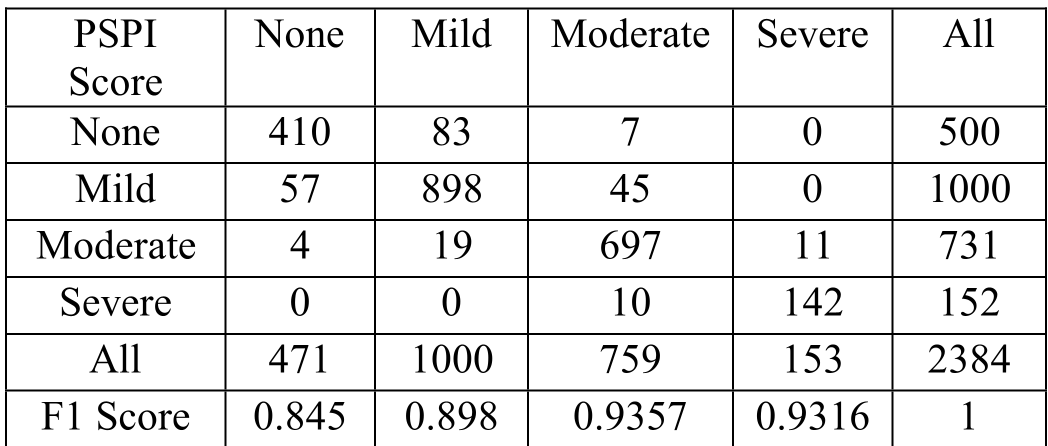 Table 1: Confusion Matrix showing high F1 scores specifically in the Moderate and Severe categories.
Real-Time Indicators
Beyond pain, the system monitors:
- Mouth/Eye status: Indicators of alertness or neurological trauma.
- Tongue detection: A specific indicator of verbal responsiveness.
- Agitation: Based on rapid head movements, identifying potential distress or dementia-related episodes.
 Figure 2: Prototype UI detecting "Mild" pain and "Tongue Out" status in a lab setting.
Critical Analysis & Future Outlook
While the results are promising, several hurdles remain:
- Environmental Lighting: The paper suggests that infrared capabilities need further testing in low-light emergency scenarios.
- Privacy/Ethics: Detecting patient demeanor via video raises significant data security concerns, particularly over 5G networks.
- Broadening the Scope: The authors suggest incorporating voice analytics in the future to supplement visual cues.
Conclusion: MAT is a significant step toward "Computer-Aided Triage." By shifting the cognitive load of pain assessment from the paramedic to an AI model, medical first responders can focus on intervention rather than interpretation.
Takeaway
The integration of 5G Mobile Edge Computing (MEC) and depth-sensing AI will likely make "Wearable Diagnostics" (like the BlueEye system mentioned in the paper) a standard part of the paramedic's toolkit in the coming decade.