
SVM-NN: Engineering a Hybrid Shield Against Social Media Bots
Detecting Fake Accounts on Social Media
This paper introduces SVM-NN, a hybrid machine learning algorithm designed to detect fake Twitter accounts and bots. By combining Support Vector Machines (SVM) with Neural Networks (NN) and applying rigorous feature selection, the method achieves a high classification accuracy of approximately 98% on the MIB dataset.
TL;DR
Social media "inhabitants" are no longer just humans; millions of bots influence elections and markets. This paper presents SVM-NN, a hybrid algorithm that stacks Support Vector Machines and Neural Networks. By feeding the probabilistic decision values of an SVM into a Neural Network, the researchers achieved a staggering 98.3% detection accuracy, effectively cleaning the noise from Twitter datasets.
Background & Motivation: The "Walled Garden" Crisis
Attackers view Online Social Network (OSN) accounts as "keys to walled gardens." Once inside, fake accounts (Imposters) and automated programs (Bots) steal data and manipulate public opinion.
The core challenge isn't just "finding the bots"—it's doing so efficiently. Previous researchers used massive feature sets (up to 16+ variables), many of which are redundant or even counter-productive. This paper identifies that standalone algorithms—while mathematically sound—often fall into local minima or struggle with the high-dimensional noise of social behavior.
Methodology: The Power of Hybridization
The authors didn't just throw more data at the problem; they re-engineered the decision pipeline.
1. Feature Reduction: Trimming the Fat
Using techniques like Spearman’s Rank-Order Correlation and Markov Blanket, they identified which features truly mattered. Interestingly, they found that Principal Component Analysis (PCA) actually hindered accuracy because it created linear combinations of noise, whereas direct feature selection preserved the "physical" meaning of user behavior (like the ratio of followers to following).
2. The SVM-NN Architecture
The heartbeat of the paper is the hybrid flow:
- Step A: Data is fed into an SVM with a Radial Basis Function (RBF) kernel.
- Step B: Instead of taking the binary "Real/Fake" output, the model extracts the Internal Decision Values (the distance from the hyperplane).
- Step C: These values are used to train a Neural Network.
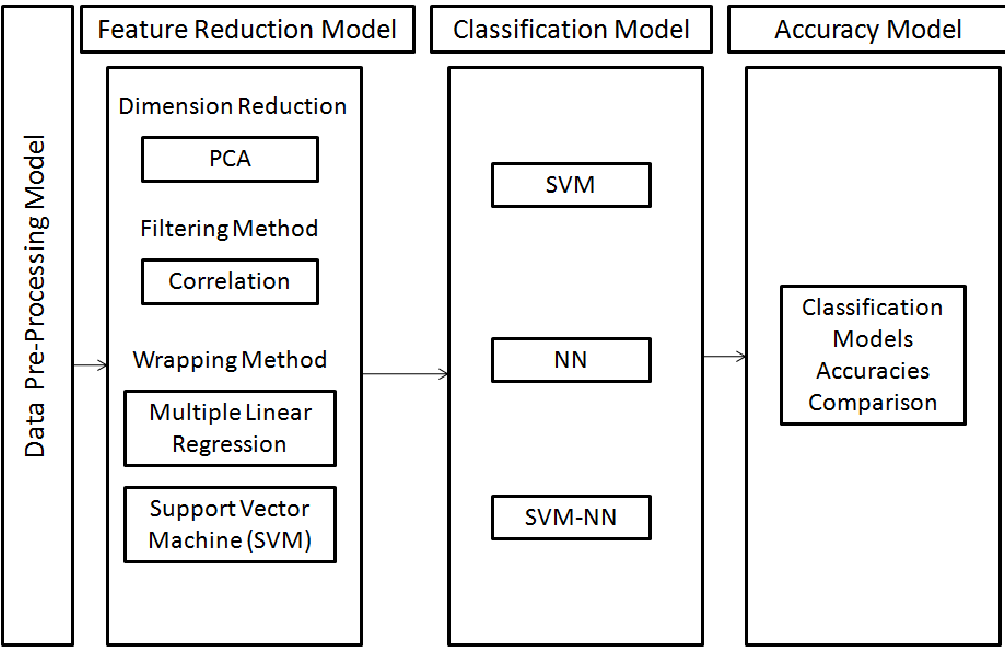 Figure: The design approach integrating data pre-processing, feature reduction, and the hybrid SVM-NN classifier.
Why it Works: Geometric Intuition
Why is SVM-NN better than a simple NN?
- SVMs are excellent at finding a "Global Minimum" in a high-dimensional space.
- NNs are prone to "Local Minima" but are superior at capturing non-linear patterns within specific segments of data. By using the SVM to define the primary boundary (geometry), the NN can focus on refining the complex edge cases that sit near that boundary.
Experimental Results: Breaking the 98% Barrier
The researchers tested their method against the MIB (Multi-platform Information Base) dataset.
| Feature Set | SVM Accuracy | NN Accuracy | SVM-NN Accuracy |
|---|---|---|---|
| Yang et al. | 0.886 | 0.737 | 0.912 |
| Correlation | 0.923 | 0.822 | 0.983 |
| Wrapper-SVM | 0.956 | 0.833 | 0.965 |
As shown in the table above, the Correlation-based SVM-NN achieved the highest performance. Standard Neural Networks struggled significantly (dropping as low as 65% accuracy with PCA), proving that for structured account data, "Deep Learning" isn't always the silver bullet—Smart Architecture is.
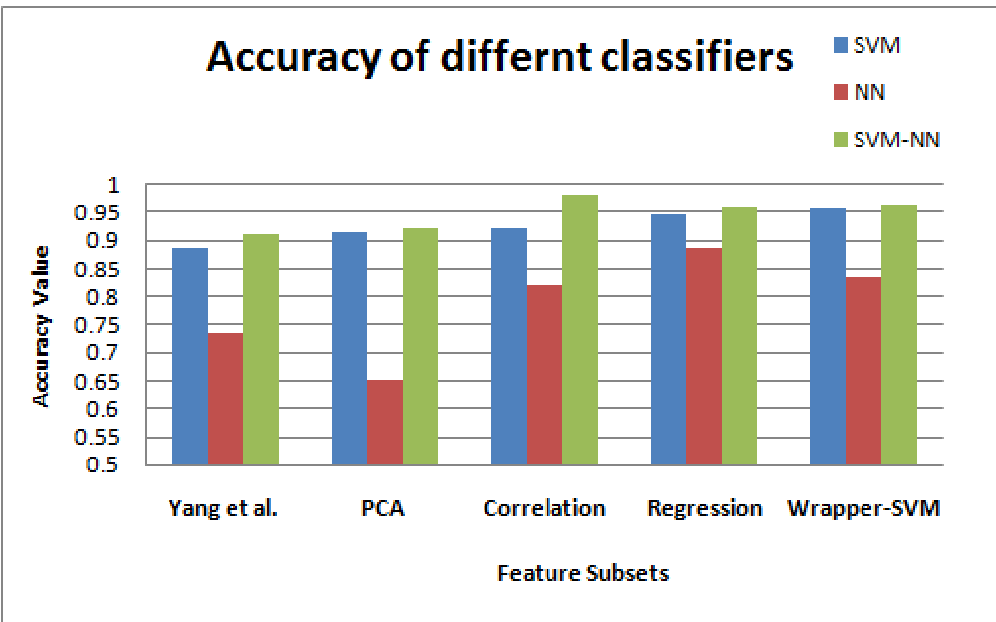 Figure: Comparison showing SVM-NN consistently outperforming standalone classifiers across all feature subsets.
Critical Insight & Conclusion
The biggest takeaway here is the disutility of PCA in this specific domain. While PCA is a staple of data science, in social media detection, it tends to blend "signal" and "noise" together. Pure feature selection, which identifies categorical "red flags" (like a 0% API URL ratio), remains superior.
Future Outlook: While 98% is impressive, the "arms race" between attackers and defenders continues. The next frontier involves Adversarial Machine Learning, where bots are trained specifically to mimic the feature distributions that the SVM-NN model considers "human."