
CMPA: Beating Misinformation Before It Goes Viral via Time-Constrained Monitoring
Detecting misinformation in online social networks before it is too late
The paper introduces the Time Constrained Misinformation Detection (TCMD) problem, aimed at placing a minimal set of monitors in Online Social Networks (OSNs) to detect cascades within a deadline. It proposes the IC-ED (Independent Cascade with Edge Delay) model and a network-compression-based solution (CMPA) to handle large-scale network topologies.
TL;DR
Information in social networks spreads like wildfire, but even fire takes time to travel between trees. This paper tackles the Time Constrained Misinformation Detection (TCMD) problem—finding the smallest number of "monitors" (users) needed to catch any fake news cascade before a specific deadline . By introducing a new delay-aware diffusion model and a clever network compression algorithm, the authors provide a scalable way to protect massive social networks.
The Problem: Timing is Everything
Most existing models assume information spreads in discrete rounds or at a constant speed. In reality, human behavior is "bursty"—we might ignore a message for hours then reply instantly. This creates heterogeneous edge delays.
The challenge is twofold:
- Mathematical Hardness: The authors prove TCMD is NP-hard and cannot be approximated within a specific logarithmic ratio in polynomial time.
- Scale: With millions of users, calculating every possible cascade path to place monitors is computationally impossible.
Methodology: IC-ED and Network Compression
The authors first propose the Independent Cascade with Edge Delay (IC-ED) model. Every edge has two values: a probability and a time delay .
To solve the placement problem at scale, they introduce a three-step framework:
- Graph Compression (GCA): Adjacent nodes are merged into "supernodes" if their diffusion patterns are similar. This reduces the graph size drastically while preserving "dissimilarity" metrics.
- Greedy Selection: Monitors are selected on this smaller, compressed graph to maximize the "marginal gain" in detection coverage.
- Solution Recovery: The "super-monitors" are mapped back to actual users in the original high-resolution network.
 Figure 1: The logic of merging nodes and into supernode while reassignment of probabilities and delays.
Experimental Insights
The researchers tested their approach on massive datasets, including Livemocha and BlogCatalog.
Key Findings:
- Superiority: The proposed CMPA (Compression based Monitor Placement Algorithm) consistently required fewer monitors than PageRank or Degree-based heuristics to achieve the same detection guarantee.
- The sparsity factor: In sparse networks like Gnutella, you need a high percentage of monitors because there are fewer "bottleneck" nodes to watch.
- Efficiency: On the Livemocha dataset (104k nodes), they achieved a 90% reduction in graph size in just 5 rounds of compression, making the optimization problem manageable.
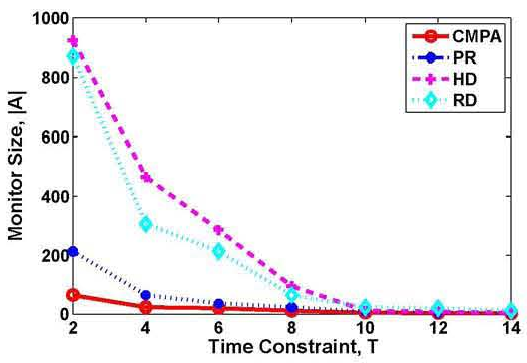 Figure 2: Performance comparison showing CMPA requiring significantly fewer monitors as the detection probability requirement () increases.
Critical Analysis & Conclusion
The true innovation here is the shift from "How do we detect it?" to "How do we detect it in time?". By treating time as a physical constraint rather than a byproduct, the model becomes much more realistic for real-world OSN intervention.
Limitations: The model assumes we can place a monitor on any node. In practice, recruiting users to act as monitors involves incentives and privacy concerns that aren't fully addressed here.
Future Outlook: This compression technique could likely be applied to other "budgeted" network problems, such as placing EV charging stations in a city or cache servers in a content delivery network (CDN).