
Beyond Hashtags: Unveiling Twitter Polarisation via Pseudo-Bimodal Networks
Detecting Opinion Polarisation on Twitter by Constructing Pseudo-Bimodal Networks of Mentions and Retweets
The paper introduces a "pseudo-bimodal" network approach to detect opinion polarisation on Twitter by artificially separating users into two modes based on PageRank. By projecting these bipartite structures back into unimodal networks, the authors achieve superior community detection and visual clustering in both retweet and mention networks compared to traditional hashtag or hyperlink-based methods.
TL;DR
This research presents a novel way to visualize political "wars" on Twitter by re-imagining how we look at mentions and retweets. Instead of treating all users as equals, the authors use a pseudo-bimodal projection method to separate influencers from the crowd. This technique reveals deep ideological divides in "mention" networks that were previously thought to be homogeneous.
The Problem: The "Messy" Middle of Twitter
In social network analysis, we often look for "communities"—groups of people who talk mostly to each other. In highly charged political events, like the 2011 Russian protests or US elections, you expect to see two clear camps.
However, traditional methods often fail:
- Mention Networks are "Noisy": Unlike retweets (which signal agreement), mentions often cross ideological lines for the sake of argument, making the graph look like a giant, inseparable blob.
- Hashtags and URLs are Shallow: Relying on specific hashtags (like #Trump or #Biden) ignores the vast number of users who use neutral language but still belong to a specific camp.
Methodology: The Pseudo-Bimodal Pivot
The researchers' "Aha!" moment was treating Twitter not as a single-layer network, but as a Bipartite (Two-Mode) Graph.
1. Identifying the "Top" Mode
They use PageRank to identify the "Opinion Leaders" (Top Users). These are nodes with high in-degrees—the politicians, celebrities, and media outlets that everyone talks about but who rarely talk back to the "ordinary" users.
2. Creating the Bipartite Split
The algorithm deletes all edges between two ordinary users and all edges between two top users. What remains is a Bipartite Graph where edges only exist between a top user and an ordinary user.
3. The Unimodal Projection
Using Newman’s projection method, they collapse this bipartite graph. Two ordinary users are now connected if they mention or retweet the same set of influencers. This "filters" the noise, as it groups people based on the objects of their attention.
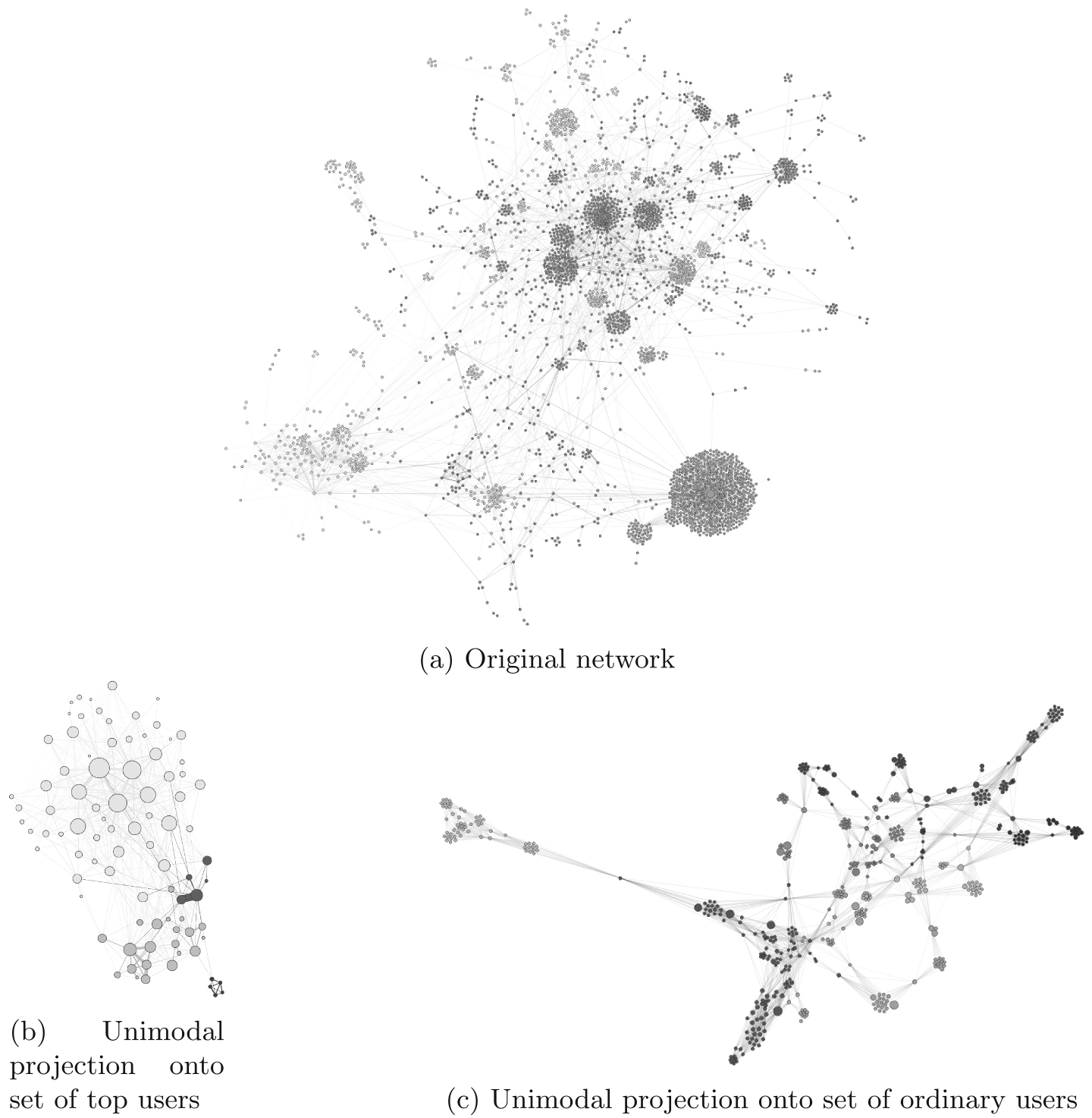 Figure: The projection process (k=100) demonstrates how top users influence the clustering of ordinary users.
Experiments & Results: Seeing the Divide
The authors tested their method on two major datasets: the 2011 Russian protest meetings and the 2010 US Midterm elections.
Key Findings:
- Mention Networks Transformed: Previously, mention networks had low modularity (around 0.17). With the pseudo-bimodal approach, they achieved much higher modularity scores, showing clear "pro-opposition" and "anti-opposition" clusters.
- Comparison to Hashtags: The modularity for hashtag networks was a dismal 0.122, proving that what people say (hashtags) is often less indicative of their tribe than who they interact with.
- Robustness: As shown in the graph below, even selecting a small number of "Top Users" drastically improves the modularity (separability) of the remaining network.
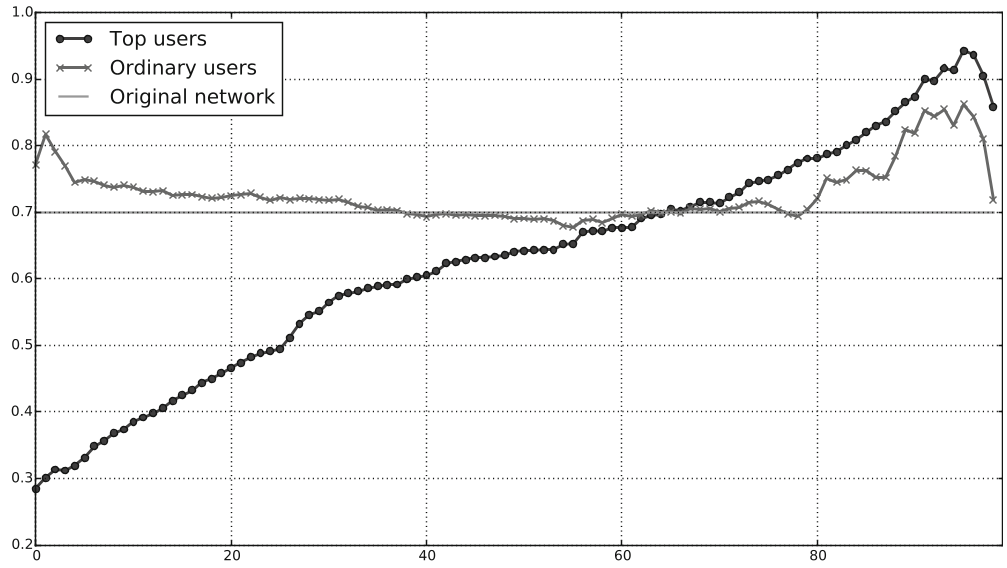 Figure: Modularity scores increase as we refine the top-user threshold, revealing the latent community structure.
Critical Insight & Conclusion
The brilliance of this work lies in its Inductive Bias: it assumes that in a polarized society, your "tribe" is defined by which "elites" you engage with.
Takeaway: If you want to see the true structure of a social conflict, stop looking at what people are saying. Look at who they are shouting at (mentions) and who they are amplifying (retweets) through the lens of influencer-driven bimodal projections.
Limitations: The study focuses on highly polarized political events. It remains to be seen if this "pseudo-bimodal" effect exists in more harmonious settings, like scientific discourse or fandoms, where influencers might be universally respected rather than divisive figures.