
PersonaWeb: Decoding Personality Traces from the Real-Time Social Stream
Detecting Personality Traces in Users’ Social Activity
The paper presents <b>PersonaWeb</b>, a Facebook-based application designed to implicitly extract and visualize user personality models in real-time. By mapping Facebook activities (likes, status updates, check-ins) to the "Big Five" personality traits based on prior psychological research, the system attempts to bridge the gap between social media behavior and psychometric profiling.
TL;DR
PersonaWeb is an innovative Facebook application that moves beyond offline data mining by providing real-time personality modeling. By authorized access to private activity metrics, it calculates Big Five personality scores and presents them alongside traditional test results. While it shows promise in identifying Extraversion and Conscientiousness, it uncovers the significant complexity of mapping digital "drifts" to internal psychological states.
Motivation: The Digital Mirror
Every "Like," "Share," and "Check-in" we perform online is a psychological footprint. While social scientists have long used surveys to connect these dots, and tech giants have used data mining for targeted ads, a gap remains: The User is left out of the loop.
The authors argue that a truly adaptive system should not just observe the user but provide a "digital mirror." The motivation of this study is to determine if existing social science theories can be successfully operationalized into a real-time computational engine that tells you who you are, based on what you do on Facebook.
Methodology: From Activity to Archetype
The researchers built a dual-phase framework focusing on Data Extraction and Model Derivation.
1. The Active Friend Insight
Standard metrics like "Friend Count" are often noisy. To refine the user model, the authors introduced the concept of "Active Friends"—contacts who interact significantly (at least 4 wall posts per year to exclude generic birthday wishes). This filters social noise to reveal genuine social clusters.
2. The Weighting Mechanism
The core of the PersonaWeb engine is a mapping table. Each activity is given a weight (0 to 1) and a direction (Positive or Negative).
- Extraversion: Positively linked to status updates, friend count, and frequent check-ins.
- Conscientiousness: Negatively linked to likes and status updates (implying these users are more task-oriented and spend less time on social maintenance).
- Neuroticism: Linked to fewer friends but higher "Like" activity as a means of social validation.

The formulas above show how trait values (ptv) are incrementally updated based on whether an activity (activity_ia) is positively or negatively correlated with the trait.
Experiments & Real-World Results
The study evaluated 62 users, comparing their survey-based "ground truth" with the app's implicit predictions.
Performance Metrics
The results were a mixed bag for psychological theory:
- Successes: Extraversion and Conscientiousness showed positive correlations. This suggests that "outward-facing" traits are easier to capture through digital volume and frequency.
- Challenges: Openness and Neuroticism actually showed negative correlations. This highlights a "Social Media Paradox"—for example, while neurotics might feel anxious, their online behavior might overcompensate, making them look different on a dashboard than they feel internally.
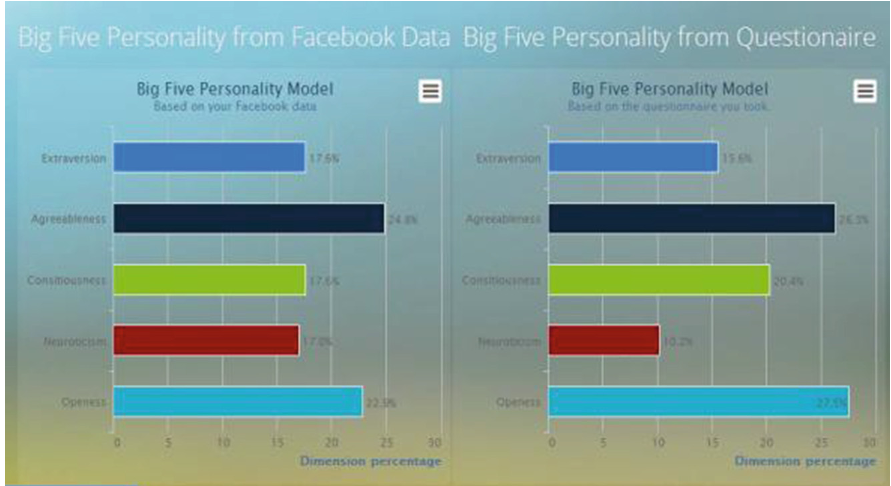 Figure: The app allows users to visually compare their predicted model (left) with their questionnaire result (right).
Critical Insight: The "Image" vs. The "Self"
One of the most profound takeaways from the evaluation was the qualitative feedback. Users felt the system accurately captured their "Like Activity Image" but noted that historical data (posts from years ago) often muddied the current personality model. This suggests that personality modeling must account for temporal decay—our digital footprints from 2015 might not reflect our Conscientiousness in 2024.
Conclusion
PersonaWeb represents a step toward transparent AI. By showing users how they are being modeled, it invites a dialogue between the algorithm and the individual. However, the study confirms that "Social Big Data" is not a silver bullet; without more refined weights and potentially NLP (Natural Language Processing) to understand the content of posts rather than just the count, digital personality modeling remains an evolving science.
Future Work: The authors point toward incorporating textual analysis and more granular weights to improve the accuracy of the more "internal" traits like Openness and Neuroticism.