
Decoding the Self: Objective Personality Detection via Brainwave Asynchrony
5490_Detecting Personality Traits Using Inter-Hemispheric Asynchrony of the Brainwaves.
This paper introduces an objective EEG-based method for detecting 16 distinct personality traits (from Dark Triad, BIS/BAS, and HEXACO models) by measuring inter-hemispheric asynchrony. Utilizing an SVM classifier on brainwave data evoked by affective image and video stimuli, the system achieves a peak classification accuracy of 95.49% for discretized trait levels.
TL;DR
Researchers have developed a highly accurate (95.49%) method to detect personality traits by measuring how "out of sync" the two hemispheres of our brain are. By analyzing EEG signals while subjects view emotional videos and images, the system can objectively identify traits from the Dark Triad, HEXACO, and BIS/BAS models, potentially replacing subjective and biassed self-report questionnaires.
Background: The Subjectivity Trap
Personality isn't just a social construct; it is a clinical roadmap. High scores in certain traits are proven risk factors for dementia, Parkinson's, and mortality. However, our current gold standard—self-reported inventories like the 25-item HEXACO—depends entirely on a subject's honesty and self-awareness. To move toward preventative healthcare, we need a "thermometer" for personality: an objective, physiological measure.
The Insight: Inter-Hemispheric Asynchrony
The core hypothesis of this study is that personality is etched into how the left and right hemispheres of the brain communicate. The authors focus on Inter-Hemispheric Asynchrony, defined as the correlation between spectral energy in symmetric brain regions.
Why does this work? Research suggests that traits like Agreeableness or Psychopathy are linked to structural and functional connectivity differences between hemispheres. By measuring the "lag" or "mismatch" in brainwave intensity (particularly in the Alpha band) when stimulated by emotions, we can build a unique "neural fingerprint" of a person's character.
Methodology: Eliciting the "Neural Self"
The researchers used a 14-channel wireless EEG headset on subjects exposed to two types of stimuli:
- IAPS Images: 50 images categorized from strongly negative to strongly positive.
- FilmStim Videos: Video clips designed to trigger specific emotions like fear, amusement, and disgust.
The Feature Engineering Pipeline
The EEG data was processed through a Discrete Fourier Transform (DFT) to extract power across seven bands (Delta to Gamma).
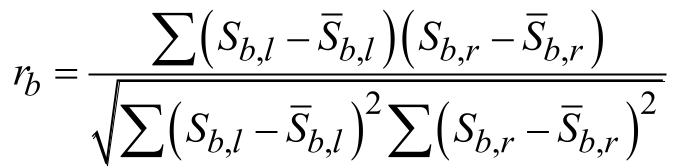
The researchers calculated the correlation () between channel pairs (e.g., AF3-AF4, F3-F4). A high correlation implies synchrony, while a low correlation implies asynchrony.
(Note: The workflow involves Stimulus → EEG Capture → Feature Extraction via DFT → ANOVA Selection → SVM Classification)
Results: A Multi-Modal Triumph
The study compared multiple classifiers (kNN, Logistic Regression, Naïve Bayes, and SVM). SVM (Support Vector Machine) emerged as the clear winner.
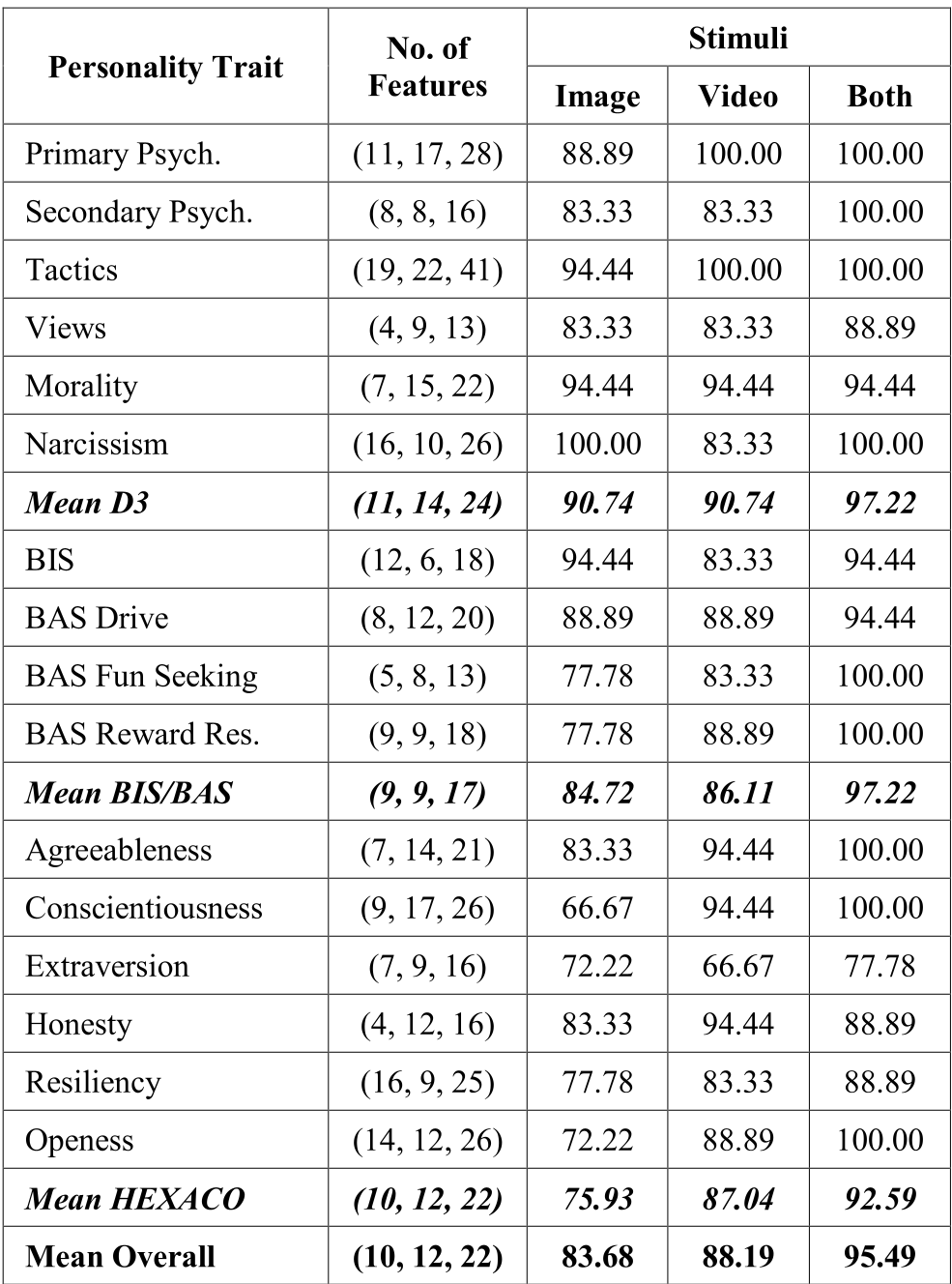
| Stimulus Type | SVM Accuracy |
|---|---|
| Image Only | 83.68% |
| Video Only | 88.19% |
| Combined (Image + Video) | 95.49% |
Key Breakthroughs:
- The Alpha Band Secret: 18.5% of all discriminative features came from the Alpha band (8-12 Hz). This confirms that Alpha waves are the primary carriers of personality-relevant neural information.
- Video > Image: Video stimuli provided higher accuracy than images, likely because the temporal nature of film allows for deeper emotional immersion and more authentic neural responses.
- Perfect Predictions: 9 out of 16 traits (including Narcissism, Psychopathy, and Conscientiousness) reached 100% accuracy when using the combined stimulus model.
Critical Analysis & Future Outlook
While the 95.49% accuracy is staggering, some academic caution is required.
- Sample Size: The study used a small cohort of 18 subjects. While Leave-One-Out Cross-Validation (LOOCV) is a standard practice for small datasets, scaling this to hundreds of participants is necessary to ensure the model generalizes across diverse populations.
- Discretization: The researchers simplified the problem by grouping scores into "Low, Medium, High." Real-world clinical utility would benefit from regression models that predict exact trait scores.
Conclusion: This work proves that the "asynchrony" of our brain's two halves is more than just noise—it's a window into our fundamental nature. By leveraging the Alpha band via EEG, we are moving closer to a future where mental health risks can be diagnosed as objectively as a blood test.