
Decoding Interpersonal Dynamics: Machine Learning for Personality Detection in Serious Games
Detecting Players Personality Behavior with Any Effort of Concealment
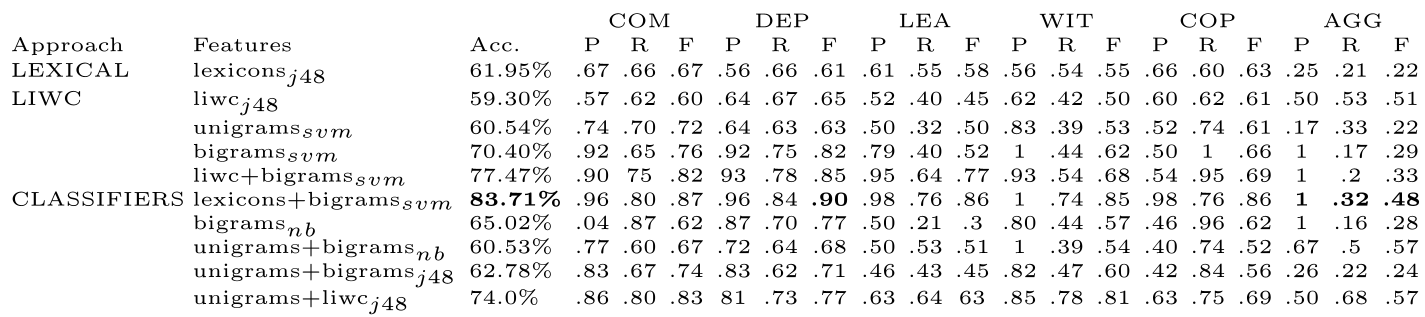
This paper presents an NLP component for predicting player personality behaviors within the "Land Science" serious game using the Leary’s Rose framework. By employing a multi-class SVM classifier with a fusion of Bigrams and Lexical features, the authors achieved an 83.71% classification accuracy across six personality traits (Competitive, Leading, Dependent, Withdrawn, Aggressive, and Helping).
TL;DR
Researchers have developed a high-accuracy system (83.71%) to detect player personality traits in the "Land Science" serious game. By mapping chat logs to Leary’s Rose framework, the model distinguishes between roles like "Leading," "Helping," or "Aggressive" using a strategic blend of sentiment lexicons and bigram analysis.
Background & Motivation: Why Chat Data Matters
In educational "serious games," understanding how players interact is crucial for mentors to provide appropriate guidance. However, identifying personality—behavioral patterns like dominance or cooperation—is notoriously difficult in text. Players might mask their attitudes, or their tone might shift depending on the group's vibe.
The authors identified that while psycholinguistic tools like LIWC are powerful, they often miss the "local context" of a conversation. They sought to bridge the gap between psychological theory (Leary's Rose) and computational linguistics.
Methodology: The Framework of Interaction
The study utilizes Leary’s Interpersonal Circumplex, which visualizes personality on two axes:
- Above-Below: Dominance vs. Submission.
- Opposed-Together: Rebellious vs. Cooperative.
Feature Engineering
The researchers didn't just look at what words were said; they looked at the psychological payload behind them.
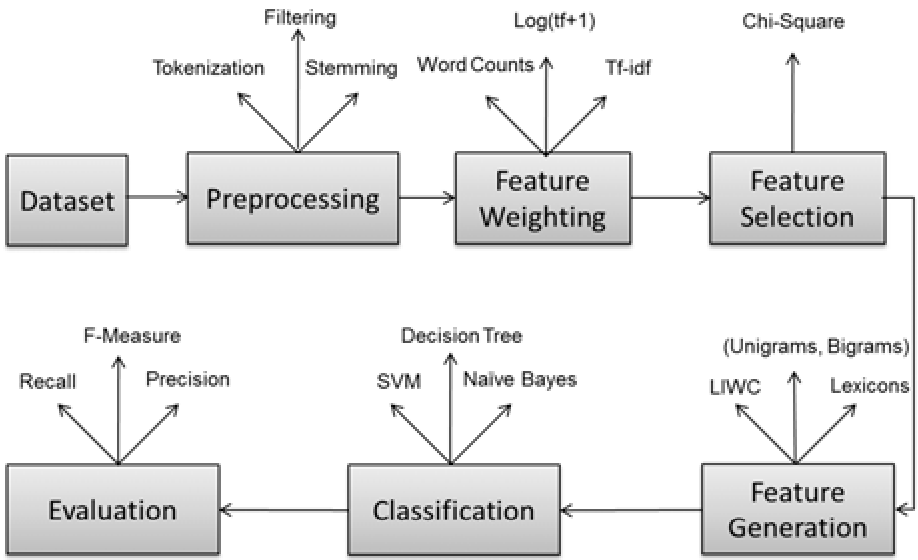
- Psycholinguistic (LIWC): 80 dimensions covering social, emotional, and cognitive processes.
- Sentiment Lexicons: Utilizing four different resources (e.g., SentiWordNet) to compute weighted polarity scores.
- N-Grams: Capturing the context that single words miss (e.g., distinguishing "no need" from "need to").
Experiments & Results
The study compared Naïve Bayes, J48 Decision Trees, and Support Vector Machines (SVM).
Key Findings:
- SVM Dominance: The SVM classifier using
LEXICONS + BIGRAMSachieved the highest accuracy (83.71%). - N-Grams vs. LIWC: Interestingly, simple Bigrams often outperformed LIWC. This suggests that in fast-paced game chats, specific word sequences (context) are more indicative of personality than broad psychological categories.
- The "Aggressive" Challenge: The model struggled slightly with "Aggressive" behaviors (low recall), primarily because students tend to be more polite when they know a mentor is watching—a phenomenon essentially creating an imbalanced dataset.
Deep Insight: The Overlap of Roles
One of the most fascinating findings in the paper is the linguistic similarity between "Helping" and "Aggressive" behaviors. Both personalities frequently use phrases like "you need to" or "do this." The difference lies in the nuance—"Helping" uses it as guidance, بينما "Aggressive" uses it as an ultimatum. This reinforces why context-sensitive features (Bigrams) are mandatory for this task.
Critical Analysis & Conclusion
This work successfully demonstrates that personality detection doesn't require complex prosody or video; structured natural language contains enough signal to categorize complex human behaviors.
Limitations
- Data Scale: The study used 1,000 manually annotated excerpts. In the age of Deep Learning, a larger dataset could likely push these boundaries further.
- Environment Bias: Being a professional simulation, the "Aggressive" and "Withdrawn" labels were underrepresented.
Future Outlook
The authors suggest moving towards the Big-Five personality model. As AI mentors become more common in virtual environments, the ability to detect an "Introverted" vs. "Extroverted" learner in real-time will allow for much more personalized and effective educational interventions.