
Pruning the Tree of Knowledge: A Hybrid Approach to Protein-Protein Interaction
Detecting Protein-Protein Interactions in Biomedical Texts Using a Parser and Linguistic Resources
The paper presents a hybrid system for detecting Protein-Protein Interactions (PPI) in biomedical literature using syntactic dependency parsing and a novel linguistic resource called "transparent words." By combining manually disambiguated syntactic paths from the GENIA corpus with machine-learning-assisted lexical filtering, the system achieves a loose precision of 80.5% on the IntAct corpus.
TL;DR
Extracting protein-protein interactions (PPI) from the vast sea of biomedical literature is a needle-in-a-haystack problem. This paper proposes a hybrid methodology that leverages Dependency Parsing and a curated list of "Transparent Words" to distill meaningful biological signals from complex sentences. The system achieves a high precision of over 80%, demonstrating that linguistic intuition—specifically how we shorten and simplify syntactic paths—is key to overcoming data sparseness.
Problem & Motivation: The Precision-Recall Paradox
In the world of BioNLP, we typically see two extremes:
- Co-occurrence Baselines: If Protein A and Protein B are in the same sentence, they might interact. This is great for recall but disastrous for precision (39.2% in this study).
- Handcrafted Rules: "A activates B" is a clear interaction. However, human language is messy. Writers use appositions, conjunctions, and complex nested clauses that these rigid rules miss.
The authors argue that the middle ground lies in Syntactic Paths. By looking at the dependency tree between two protein mentions, we can capture the structural relationship. But there's a catch: the "Sparse Data" problem. Using the entire path is too specific (low recall); using only labels is too vague (low precision).
Methodology: The Power of "Transparent Words"
The core innovation is the treatment of the syntactic path as a single feature, refined by linguistic insights.
1. Syntactic Path Extraction
Using a dependency parser, the system finds the lowest common ancestor of two proteins and records the path. To prevent the path from becoming too specific, the authors only keep the head lemma of the top node and the grammatical labels (e.g., subjects, objects, or prepositions).
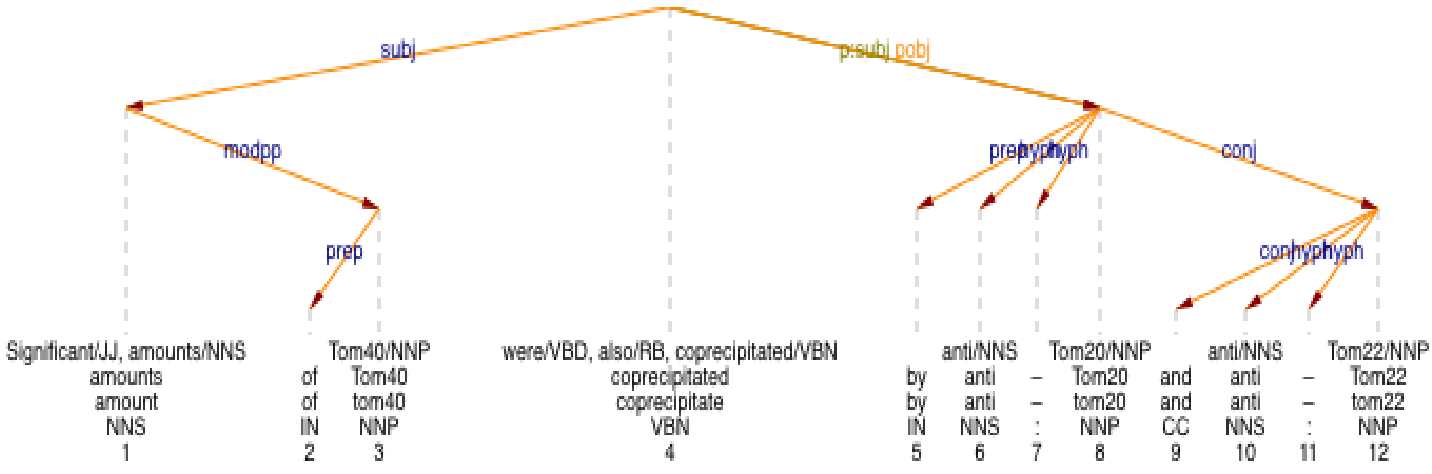 Figure 1: Dependency parse tree showing the path between proteins like Tom40 and Tom20.
2. The Concept of "Transparency"
The authors identified a class of Transparent Words—nouns that don't block the semantic flow of an interaction. For example, in the phrase "A activates the production of B", the word "production" is transparent; the core interaction is still between A and B.
The system uses these words to:
- Shorten paths: If a protein is inside a noun chunk headed by a transparent word, the protein replaces the head.
- Prune trees: Parts of the tree headed by transparent words are cut to simplify the connection.
Experiments & Results: Precision over Bulk
The system was trained on fragmented GENIA corpus data and applied to the IntAct corpus.
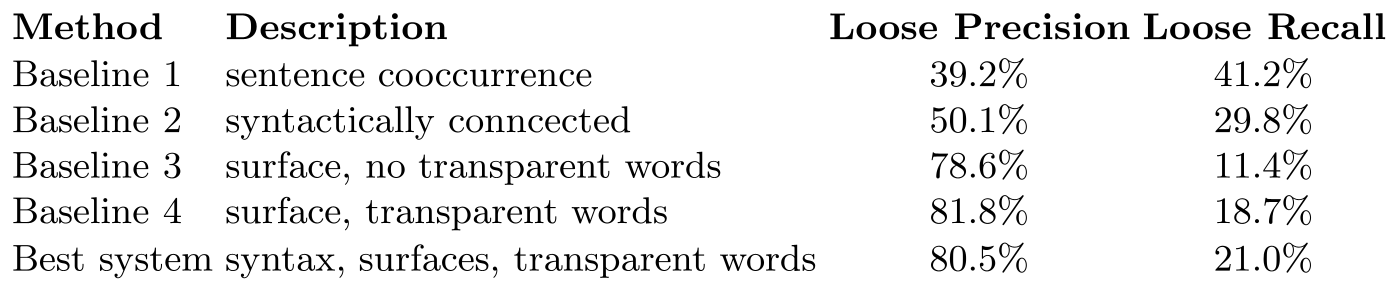 Table 1: Step-wise performance improvement compared to baselines.
Key Findings:
- Precision Gains: While a simple sentence co-occurrence (Baseline 1) only yields 39.2% precision, the Best System jumps to 80.5%.
- The Impact of Transparency: Adding transparent words to surface-level patterns (Baseline 4) actually yielded higher precision (81.8%) than the initial full-syntax approach (Baseline 2). This highlights that lexical "noise" is often a greater hurdle than structural complexity.
- Back-off Strategy: The system utilizes a hierarchy: it first checks for a known syntactic path; if none exists, it looks for "same chunk" relationships, and finally falls back to surface keywords (e.g., "A binds B").
Critical Analysis & Conclusion
Takeaway
The study proves that path-based features are robust for PPI when combined with a smart filtering mechanism. The introduction of "transparent words" is a powerful heuristic for collapsing complex biological descriptions into their functional core.
Limitations
- Recall Ceiling: The system is heavily dependent on the quality of initial term recognition. If the protein tagger misses a name, the interaction logic never fires.
- Manual Effort: The classification of 2,500 syntactic paths required manual annotation, which, while more scalable than writing rules, still presents a bottleneck for wider domain adaptation.
Future Outlook
As the field moves toward deep learning, the "transparent word" insight remains relevant. Modern attention mechanisms often "fixate" on these same lightweight nouns; explicitly incorporating these linguistic biases into neural architectures could further enhance the precision of biomedical relation extraction.