
Breaking the Ambiguity: A Hybrid Approach to Semantic Relation Classification
Detecting Semantic Relations Between Nominals Using Support Vector Machines and Linguistic-Based Rules
This paper presents a hybrid system for detecting semantic relations between nominals (e.g., Cause-Effect, Product-Producer) by combining Support Vector Machines (SVM) with linguistically motivated rules. The system integrates lexical, morpho-syntactic, and semantic features to achieve a significant performance boost over pure machine learning baselines across multiple categories in the SemEval-2007 benchmark.
TL;DR
Semantic relations between nouns (like "is the cause of" or "is made by") are notoriously difficult for machines to grasp due to their high context dependency. This paper introduces a hybrid model that marries the statistical power of Support Vector Machines (SVM) with the precision of expert linguistic rules. By injecting domain-specific knowledge—such as WordNet synsets and syntactic patterns—the researchers achieved up to a 15% accuracy boost over standard machine learning techniques, setting a new benchmark for tasks like Part-Whole relation detection.
The Semantic Challenge: Why Machine Learning Isn't Enough
Identifying whether "tea" and "jug" in the sentence "Put tea in a heat-resistant jug" represent a Content-Container relation sounds easy for humans, but it’s a minefield for algorithms. The primary hurdles are:
- Syntactic Ambiguity: The same syntactic structure can represent different semantic meanings.
- Context Sensitivity: Meaning is often governed by underlying semantic properties (e.g., an object vs. an activity) rather than just word order.
- Data Scarcity: Benchmark datasets like SemEval-2007 provide limited training samples, making it hard for pure statistical models to generalize effectively.
Methodology: Marrying SMO-SVM with Linguistic Logic
The authors developed a two-pronged system designed to handle these complexities.
1. The Statistical Engine: SVM with SMO
They utilized a Support Vector Machine trained via Sequential Minimal Optimization (SMO). The feature set was comprehensive, encompassing:
- Lexical & POS Features: Lemmas, word tokens, and Part-of-Speech tags of the nominals and their surrounding context.
- Semantic Depth: Synset numbers and lexical file numbers from WordNet, including a custom 13-dimension "WordNet vector" representing ancestral nodes to help the model generalize to unseen data.
2. The Rule-Based Refiner
Parallel to the SVM, the authors hand-crafted rules based on four categories:
- Semantic Rules: E.g., If the "Cause" is a "Person" or "Animal," the Cause-Effect relation is likely False.
- Lexico-Semantic Rules: Identifying specific tokens like "after" which might suggest frequency rather than causality (e.g., "frustration after frustration").
- Morphosyntactic Rules: Using POS sequences to identify patterns.
- Complex Rules: Handling nuances like passive voice, which can negate "Agency" in Instrument-Agency relations.
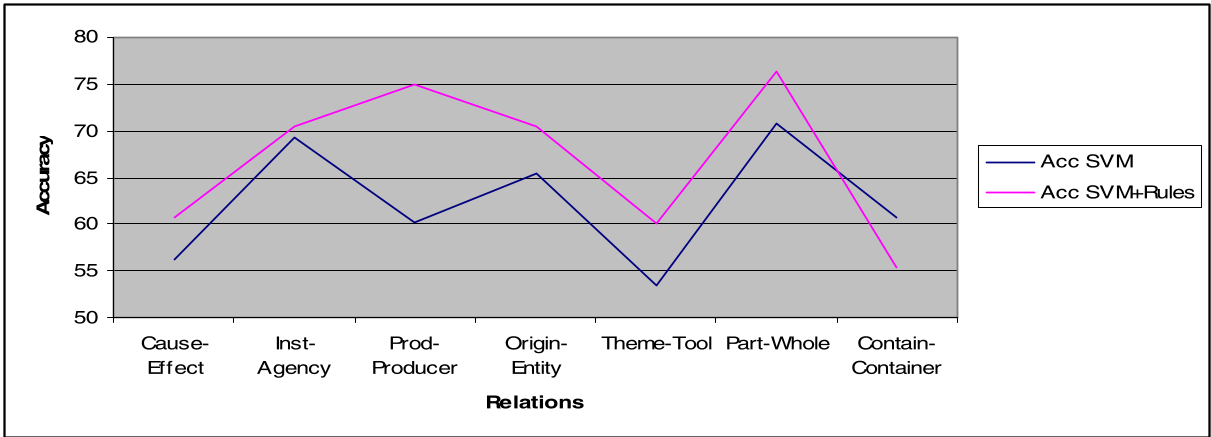 (Note: The graph illustrates the consistent accuracy gains when rules are applied atop the SVM base.)
Experimental Results: The Power of Hybridization
The results across seven semantic relations proved the authors' hypothesis: linguistic constraints provide a vital safety net for statistical classifiers.
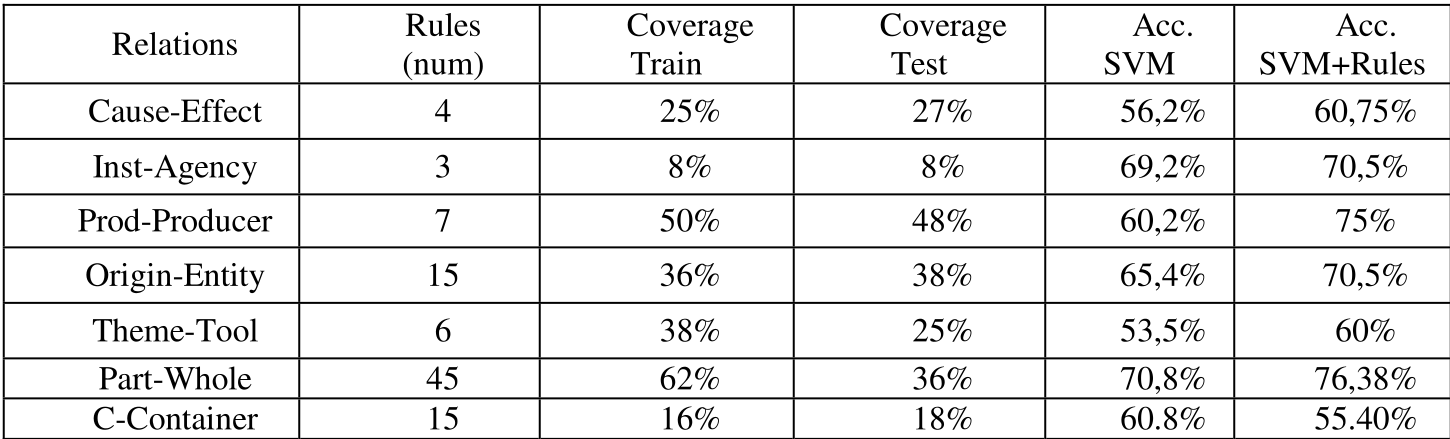
| Relation | SVM Accuracy | Hybrid (SVM + Rules) | Improvement |
|---|---|---|---|
| Product-Producer | 60.2% | 75.0% | +14.8% |
| Part-Whole | 70.8% | 76.38% | +5.58% |
| Cause-Effect | 56.2% | 60.75% | +4.55% |
The most dramatic improvement occurred in the Product-Producer category. The rules here successfully captured transitive verb patterns (make, produce, create) and applied constraints (e.g., a "Product" cannot be a "State" or "Time"), leading to a massive 15% jump in accuracy. Interestingly, the only decline was in "Content-Container," suggesting that some relations are too volatile for rigid rule sets.
Deep Insight: Why Why This Matters for the Future
The core takeaway of this research is the Inductive Bias provided by human language structure. While modern LLMs often learn these patterns implicitly, this paper illustrates a transparent, interpretable way to resolve ambiguity.
By using WordNet as a grounding mechanism, the authors proved that the "depth" of a word in a semantic hierarchy is a potent feature for machine understanding. For future applications—such as Question Answering (e.g., "What are the components of aspirin?") or Ontology Building—integrating these structured linguistic "guardrails" ensures that even when the specific context is new, the underlying semantic logic remains sound.
Conclusion
The collaboration between machine learning and linguistic expertise remains a high-value strategy. While SVMs provide the capacity to capture complex patterns in data, human-authored rules provide the precision necessary to master the nuances of human semantics. As we move toward more autonomous AI, the lessons from this hybrid approach—emphasizing transparency and linguistic grounding—remain more relevant than ever.