
Beyond Keywords: Detecting Social Anxiety through the Lens of Online Behavior
Detecting Social Anxiety with Online Social Network Data
This study proposes a machine-learning framework for the automatic identification of Social Anxiety Disorder (SAD) using online social network (OSN) data. By integrating behavioral, topological, and psychological features, the researchers achieved an F1-score of 0.794 using a One-class SVM approach, significantly outperforming traditional supervised baselines in imbalanced scenarios.
TL;DR
Early intervention for Social Anxiety Disorder (SAD) is often hindered by the "invisible" nature of the condition. This research breaks new ground by moving beyond simple text analysis, using One-class SVMs and behavioral features (like parasocial relationships and self-disclosure) to identify SAD patients with a high degree of accuracy (F1-score of 0.794) even when clinical data is scarce.
The "Linguistic Trap" in Mental Health AI
Most AI research in mental health focuses on Depression, primarily because it leaves a loud linguistic trail—specific keywords, repetitive negative sentiments, and distinct patterns of "I-talk."
Social Anxiety Disorder (SAD) is different. SAD patients often suffer in silence or adjust their online presence to avoid scrutiny. Traditional models that look for "sad words" fail here. The authors argue that to catch SAD, we must look at the digital architecture of shyness: how often someone logs on, how they interact with others they don't know (parasociality), and the types of visual media (stickers vs. selfies) they use to hide or reveal themselves.
Methodology: Tuning into the Digital Pulse
The researchers collaborated with mental health professionals to ground-truth a dataset of 200 OSN users. The core innovation lies in their Feature Engineering, which translates psychological symptoms into digital metrics:
- Parasocial Relationships: Measuring asymmetric connections where a user follows many but is followed/interacted with by few—a proxy for online loneliness.
- Self-Disclosure Proxies: Analyzing the use of stickers, emoticons, and selfies as indicators of how comfortable a user is with expressing their identity.
- Temporal Patterns: Tracking "anxious" log-on/log-off rhythms and message bursts.
(Note: This diagram illustrates the pipeline from OSN data crawling to psychological proxy feature extraction and One-class SVM classification.)
Why One-class SVM?
In the real world, SAD patients are a minority (approx. 12-17% in this study). Traditional classifiers (like standard SVM) often get "lazy" and classify everyone as healthy to achieve high nominal accuracy, resulting in a zero recall for actual patients.
By using One-class SVM, the authors flipped the script:
- They modeled what a "Normal User" looks like.
- Anyone falling significantly outside this multidimensional "norm" is flagged as a potential SAD case.
- This outlier-detection strategy proved robust against the data imbalance that usually kills clinical AI models.
Experimental Showdown
The results highlight a dramatic gap between standard machine learning and specialized anomaly detection:
| Method | Precision | Recall | F1-Score |
|---|---|---|---|
| One-class SVM | 0.658 | 1.000 | 0.794 |
| Ensemble | 0.691 | 0.700 | 0.694 |
| Standard SVM | 0.000 | 0.000 | 0.000 |
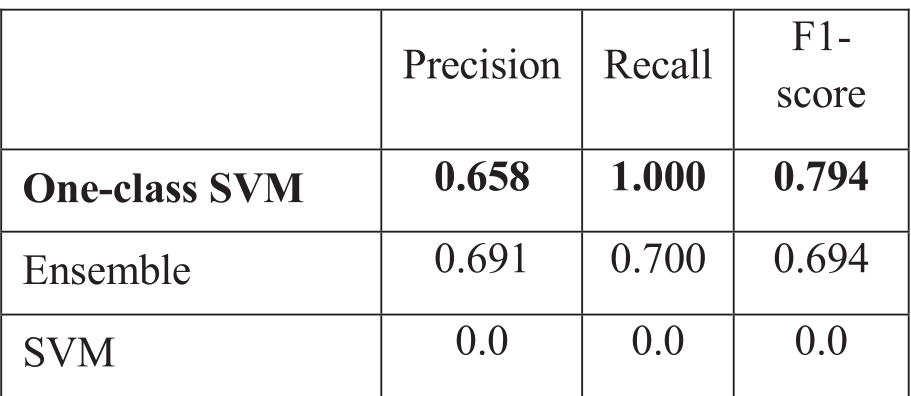
The 100% recall of the One-class SVM is particularly vital in a medical context; it ensures that no potential patient is missed, even if it requires a secondary human screening to filter out a few false positives.
Critical Insight & The Road Ahead
This work shifts the paradigm from Content Analysis (what you say) to Contextual Analysis (how you exist online).
Limitations: The study relies on a relatively small sample (200 users) and focuses on Facebook. In an era of TikTok and Instagram, "Self-Disclosure" metrics might need to evolve to account for video-based anxiety or "performative" online personas.
Future Outlook: The authors suggest moving toward network intervention—using these insights to automatically form support groups or deliver subtle therapy prompts to those flagged by the system. This bridges the gap between passive detection and active digital therapeutics.
Index terms: Social Anxiety Disorder, Mental Disorder Detection, One-class SVM, Behavioral Feature Mining.