
Detecting Social Positions: Leveraging Simulation for Advanced SNA
Detecting Social Positions Using Simulation
This paper introduces the "Simulation Relation" from computer science to Social Network Analysis (SNA) for identifying social positions and roles. It proposes using simulation equivalence and preorder as a less restrictive alternative to regular equivalence, specifically optimized for weighted directed networks in military intelligence contexts.
TL;DR
In the world of Social Network Analysis (SNA), identifying "who is who" in a sea of data is a monumental task. This paper proposes a transition from strict mathematical symmetry to a more flexible Simulation Relation. By moving beyond the rigidity of regular equivalence, the authors provide a method to collapse massive, complex networks—like terrorist cells or corporate hierarchies—into manageable abstractions that preserve the "behavioral traces" of the original system.
Background: The Problem with Mathematical Perfection
Traditionally, researchers used Regular Equivalence (known in CS as bisimulation) to find social roles. In this model, two people are equivalent only if they communicate with equivalent people in exactly the same way.
The catch? It's too sensitive. If two "neighborhood bullies" act identically, but one bully decides to rob a kid in addition to scaring them, regular equivalence immediately treats them as entirely different social roles. In a military intelligence setting, this leads to "fragmented intelligence" where the overarching structure is lost in the noise of minor behavioral differences.
The Core Insight: Simulation is "Good Enough"
The authors argue that we should care about Simulation, not just equivalence.
- Logic: If Actor A "simulates" Actor B, it means Actor A can do everything B can do (and possibly more).
- Insight: This creates a partial order (a hierarchy). Instead of looking for perfect clones, we look for individuals who can "replace" or "dominate" others in terms of their connectivity and influence.
Theoretical Comparison
| Feature | Regular Equivalence | Simulation Equivalence |
|---|---|---|
| Strictness | High (Exact match required) | Moderate (Inclusive of "more" capability) |
| Weighted Support | Weights must be identical | Weights must be ≥ the target |
| Practicality | Leads to many tiny groups | Leads to fewer, functional groups |
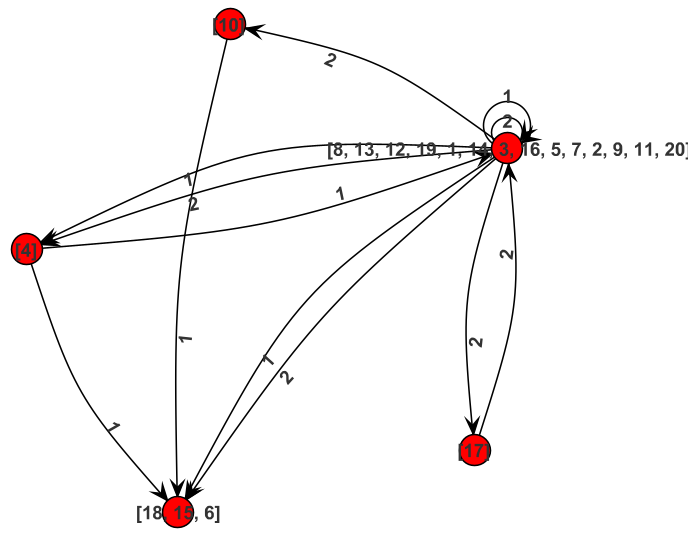 Fig 1: A weighted communication network before reduction.
Methodology: From Graphs to Abstractions
The authors extend these concepts to Weighted Directed Networks. In these graphs, edges aren't just 1s and 0s; they represent communication intensity (e.g., Phone calls = weight 2, Emails = weight 1).
- Define Weighted Simulation: Actor simulates if for every communication , there exists where the tie weight from is at least as strong as that of , and simulates .
- Aggregation: Group all actors who simulate each other into "Social Positions."
- Abstraction: Remove non-maximal actors—those who can be completely simulated by someone else—leaving only the "key players" who provide unique communication signatures.
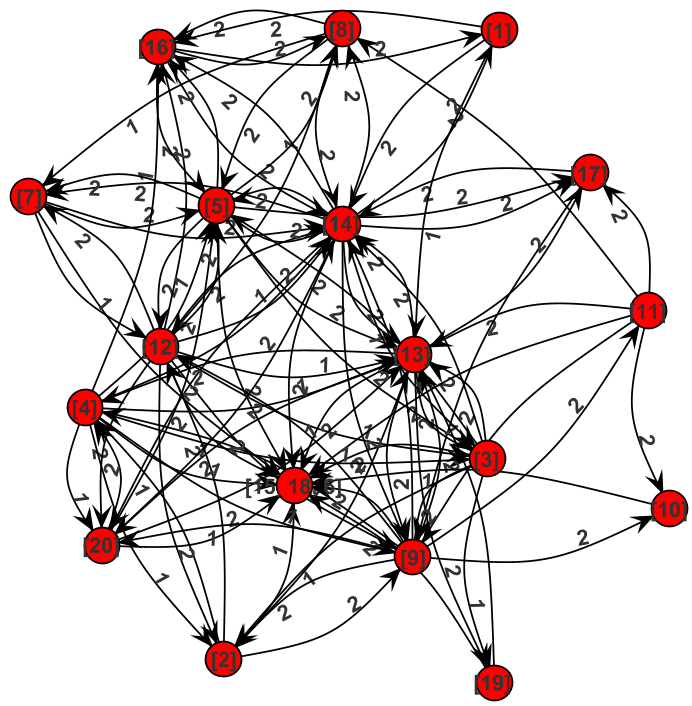 Fig 2: The network condensed via Simulation Equivalence. Note the significantly reduced complexity compared to the original.
Results: A Real-World Test
The researchers tested their method on a communication network of 20 researchers.
- Regular Equivalence was a failure for visualization, resulting in 18 classes (essentially no reduction).
- Simulation Equivalence performed better, resulting in 5 classes.
- Simulation Preorder Abstraction collapsed the entire department into 1 single node.
While a single-node result might seem extreme, it highlights a profound truth: in a specialized research group where everyone is a "scientist" and shares similar duties, the functional roles are redundant. One "scientist" node can simulate the communication pattern of the whole group.
Deep Insight & Conclusion
This paper shifts the paradigm of SNA from "finding identical nodes" to "finding functional dominance." For military intelligence, this is a game-changer. It allows analysts to:
- Detect Redundancy: Who is the backup for a leader?
- Identify Vulnerability: Which nodes cannot be simulated and are "critical points of failure"?
- Visual Clarity: Focus on the 5% of actors that define the organization's behavior rather than the 95% who are subordinates.
Future Outlook: The next frontier involves Uncertain Data. In real-world intelligence, we rarely know for sure if a link exists. Applying these simulation relations to probabilistic graphs will be the key to unlocking "Grey Zone" intelligence.