
Beyond Spammers: Message-Level Spam Detection for Sina Weibo
Detecting Spam in Chinese Microblogs - A Study on Sina Weibo
This paper introduces a machine learning-based framework specifically for detecting spam on Sina Weibo, the leading Chinese microblogging platform. Unlike prior methods that focus on identifying "spammer accounts," this approach detects spam at the individual message level using a combination of lexical, status, and user features to capture malicious content posted even by verified or normal users.
TL;DR
As social media ecosystems evolve, spam is no longer just the product of "bot accounts"; even verified users can be sources of malicious content. This paper presents a specialized machine learning framework for Sina Weibo that detects spam on a per-message basis. By focusing on Chinese-specific lexical features and message status indicators, the authors achieve a 95% accuracy rate using Support Vector Machines (SVM).
The "Verified Spammer" Paradigm Shift
Historically, spam detection was binary: you identify the spammer and block the account. However, the authors observed a troubling trend on Sina Weibo: normal users and popular verified users (those with over 100,000 followers) were posting or reposting advertising and malicious links.
In their dataset, nearly 34% of spam messages came from these "trusted" accounts. This renders account-level blocking ineffective and even harmful to user retention. The solution? Analyze the message, not just the messenger.
Methodology: Capturing the "look" of Chinese Spam
The authors treat spam detection as a binary classification problem. The core innovation lies in the feature engineering designed for the Chinese language and the Weibo interface.
1. Feature Categories
- Lexical Features: Since Chinese doesn't use spaces between words, the authors utilize character-based N-grams (unigrams, bigrams, and trigrams) to capture word-level patterns without needing complex segmentation.
- Status Features: These are metadata "tells." Spam Weibos are statistically longer, contain more external URLs, and frequently hijack trending hashtags (#topics#) to gain visibility.
- User Features: Basic metrics like follower/followee counts are included, though social graph analysis is intentionally avoided to keep the model focused on the content itself.
2. Model Architecture
The researchers compared three classic algorithms: Naive Bayes (fast and simple), Logistic Regression (robust for high-dimensional text), and SVM.
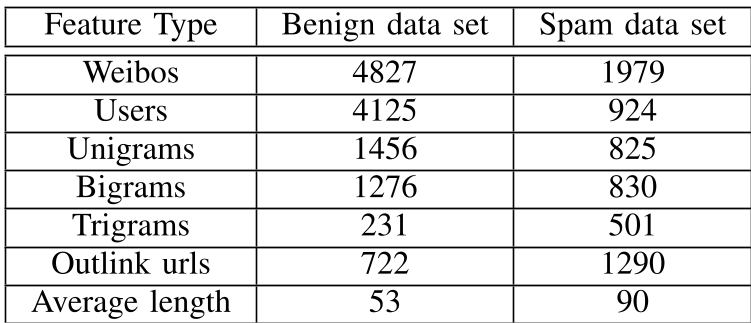 Table 1: Data statistics showing that spam messages have significantly higher URL density and nearly double the average length of benign posts.
Experimental Insights
The study involved 4,827 benign and 1,979 spam Weibos. By testing different feature combinations, the authors reached a surprising conclusion: User features actually decreased performance.
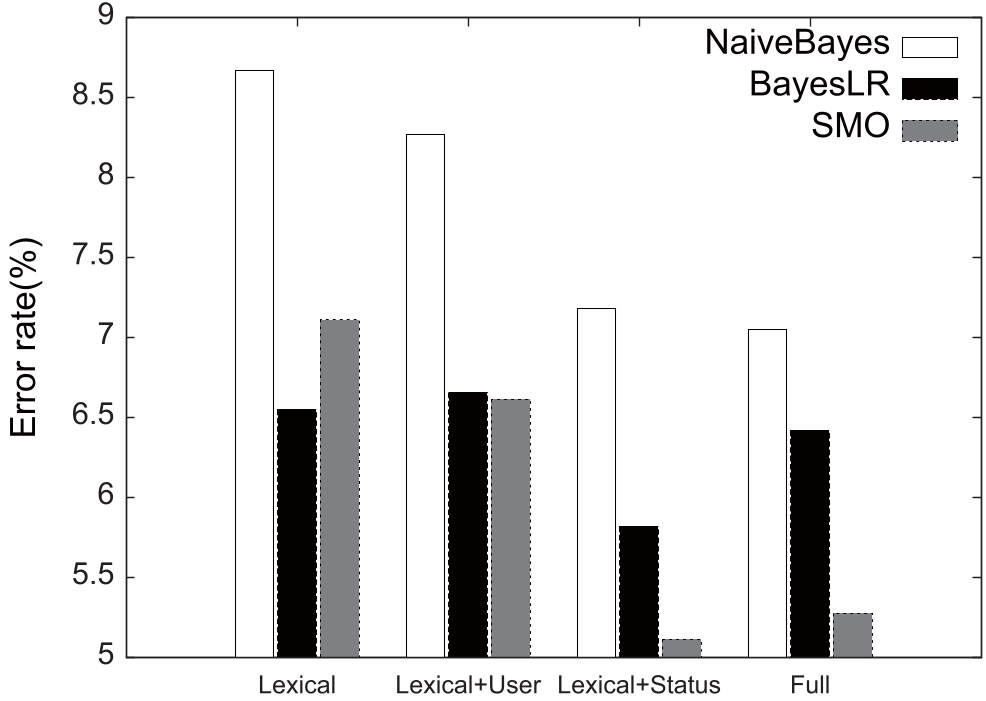 Figure 3: SVM (SMO) consistently outperformed other models, especially when combining Lexical and Status features.
Key Findings:
- The Winner: SVM + Lexical + Status features achieved an error rate of ~5%.
- The Insight: Status features (URLs, hashtags, length) provide a massive boost to accuracy. If a Weibo is long and contains an external link, the probability of it being spam increases significantly.
- Efficiency: Despite the high dimensionality of N-gram vectors, the model remains lightweight enough for real-time application compared to heavy graph-based methods.
Critical Analysis & Future Outlook
While this work laid the foundation for Chinese-specific spam detection, it faces limitations in the modern era of AI. The reliance on N-grams cannot capture the semantic intent or "hidden" spam where attackers use homophones to bypass keyword filters—a common tactic in Chinese social media.
Furthermore, today's spam is often multi-modal, involving text embedded in images or videos. However, the author's insight—that message-level detection is more critical than account-level blocking—remains the gold standard for modern content moderation systems.
Conclusion
This study successfully transitioned Sina Weibo spam detection from "who is the sender" to "what is the content." For researchers today, it serves as a reminder that understanding specific platform mechanics (like Weibo's unique hashtag usage) and linguistic nuances (N-gram vs. Segmentation) is just as important as the algorithm itself.