
Unmasking the Polluters: How Behavioral Signals Expose YouTube Spammers and Promoters
Detecting spammers and content promoters in online video social networks
This paper presents a supervised learning framework to detect "spammers" and "content promoters" within video social networks like YouTube. By analyzing a test collection of over 800 manually classified users, the authors use SVM-based classification to achieve 96% detection recall for promoters and significantly identify spammers based on social and content attributes.
TL;DR
In the early golden age of YouTube, a team of researchers from the Federal University of Minas Gerais cracked the code on identifying malicious actors. By shifting focus from what is in the video to how users interact with the system, they developed a machine learning approach that catches nearly all "content promoters" and a majority of "spammers" using 60 distinct behavioral features.
The Evolution of Pollution
While email spam was a solved problem of text filtering, video social networks introduced a new kind of "pollution." The paper identifies two primary villains:
- Spammers: They post unrelated videos (ads, porn, or clickbait) as responses to popular topics to hijack traffic.
- Promoters: Opportunists who post dozens of responses to a single video—sometimes empty 0-second clips—just to trick the "Most Responded" algorithm and land on the front page.
The difficulty lies in the "dual behavior" of these users. Unlike blatant bots, many spammers maintain a veneer of legitimacy, making them hard to distinguish from active, legitimate creators.
Methodology: The Behavioral Fingerprint
Instead of trying to "watch" the videos (which was computationally prohibitive in 2009), the authors analyzed three layers of metadata.
1. The Attribute Hierarchy
- Video Attributes (The "Quality" Proxy): Total views, ratings, and number of honors.
- User Attributes (The "Activity" Proxy): Upload frequency and subscription counts.
- Social Network (SN) Attributes (The "Interaction" Proxy): Parameters like UserRank (a PageRank adaptation) and Betweenness Centrality to see if the user is truly part of the community or an isolated noise generator.
2. The Model Architecture
The researchers utilized a Support Vector Machine (SVM) with a Radial Basis Function (RBF) kernel. They experimented with two structures:
- Flat Classification: A direct 3-way split (Legitimate vs. Spammer vs. Promoter).
- Hierarchical Classification: A "decision tree" style approach that first isolates Promoters (the easiest to catch) and then focuses the more nuanced "Spammer vs. Legitimate" battle.
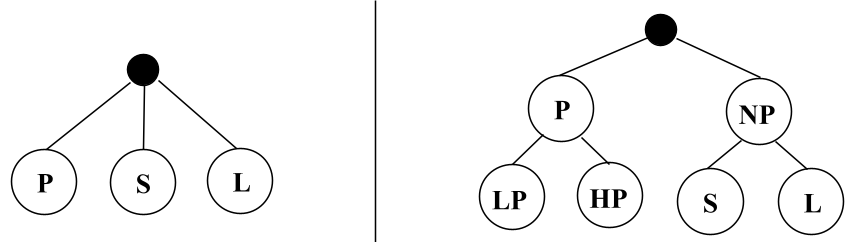 Figure 1: Comparison between Flat and Hierarchical Classification approaches.
Key Insights from the Data
The study found that the popularity of the responded-to video (Target Video) was the single most discriminative feature.
- Spammers hunt for "High View" counts to maximize their reach.
- Promoters target "Low View" videos (their own or a client's) to boost them from obscurity.
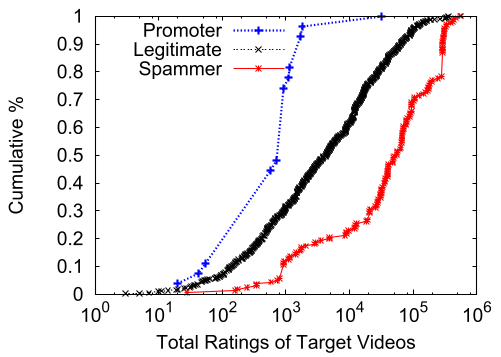 Figure 2: Statistical distinction in the average time between uploads—Promoters (solid line) are significantly more aggressive than spammers and legitimate users.
Performance & Results
The Results were impressive for the era:
- Promoter Detection: ~96% Recall. Their behavior is so aggressive (hundreds of uploads in 24 hours) that they are nearly impossible to hide.
- Spammer Detection: ~57% Recall. Spammers are "stealthier," often behaving like legitimate users for weeks before dropping a spam link.
- False Positives: Only 5% of legitimate users were misidentified, a crucial metric for maintaining platform trust.
The authors also introduced the J Parameter tradeoff. System admins could tune the model: be "Conservative" (catch fewer spammers but never ban a real user) or "Aggressive" (catch more spammers but require more manual human review).
Critical Analysis: 15 Years Later
This paper was a pioneer in Behavioral Analytics for social media. While today's spammers use sophisticated AI to generate "relevant-looking" content, the underlying logic remains: malicious intent leaves a footprint in the metadata.
Limitations
- Adaptability: As the authors noted, once spammers know "Upload Frequency" is a signal, they will simply slow down their bots.
- Data Scale: The test collection (829 users) is tiny by modern standards, though it provided the first high-quality labeled dataset for this niche.
Future Outlook
The legacy of this work is found in today's Collusion Detection algorithms. By identifying one "Light Promoter," platforms can follow the "Social Graph" to unmask entire botnets. As we move into an era of AI-generated video pollution, these behavioral signals—who you respond to and how fast you do it—remain our strongest line of defense.