
Hybrid Intelligence: Bridging the Gap Between Unsupervised Clustering and SVM for Spammer Detection
Detecting spammers on social networks based on a hybrid model
This paper introduces a hybrid spammer detection model for social networks (Sina Weibo) that integrates the OPTICS clustering algorithm with Support Vector Machines (SVM). By leveraging unsupervised learning to generate initial pseudo-labels and supervised learning for refinement, the model achieves 87.6% accuracy for spammers and 94.7% for legitimate users without requiring a pre-labeled training dataset.
TL;DR
Detecting spammers on social media is a cat-and-mouse game. Supervised models are accurate but expensive to train; unsupervised models are cheap but inaccurate. This paper proposes a Hybrid OPTICS-SVM Model that uses clustering to "self-label" data, which then trains an SVM classifier. This approach achieves 87.6% spammer detection accuracy on Sina Weibo data without the need for manual labels.
Problem & Motivation: The "Labeling" Bottleneck
Social networks like Sina Weibo have become breeding grounds for malicious actors spreading phishing links and fake news. Two major hurdles exist in current detection research:
- Supervised Learning (e.g., SVM, Random Forest): Highly accurate but requires massive amounts of human-labeled data. Spammers change tactics so fast that labels become "stale" rapidly.
- Unsupervised Learning (e.g., K-Means, DBSCAN): Requires no labels but struggles to distinguish between "noisy" legitimate users and actual spammers, leading to low precision.
The authors' insight was simple yet powerful: Use the density-based strengths of OPTICS to find "clean" examples of each class automatically, then use those examples to teach an SVM how to recognize the rest.
Methodology: The Hybrid Workflow
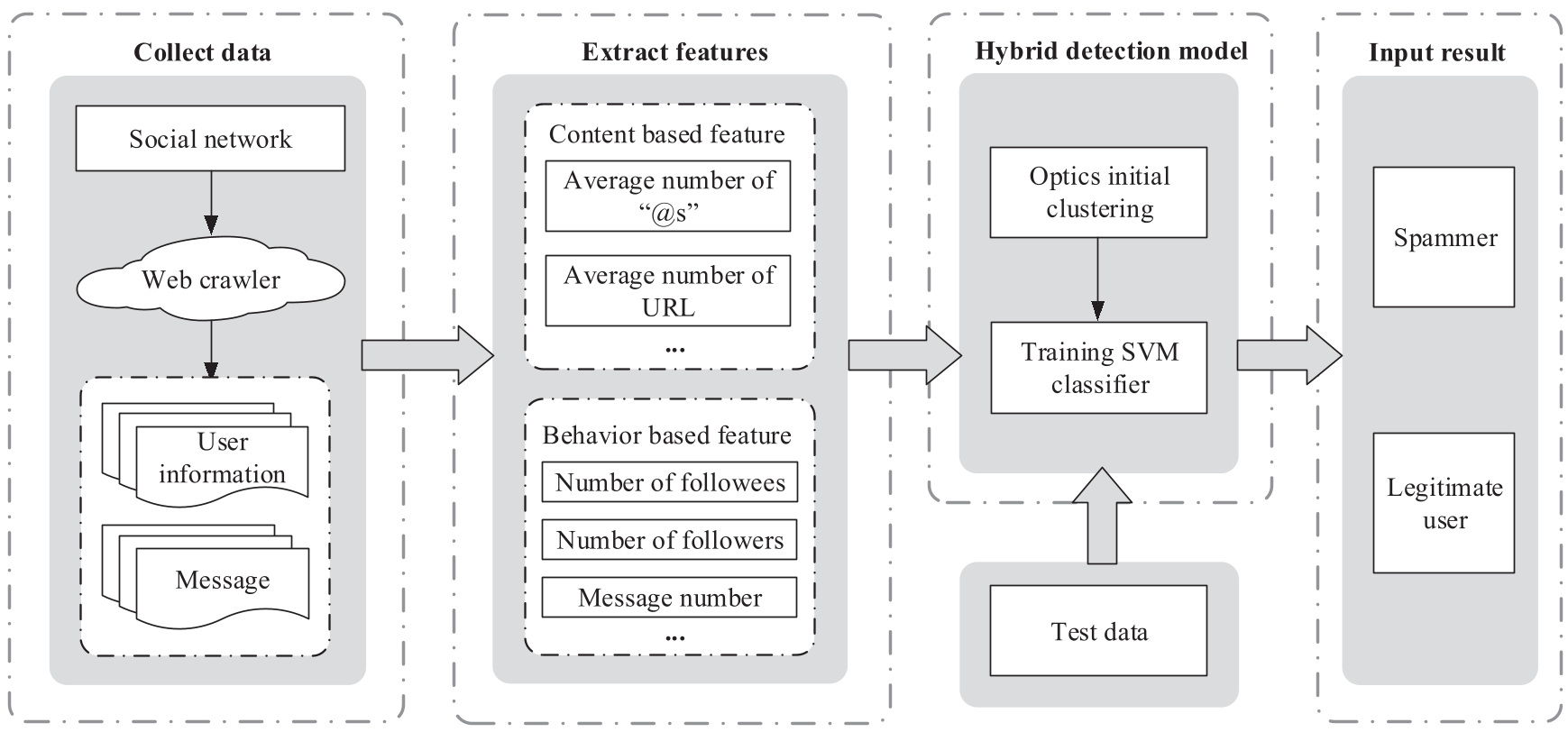
The framework consists of three distinct phases:
1. Multi-Dimensional Feature Extraction
The model analyzes 18 distinct features categorized into:
- Content-Based: Frequency of "@" mentions, URLs, hashtag usage, and a cosine similarity score of message content (detecting bot-like repetitive posting).
- Behavior-Based: Follower/followee ratios, daily post frequency, and engagement metrics (likes/reposts).
2. Initial Clustering via OPTICS
Unlike K-means, OPTICS (Ordering Points To Identify the Clustering Structure) doesn't require a pre-defined number of clusters. It creates a reachability plot that reveals the density landscape of the user base.
3. Training Sample Selection and SVM Refinement
The core innovation lies here: The authors don't trust all clustered points. They only select "core" points with a low reachability-distance (). These high-confidence points serve as the training set for a Polynomial-kernel SVM.
Experiments & Results: Accuracy vs. Efficiency
The authors tested their model on a real-world crawl of 10,000 Sina Weibo users.
Feature Discriminative Power
CDF (Cumulative Distribution Function) plots revealed clear behavioral divides. For instance, spammers showed a significantly higher "Average Number of @s" and higher "Message Similarity" compared to legitimate users.
Performance Comparison
The results demonstrate that the Hybrid Model provides a "best-of-both-worlds" performance:
| Method | Spammer Precision (P) | Spammer Recall (R) | Spammer F-Measure |
|---|---|---|---|
| OPTICS (Pure Unsupervised) | 0.609 | 0.510 | 0.555 |
| Hybrid Model | 0.876 | 0.828 | 0.851 |
| SVM (Pure Supervised) | 0.939 | 0.872 | 0.904 |
Note: While pure SVM is technically more accurate, it requires 100% human-labeled data, whereas the Hybrid model achieves comparable results with zero manual intervention during training.
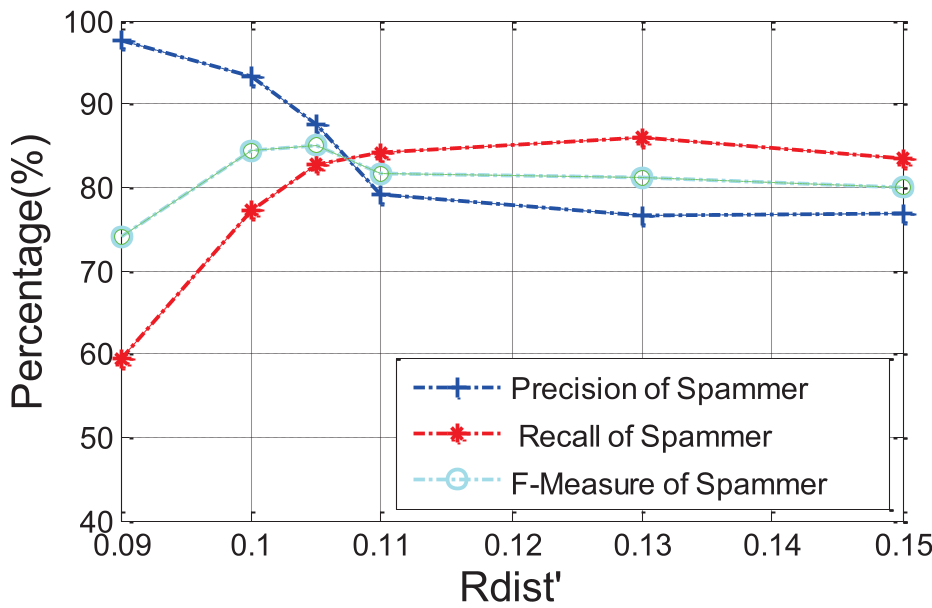 Figure: The impact of varying the rdist threshold on Spammer detection metrics.
Critical Analysis & Conclusion
Summary
The paper successfully proves that modern clustering can "bootstrap" supervised classifiers. By filtering out noise using density metrics (), the SVM is protected from the "garbage in, garbage out" problem often found in semi-supervised setups.
Limitations & Future Work
- Computational Complexity: OPTICS and SVM are computationally expensive on massive datasets. For a network with millions of users, this pipeline would require distributed computing (e.g., Spark) to remain real-time.
- Feature Evasion: As spammers become more sophisticated (e.g., using LLMs to vary message content), the "Message Similarity" feature may lose its predictive power.
- Future Outlook: Integrating this hybrid approach with Graph Neural Networks (GNNs) could capture not just user behavior, but the structural topology of spam rings.
Final Takeaway: This research provides a practical blueprint for developers building moderation tools where human labeling is the primary bottleneck.