
CRF vs. HELM: Advancing Automated Stuttering Detection in Children’s Speech
Detecting Stuttering Events in Transcripts of Children’s Speech
This paper presents a machine learning-based framework for detecting stuttering events in children's speech transcripts using Hidden Event Language Models (HELM) and Conditional Random Fields (CRF). By augmenting the UCLASS corpus with both newly transcribed human data and synthetic stuttering patterns, the study achieves a State-of-the-Art (SOTA) accuracy of 94% using the CRF approach.
TL;DR
Early intervention is critical for children who stutter, yet clinical diagnosis remains a manual, subjective bottleneck. This study evaluates probabilistic machine learning models—Conditional Random Fields (CRF) and Hidden Event Language Models (HELM)—to automate the detection of stuttering events in transcripts. By doubling the available human-annotated data and introducing a synthetic augmentation pipeline, the researchers achieved a high-precision detection rate of 94%, successfully identifying even rare disfluency types.
Problem & Motivation: The Clinical Bottleneck
Stuttering (or stammering) assessment is currently a "human-in-the-loop" process. Clinicians must meticulously transcribe sessions and categorize every spoken term into categories like prolongations or interjections. This is not only time-consuming but also suffers from inter-rater variability.
Existing Rule-Based (RB) automated systems exist, but they are fragile. They rely on "if-then" logic (e.g., "If word X repeats within C words, trigger event Y"), which fails to capture the stochastic nature of human speech. The authors identify a dual challenge:
- Model Limitation: Deterministic rules cannot handle the complexity of speech variability.
- Data Scarcity: Children’s speech datasets are notoriously small due to privacy and the difficulty of transcription.
Methodology: From Rules to Probabilities
The core innovation lies in treating stuttering as a Sequence Labeling Task. Instead of rigid rules, the researchers compared two probabilistic powerhouses:
- Hidden Event Language Model (HELM): Treating stuttering events as "hidden" transitions between observed words.
- Conditional Random Fields (CRF): A discriminative model that looks at contextual features (n-grams and "post-words") to optimize the global probability of a label sequence.
The Power of Data Augmentation
Because rare events like Prolongations (P) and Phrase Repetitions (PH) occurred in less than 2% of the original data, the models initially ignored them. The authors solved this by training a language model to generate "weighted nonsense"—grammatically incorrect but structurally realistic stuttering patterns.
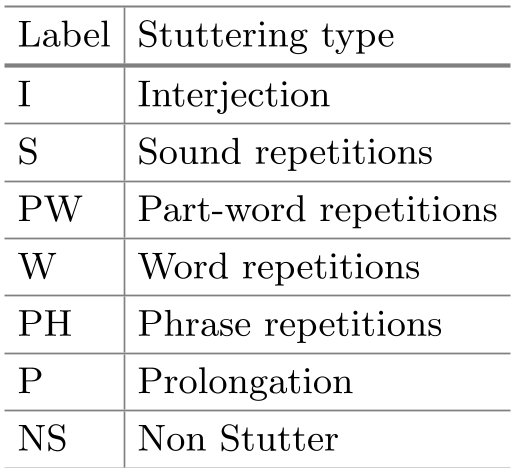 Table 1: The labeling schema used to categorize different stuttering events.
Experiments & Results
The researchers utilized the UCLASS Release One corpus and significantly expanded it, adding 32 new files to the existing 31.
Key Findings:
- Optimal Context: For CRFs, the best performance came from using 2-grams combined with 2-post-words, suggesting that the immediate future context is vital for identifying a stutter.
- The Augmentation Leap: In baseline tests, both models had 0% recall for rare events. After adding 416,456 words of augmented data, the CRF’s ability to detect Part-Word (PW) repetitions and Prolongations (P) skyrocketed.
- Final Standings: CRF achieved 94% accuracy, consistently outperforming HELM.
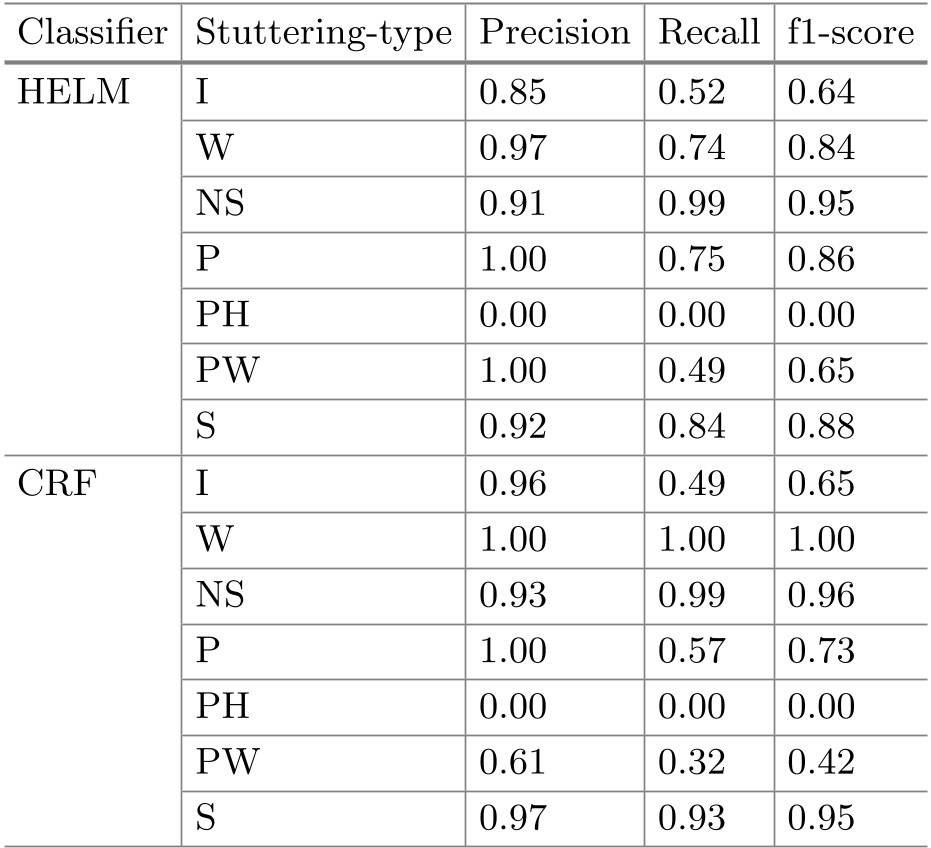 Table 7: Final results showing the massive improvement in precision and recall for rare stuttering types after augmentation.
Critical Analysis & Conclusion
Takeaway
The study proves that for specialized clinical NLP, Conditional Random Fields are superior to generative language models because they can better incorporate arbitrary overlapping features of the text. Furthermore, it demonstrates that synthetic data, even if semantically nonsensical, can provide the structural "scaffolding" required for a model to learn rare pathological patterns.
Limitations
While the system handles word and sound repetitions expertly, Phrase Repetitions (PH) remain a "black hole" (0% recall). This is because the n-gram augmentation method was word-based rather than phrase-based.
Future Work
The logical next step is integrating these transcript-based models with Automatic Speech Recognition (ASR). If an ASR system can accurately preserve disfluencies—rather than "cleaning" them—this CRF model could provide clinicians with an instant, automated severity score directly from audio.