
Unmasking the Local Spoiler: Detecting Tip Spam in LBSNs
Detecting tip spam in location-based social networks
This paper presents a robust classification framework for detecting "tip spam" in Location-Based Social Networks (LBSNs). Focusing on the Brazilian network Apontador, the authors introduce a multidimensional feature set—encompassing content, user behavior, place characteristics, and social network metrics—and achieve a 87.8% overall accuracy using a Random Forest classifier.
TL;DR
Researchers have developed a highly effective supervised learning approach to identify "tip spam" in Location-Based Social Networks (LBSNs) like Apontador. By looking beyond the text of a tip to analyze user travel patterns and venue popularity, the system achieves an 87.8% accuracy, proving that geographic behavior is as descriptive as the messages themselves.
Background: The New Frontier of Spam
Location-Based Social Networks (LBSNs) like Foursquare and Yelp have transformed how we explore cities. However, the "tips" feature—intended as crowdsourced wisdom—has become a playground for spammers pushing local ads, pornography, or malicious reputation damage. Existing filters designed for email or Twitter are ill-equipped for LBSNs because they ignore the physical reality: a user's location history and the specific characteristics of the venues they review.
Methodology: The Four Pillars of Detection
The authors identified 41 distinct attributes to distinguish a legitimate recommendation from a malicious advertisement. Their insight was that spam in LBSNs isn't just about what is said, but where and by whom.
1. The Power of "Place"
Surprisingly, the most discriminative features were not found in the text, but in the metadata of the location.
- Venue Popularity: Spammers are "trend-chasers." They target places with high tip volumes to maximize visibility.
- Place Rating: Low-rated or controversial spots often attract different spam patterns than high-rated ones.
2. Spatial Behavior and Social Standing
The team crawled a social graph of over 137,000 users to extract:
- Geographic Radius: Legitimate users usually follow a specific spatial logic. A "user" posting tips for thousands of miles apart in minutes is a clear red flag.
- Social Metrics: Using algorithms like PageRank and Clustering Coefficients, the researchers identified that spammers often lack reciprocal relationships (followers vs. followees ratio).
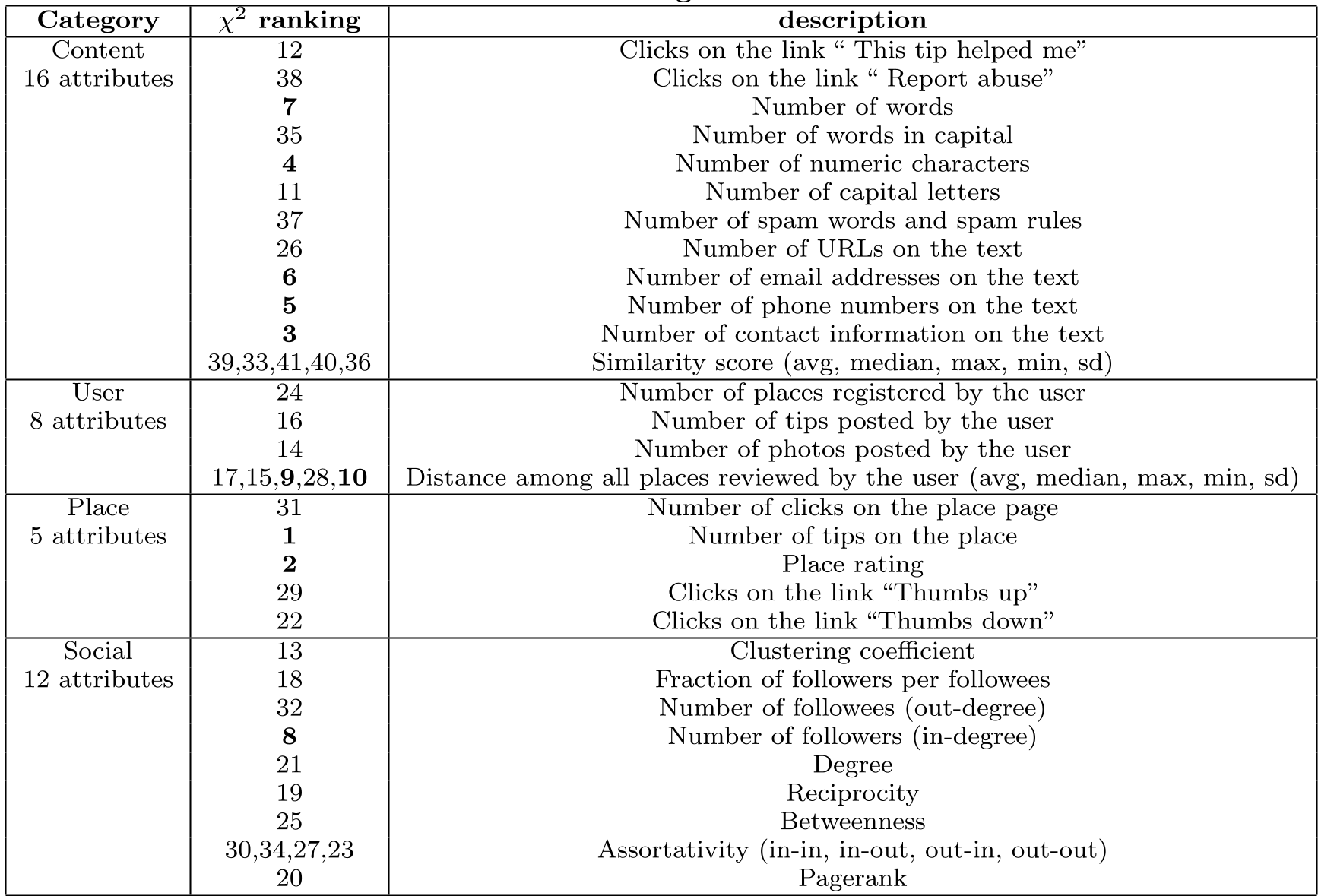 Table 1: Ranking of the most discriminative attributes across categories.
Experiments & Core Insights
Using a Random Forest classifier on a balanced dataset from the Brazilian network Apontador, the results were striking:
- Detection Performance: The model caught 84% of all spam with very few "false positives" (only 8.2% of good tips were misclassified).
- Content Signals: Spammers tend to use a high density of numeric characters (phone numbers) and contact info. As shown in the study, 60% of spam tips contained significantly higher numeric counts compared to legitimate tips.
- Efficiency: Even when stripping the model down to its top 10 features, accuracy remained at 82.6%, suggesting that LBSN platforms can implement lightweight, real-time filters without massive computational overhead.
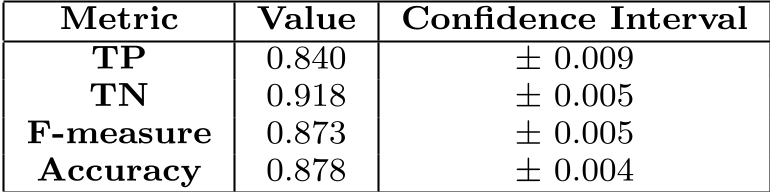 Table 2: Overall classification effectiveness metrics.
Critical Analysis: The Spatial Advantage
This work highlights a critical "Inductive Bias" in LBSN research: Distance matters. While content attributes (like the Jaccard coefficient to detect duplicate tips) are useful, they can be bypassed by sophisticated language models. However, faking a plausible geographic footprint and a realistic social network is significantly harder and more expensive for spammers.
Limitations & Future Work
The study focuses on a 2013 dataset. In the modern era of Generative AI, "Content Attributes" may become less reliable as spammers use LLMs to create unique, human-like text. Future research must lean even more heavily into Spatio-temporal dynamics and Graph Neural Networks to identify coordinated "link-farming" and "check-in" fraud that goes beyond simple tip-posting.
Conclusion
The success of this approach confirms that in the world of LBSNs, your behavior is your identity. By integrating social graph analysis with geographic constraints, we can effectively protect the integrity of crowdsourced recommendations and ensure that "tips" remain a tool for discovery rather than a vector for noise.