
Silent Leaks: How Social Media Comments De-Anonymize the Protected
Detecting unintentional information leakage in social media news comments
This paper investigates Unintentional Information Leakage (UIL) on social media, specifically how public comments on news articles can compromise the identity of individuals protected by official name-obfuscation (e.g., "Colonel G."). The authors propose a mixed-methods approach combining qualitative discourse analysis with automated text mining to identify UIL incidents on Facebook.
TL;DR
In an era where "Colonel G." or "Captain D." are standard redactions in military and legal press releases, a new security threat has emerged: the hive mind of Facebook. This paper reveals that Unintentional Information Leakage (UIL) via public comments can systematically dismantle official censorship. By combining semiotic analysis with machine learning, the researchers provide a roadmap for detecting when a "congrats, bro!" becomes a national security breach.
The Illusion of Anonymity
For decades, organizations—from courts to militaries—have relied on "Non-identification" as a primary defense. By replacing a name with an initial, they believed the individual's identity was safe. However, the authors argue that this is a relic of the pre-social media age.
The core insight is that information does not leak in a vacuum. When a news article about a censored individual is posted on Facebook, it reaches a social circle. A single comment from a friend or relative, combined with that commenter's public profile, creates a "linkable" path directly to the redacted subject.
Methodology: Decoding the Leak
The researchers tackled this problem from two directions: the human "why" and the machine "what."
1. Qualitative: The 9 Faces of UIL
Through discourse and semiotic analysis, they identified nine ways commenters accidentally leak information. These aren't just names; they are social breadcrumbs:
- Direct Acquaintanceship: "I know him personally."
- Transitive Acquaintanceship: "Regards to the parents."
- Semiotic Indicators: Using repetitive punctuation or slang that signals "I know who this secret person is" (e.g., "Sargent N... way to go bro!").
2. Quantitative: Automating Detection
The study then built two models to see if these leaks could be caught automatically.
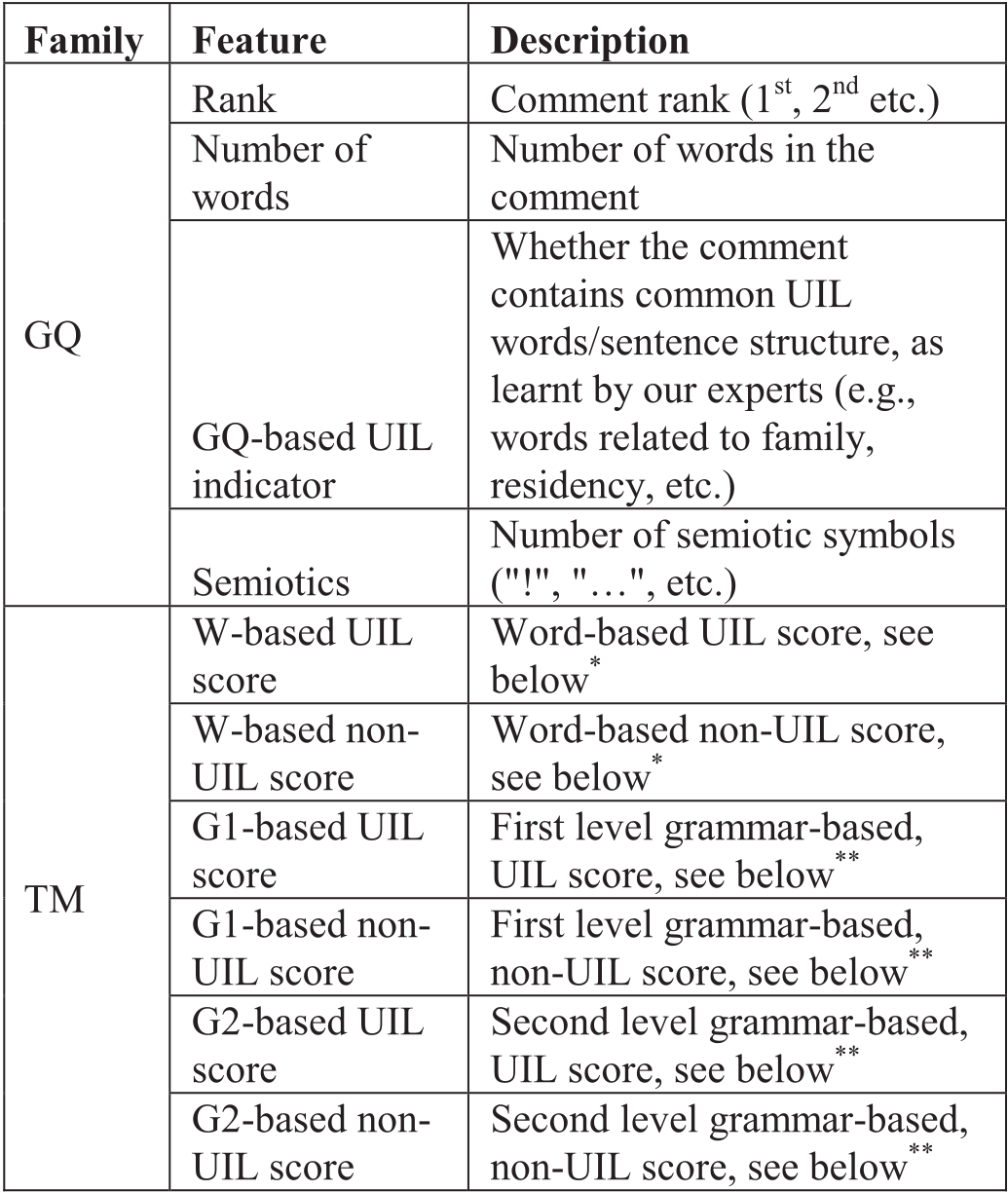
- Guided Qualitative (GQ) Model: Based on expert rules (e.g., UIL comments are usually shorter and posted very quickly after the article).
- Text Mining (TM) Model: A purely data-driven approach analyzing word importance and grammatical structures.
Experiments and Key Findings
The researchers crawled data from 37 Facebook news pages, focusing on censored Israeli military releases. Their results show a clear pattern:
- Grammar Matters: "Second-level" grammar (gender, tense, person) was a highly significant indicator of a leak. A comment addressing someone in the first person or using intimate gendered terms is a red flag.
- The Early Bird Leaks the Info: Comments with a lower "Rank" (those posted immediately after the news) were significantly more likely to be UIL, suggesting that those closest to the subject are the first to react.
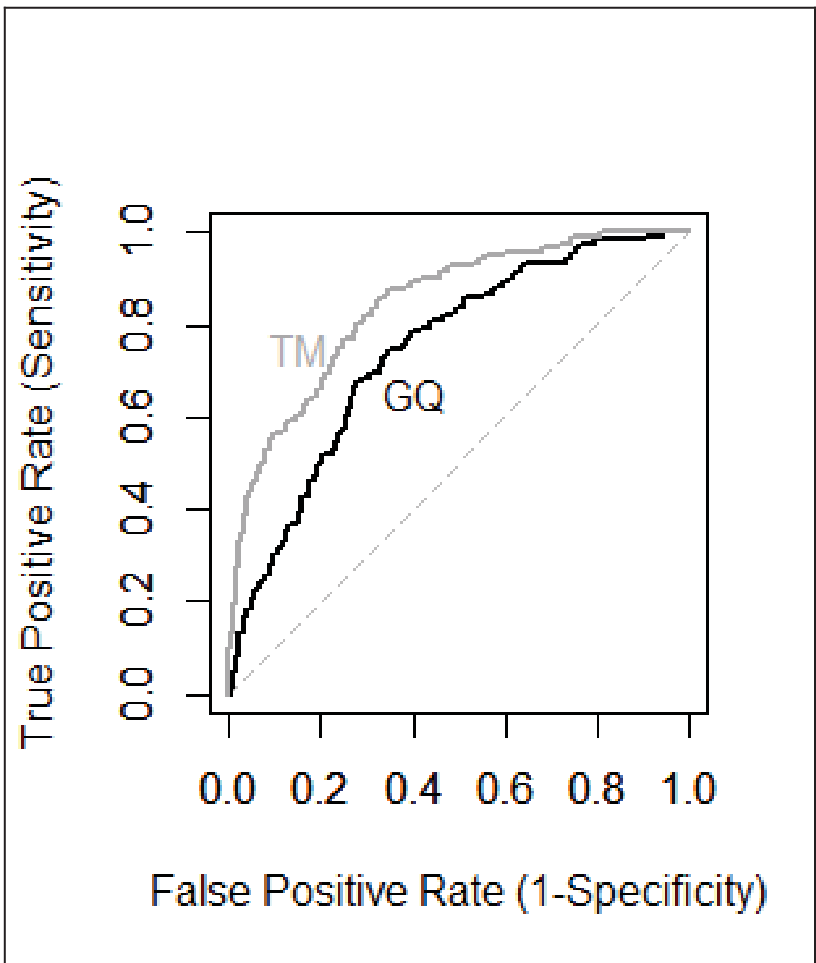
- TM vs. GQ: While the expert-driven (GQ) model was accurate, the automated Text Mining (TM) approach performed even better, as seen in the ROC curves below.
Critical Analysis & Conclusion
Takeaway
This research highlights a critical Inductive Bias in security policy: the assumption that if you hide the name, you hide the person. The reality is that social networks have turned every acquaintance into a potential (unintentional) whistleblower. Organizations need to move beyond static redaction toward dynamic content moderation that understands social context.
Limitations & Future Work
The current study is limited by its small sample size (50 articles) and its specific focus on a single region/language. Furthermore, as the authors acknowledge, semiotics symbols (like "!!!") were not found to be statistically significant in their current logistic model, suggesting that more complex non-linear models (like RNNs or Transformers) might be needed to capture the nuance of social "winks" in text.
The future of UIL detection lies in prevention mechanisms—tools that could warn a user before they post a comment that might inadvertently expose a protected individual.
Academic Reference: Yahav, I., Schwartz, D. G., & Silverman, G. (2014). Detecting Unintentional Information Leakage in Social Media News Comments.