
Unmasking the "Tip" Spammers: Behavioral Analysis on Foursquare
11448_Detection of spam tipping behaviour on foursquare.
This paper presents the first systematic study of spam detection in Foursquare "tips," identifying four distinct categories of irregular tipping behavior: Advertising, Self-promotion, Abusive, and Malicious. By utilizing a supervised learning framework with a Random Forest classifier, the authors achieved an 89.76% accuracy in distinguishing legitimate users from spammers.
TL;DR
In the early 2010s, Foursquare redefined LBSNs (Location-Based Social Networks), but its "Tips" feature—publicly visible reviews for venues—became a breeding ground for spam. This paper provides the first deep-dive into Tip Spammer behavior, categorizing them into four types and introducing an automated detection system that hits nearly 90% accuracy by looking at how users act, not just what they say.
Problem & Motivation: The LBSN Vulnerability
Unlike Twitter, where spam usually reaches only followers or hashtag-surfers, Foursquare tips are tied to physical coordinates. This makes them highly valuable for venue owners and highly exploitable for malicious actors.
The authors observed a critical gap: prior work mostly looked at "content spam" (the text). However, a single user could post legitimate-looking tips that are actually part of a massive, distributed self-promotion or abusive campaign. The challenge was to identify the User Profile—the persistent identity behind the spam.
Methodology: The Behavioral Fingerprint
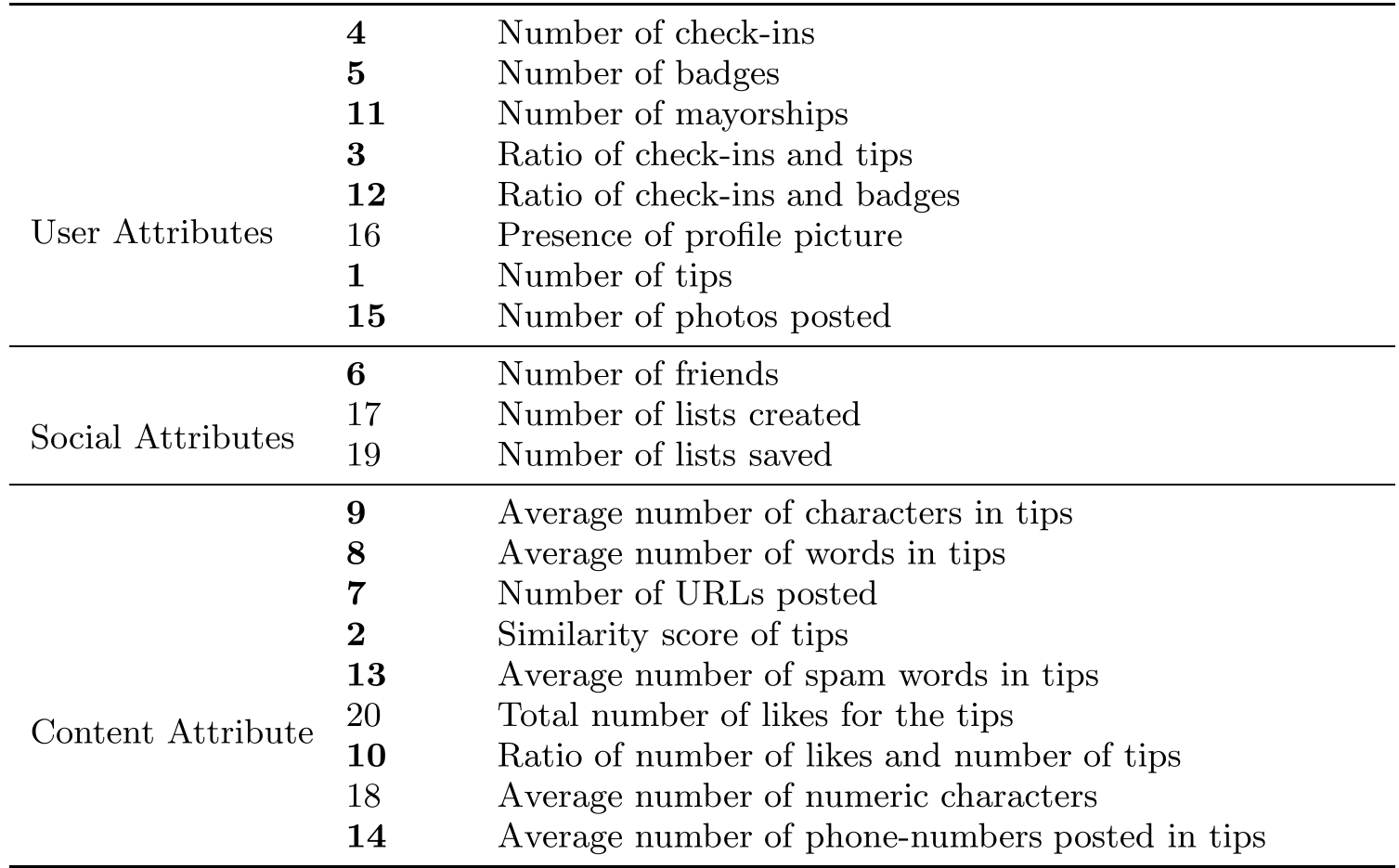
To catch these actors, the researchers extracted 20 features across three dimensions:
- User Attributes: Do they actually check-in? Legendarily, spammers have a high tip-to-check-in ratio.
- Social Attributes: Legitimate users have "friends" (social capital). Spammers are often isolated nodes.
- Content Attributes: The "Jaccard similarity" of tips across different venues and the presence of "spammy" keywords (e.g., 'free', 'lottery').
Architecture & Feature Ranking
The study utilized Chi-square () ranking to find the most informative features. Interestingly, the number of tips and the similarity score ranked higher than social friend counts.
Defining the "Four Horsemen" of Tip Spam
The authors' manual annotation revealed a taxonomy of bad actors:
- Advertising: Spreading links to brands/products.
- Self-promotion: Users obsessed with asserting presence (e.g., "I am the mayor here!") across multiple venues.
- Abusive: Targeting individuals or venues with derogatory content.
- Malicious: The most dangerous category—injecting phishing or malware URLs.
Experimental Results
The researchers compared KNN, Decision Trees, and Random Forest. The latter was the clear winner, managing to catch spammers while maintaining a low false-positive rate for "safe" users.

The divergence in behavior is best visualized in the distribution of "Badges" and "Check-ins." Legitimate users follow a power-law distribution for badges, while spammers are essentially "badge-poor" and often have zero check-ins despite posting dozens of tips.
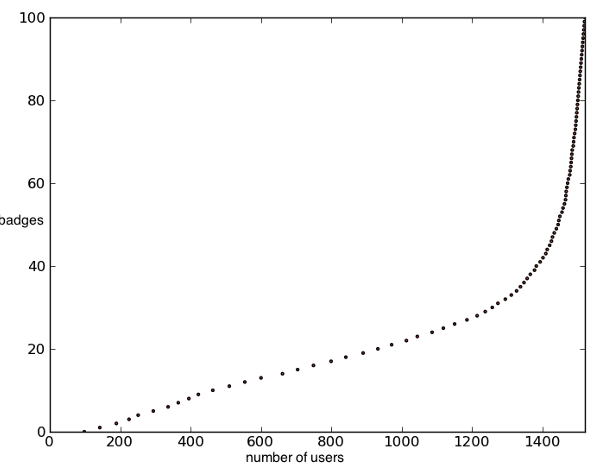 Figure: Spammers (right) significantly lag behind legitimate users (left) in gamified social milestones like Badges.
Critical Insight: Why This Works
The fundamental "Inductive Bias" of this paper is that Location is a Proof-of-Work. In Foursquare, checking in requires (ideally) physical presence. Spammers, who operate at scale, cannot be everywhere at once. Therefore, they "teleport" by posting tips without check-ins. This asymmetry—high communication, low physical confirmation—is the ultimate red flag for LBSN security.
Conclusion & Future Look
While this work achieved high accuracy in 2013, the landscape has evolved. Today's spammers use sophisticated LLMs to generate unique-sounding tips, making "Similarity Scores" less effective. However, the User Attribute analysis (the check-in to tip ratio) remains a gold standard for location-based trust.
The next frontier? Cross-platform correlation—detecting when a Foursquare spammer is the same entity as a Twitter bot.