
Beyond a Single Profile: Detecting Abnormal Behavior via Multidimensional Social Networks
Detection of Users’ Abnormal Behavior on Social Networks
The paper proposes a novel anomaly detection method for Online Social Networks (OSNs) by modeling them as multidimensional networks. It combines community detection with a Beta mixture model-based classification to identify atypical users across multiple social platforms like Facebook, Twitter, and Instagram.
Executive Summary
TL;DR: This research introduces a multidimensional approach to social network anomaly detection. By analyzing user behavior across synchronized platforms (Facebook, Twitter, Instagram), the authors move beyond one-dimensional "silos" to identify atypical users using community-based scoring and probabilistic Beta mixture models.
Positioning: This work addresses the complexity of modern social interactions. It shifts the focus from simple topological outliers in a single graph to "cross-platform" structural anomalies, marking a significant step toward more holistic digital forensic analysis.
The Problem: The Monodimensional Blind Spot
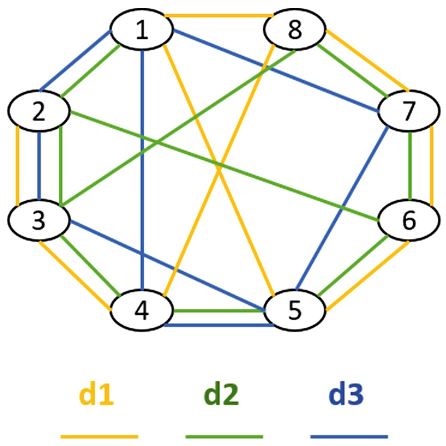
Traditional anomaly detection treats social networks as single graphs. However, human digital presence is increasingly fragmented yet synchronized. If a user acts abnormally on one platform but appears normal on another, a monodimensional view misses the critical context of their "multidimensional" identity. Existing methods often struggle with:
- Information Loss: Ignoring interactions on parallel platforms.
- Rigid Thresholds: Relying on fixed "k-nearest" or distance values that don't adapt to different datasets.
- Static Analysis: Failing to account for evolving community structures.
Methodology: The Multidimensional Framework
The authors propose a system that views the digital world as a triplet , where represents the dimensions (different social networks).
1. Community-Aware Analysis
The core intuition is that normal users form dense communities based on shared interests, while abnormal users (spammers, bots, or malicious actors) often establish random, sparse relationships across disparate communities.
2. The Anomaly Scoring Logic
The paper introduces a refined scoring mechanism based on node influence:
- : A score (0, 0.5, or 1) assigned per dimension based on whether a node influences the construction of its community.
- : The total anomaly score, averaged across all platforms the user exists on.
3. Automatic Classification via Beta Distribution
Instead of manually picking a threshold, the authors use the Beta Law. The Beta distribution is chosen for its extreme flexibility—it can take U, L, or linear shapes, making it perfect for modeling the "skewed" nature of anomaly scores where most users are normal (score near 1) and few are abnormal (score near 0).
The Expectation-Maximization (EM) algorithm is employed to estimate the parameters of the distribution, allowing the system to statistically "cluster" the anomalies.
Experiments and Results
The method was evaluated on a massive dataset of 397,000 nodes.
- Detection Capability: The system identified ~10,000 atypical nodes.
- Adjacency Matrix Validation: When nodes are sorted by their scores, the visualization clearly shows a stark contrast. Abnormal nodes (top of the matrix) appear in sparse, "ghost-like" regions, while normal users cluster in dense, bright squares representing robust communities.
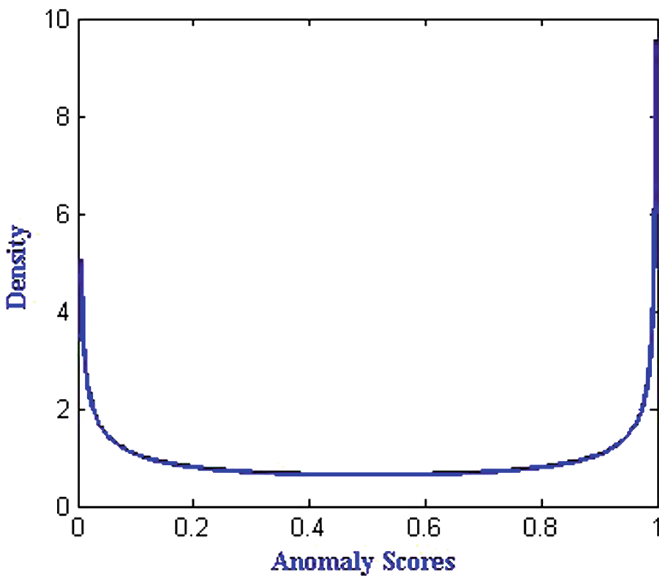 The density curve shows the Beta mixture model successfully separating the abnormal minority (low scores) from the normal majority.
Critical Insight & Conclusion
The true value of this work lies in the mathematical formalization of cross-platform influence. By using the Beta distribution, the researchers provide a mathematically grounded way to answer the question: "What constitutes a 'surprising' score?"
Limitations: The current model focuses primarily on topology. Future iterations could benefit from integrating content analysis (NLP) alongside structural metrics to further distinguish between a "new but normal" user and a malicious bot.
Conclusion: As our social lives become more integrated across the "metaverse" and multiple apps, multidimensional graph analysis will become the standard for maintaining security and trust in digital spaces.