
Decoding Eurovision: How Cultural Algorithms Predict the Next Song Contest Star
Determining the Ranking of a New Participant in Eurovision Using Cultural Algorithms and Data Mining
This paper presents a hybrid framework combining Cultural Algorithms (CA) and Data Mining to predict the ranking of new participants in the Eurovision Song Contest (ESC). By modeling the voting process as a social behavior influenced by cultural and linguistic proximities, the authors successfully forecasted Azerbaijan's 2008 performance to be within the 4th to 11th place range.
TL;DR
Can an algorithm predict the winner of Europe’s most flamboyant song contest? Researchers have developed a framework using Cultural Algorithms and Data Mining to model the complex social "negotiation" of Eurovision voting. By analyzing cultural dimensions and linguistic ties, the model accurately identifies how "new" countries—like Azerbaijan in 2008—will fit into the existing web of international preferences.
Context & Positioning
The Eurovision Song Contest (ESC) is more than a music competition; it is a laboratory for social modeling. While casual viewers often complain about "neighborly voting" or political bias, this paper treats these phenomena as measurable cultural properties. Positioned at the intersection of Evolutionary Computation and Sociology, the work moves beyond simple statistics to simulate how a group of "societies" (agents) reaches a consensus on ranking.
The Core Problem: Why Voting is Hard to Predict
Standard predictive models fail in Eurovision for two reasons:
- Logrolling (Vote Trading): Countries and may exchange votes, creating a "tit-for-tat" cycle that distorts quality-based metrics.
- Unstructured Complexity: The "quality" of a song is subjective and often correlated with the voter's own cultural background (linguistic and social proximity).
Methodology: The "Culture" in the Machine
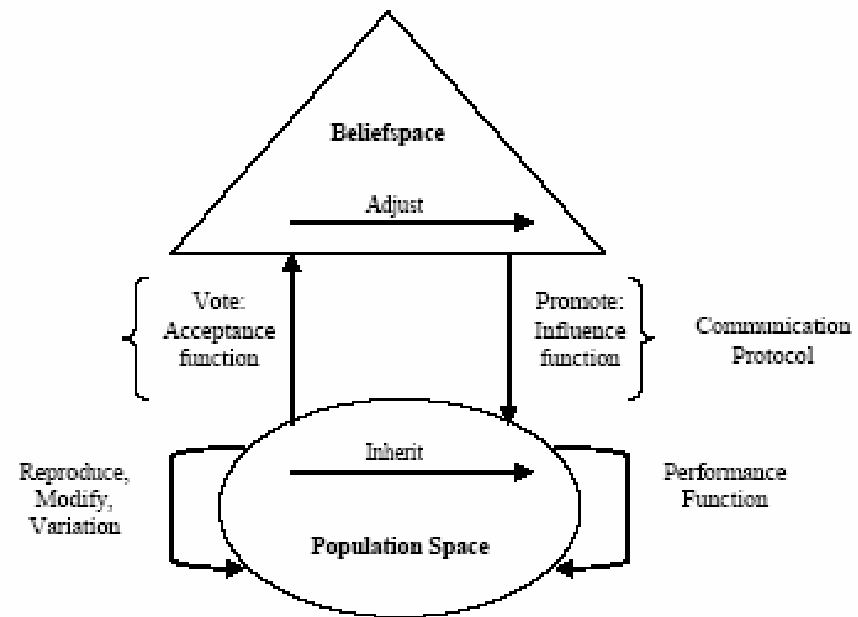
The researchers leverage Cultural Algorithms (CA), which differ from standard Genetic Algorithms by adding a Belief Space.
1. The Dual-Level Inheritance
As seen in the conceptual diagram, the CA operates on two levels:
- Population Level: Individual agents (representing voting strategies) evolve over generations.
- Belief Space: A shared repository where "cultural knowledge" (what works in the contest) is stored and used to influence the next generation of agents.
2. The Voting Equation
The math hinges on a sophisticated linear model: This equation factors in:
- (Instrumented Quality): An intrinsic talent score excluding the voter's own bias.
- Cultural Distances: Based on Hofstede's dimensions (Power Distance, Individualism, Masculinity, Uncertainty Avoidance).
Experiments and Deep Insights
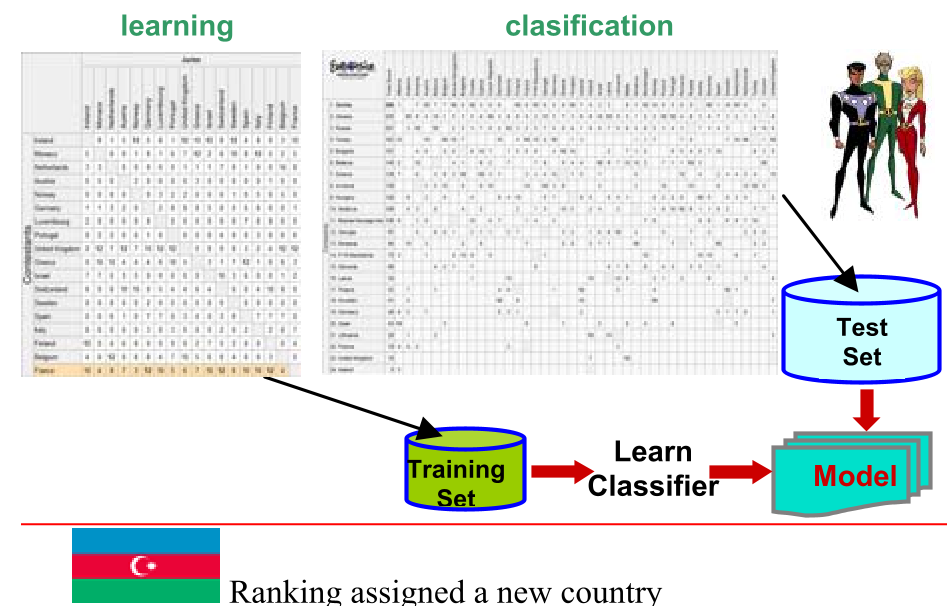
To characterize the behavior of specific "communities" (national juries), the authors applied Decision Trees. These trees act as a "divide and conquer" strategy to identify the unique patterns that lead a specific country to assign points.
Key Findings:
- Cultural Proximity > Corruption: The study found that once you account for linguistic and cultural distances, the evidence for "vote trading" (logrolling) becomes statistically insignificant. We don't necessarily vote for neighbors to be "nice"; we vote for them because we share the same musical "language."
- The "French" Effect: Surprisingly, singing in French showed a significant positive coefficient in the linear model across multiple estimations, whereas "Order of Performance" (often thought to be critical) played almost no role.
Critical Analysis & Conclusion
This work demonstrates that Cultural Algorithms are uniquely suited for problems where the "environment" is actually a collection of human biases. By treating "culture" as a vehicle for information storage, we can simulate complex international negotiations.
Takeaway: The success of a new entrant—like Azerbaijan—is largely predetermined by its cultural alignment with the existing participant pool.
Limitations: The model assumes cultural dimensions (like Hofstede's) are static. In a modern, globalized era, these cultural distances may be shrinking or shifting faster than the historical data suggests, requiring more dynamic real-time data mining.