
"The Devil You Know Knows Best": Revolutionising Recommendations via Social Networking
"The Devil You Know Knows Best" -How Online
This paper explores the integration of social networking and Recommender Systems (RS) to address the lack of social context in digital suggestions. Through a simulated film RS with 60 participants, the authors demonstrate that integrating real-world friendships and visualising profile similarity significantly enhances user trust and decision-making confidence compared to traditional collaborative filtering.
TL;DR
In early Web 2.0, researchers discovered a fundamental flaw in Recommender Systems (RS): they were too "mathematical" and not "social" enough. This seminal paper proves that users value recommendations from people they know—their friends—far more than optimized algorithmic matches. By integrating social networking data and visualising shared tastes, systems can transform from simple filters into trusted digital advisors.
The Missing Link: Why Algorithms Alone Fail
In the mid-2000s, RS research was obsessed with squeezing out small gains in RMSE (Root Mean Square Error). However, Philip Bonhard and his team argued that the industry was missing the point. Advice-seeking is a fundamentally social process.
The "Pain Points" identified were:
- Lack of Transparency: Users don't know why a system suggests a movie.
- Incentive Gap: There is little motivation for users to provide the high-quality ratings that algorithms require to function.
- The Trust Deficit: We don't trust the "average of a thousand strangers" as much as the opinion of one friend who shares our quirks.
Methodology: Testing the Social Fabric
To prove this, the authors recruited 60 participants in groups of five friends. This allowed them to test real familiarity rather than simulated repeat exposure.
The experiment compared three critical variables:
- Familiarity: Is the recommender a real-world friend?
- Profile Similarity: Do we share hobbies, music tastes, or demographics?
- Rating Overlap: Have we historically liked the same movies?
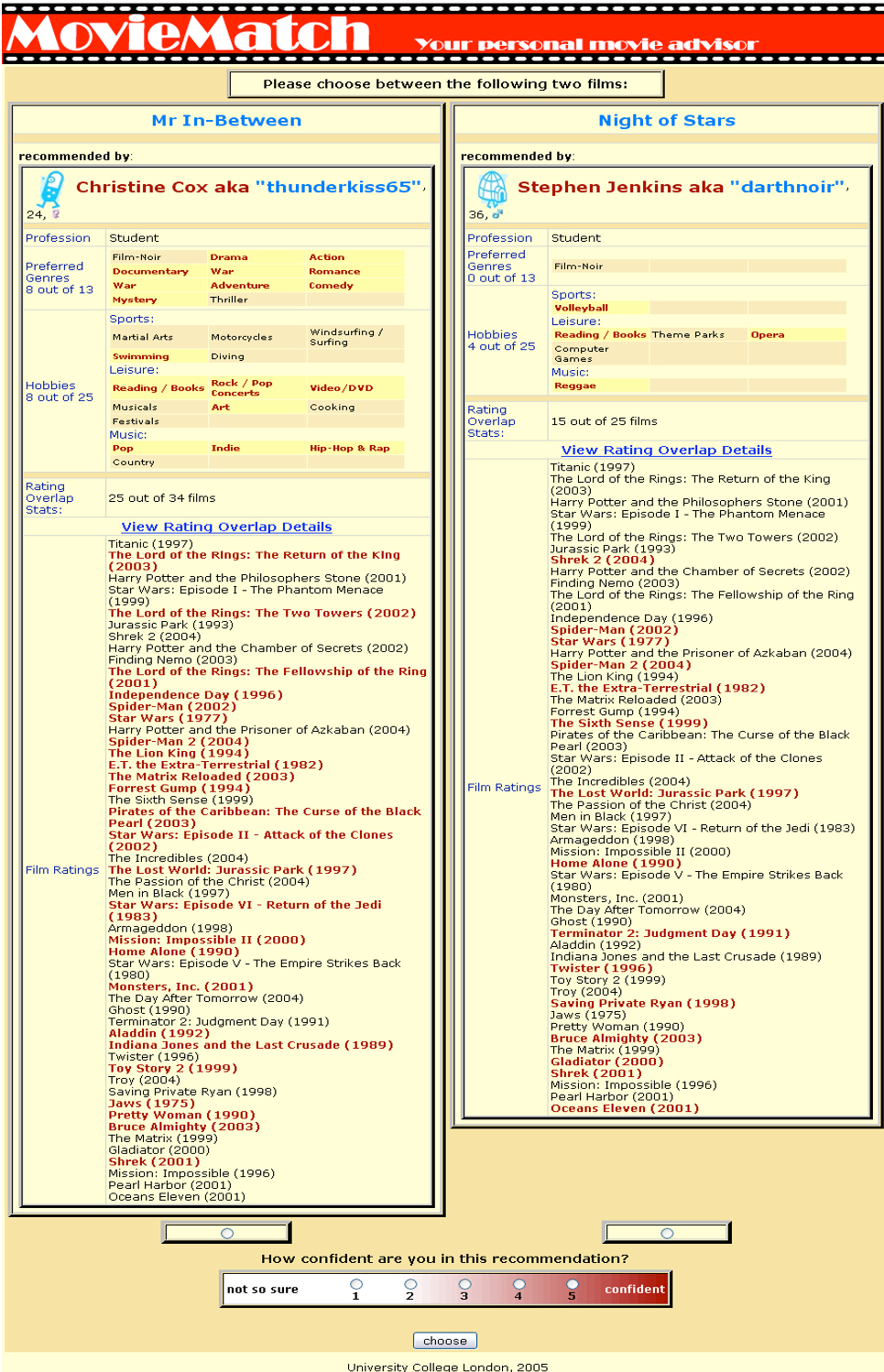 The study utilized forced-choice scenarios where users had to pick between recommendations from different types of sources.
Key Insights: Context Changes the Rules
The study’s most profound finding is that the hierarchy of decision factors shifts based on the relationship:
- When dealing with Friends: Users don't care much about "Profile Similarity" (they already know their friends). Instead, they look almost exclusively at Rating Overlap to see if their friend’s taste in this specific niche matches their own.
- When dealing with Strangers: Users pivot. Since they have no social context, they use Profile Similarity as a proxy for trust. If a stranger likes the same niche books and music, their movie recommendation carries more weight.
 Quantitative analysis showing the dominance of Rating Overlap (RATE) and Familiarity (FAM) in predicting user choice.
Design Implications: The "Enhanced Similarity" Interface
The authors didn't just stop at theory; they proposed a redesign for social platforms like Facebook. Instead of hidden algorithms, they suggested visualising common ground.
By enlarging keywords that two users have in common (e.g., "Salsa," "The Big Lebowski"), the interface provides an "explanation" for why a recommendation exists. This reduces the "scanning effort" for a user and creates an immediate psychological bond.
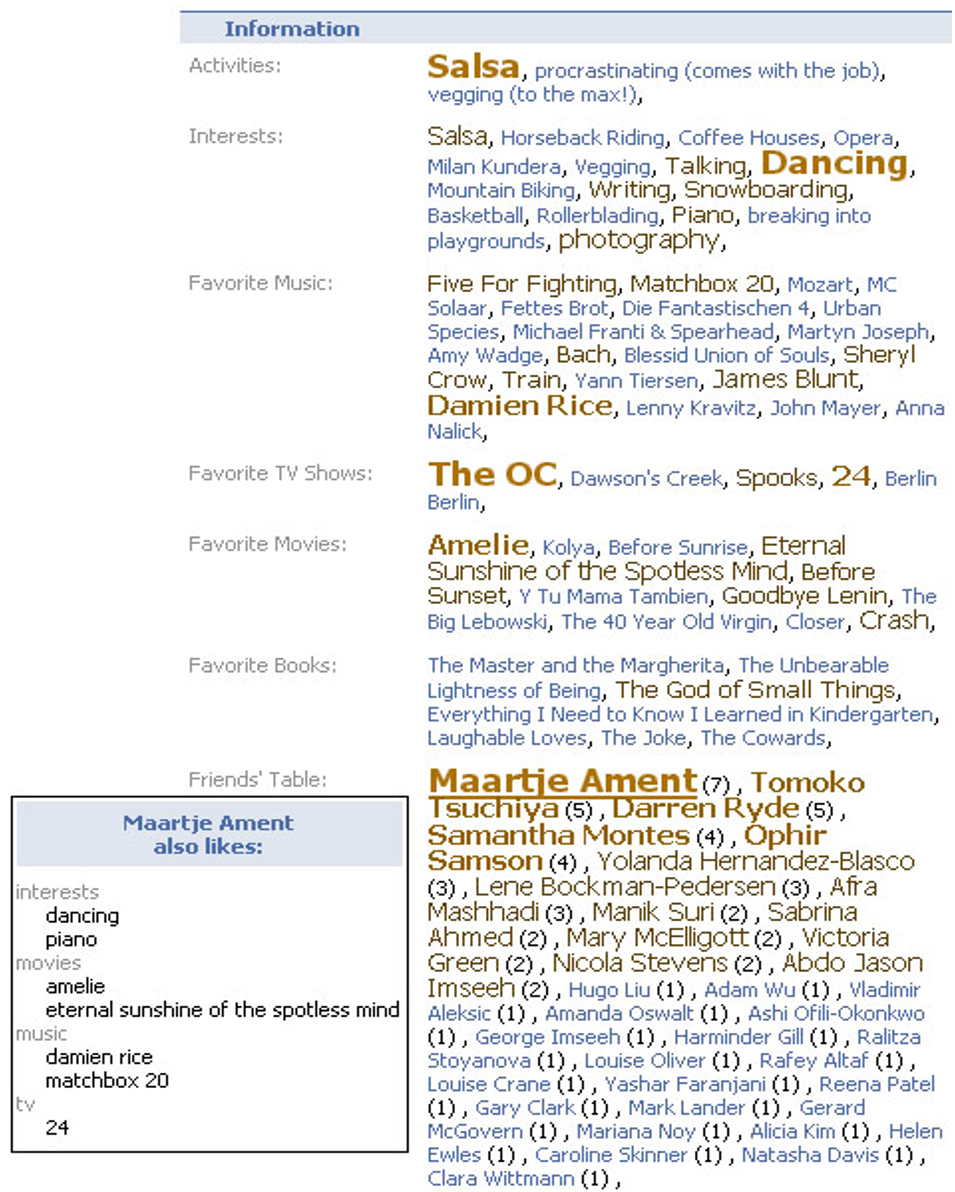 A proposed UI where shared interests are highlighted and scaled by popularity, making "like-mindedness" visually obvious.
Critical Analysis & Conclusion
This work was visionary in predicting the "Social Graph" dominance. While modern platforms like TikTok use incredibly sophisticated "interest graphs" that often outperform social graphs, Bonhard's insight remains valid: Trust is the currency of recommendation.
Takeaway for Today's Developers: If you are building a recommendation engine, don't just focus on the "what." Focus on the "who" and the "why." Visualising similarity and leveraging existing social connections can be more powerful—and more explainable—than the most complex deep learning model.
Limitations: The study's small sample size (60) and specific domain (movies) might not account for high-stakes recommendations (e.g., financial or medical advice) where expertise may trump familiarity.