
Beyond Simple Gaps: Rethinking Difference Scores in IT Workforce Research
A review of difference score research in the is discipline with an application to understanding the expectations and job experiences of it professionals
This paper evaluates the methodological rigor of "difference scores" in Information Systems (IS) research, specifically regarding Person-Job (P-J) fit for IT professionals. It advocates for the adoption of polynomial regression and Response Surface Methodology (RSM) as superior alternatives to traditional algebraic subtraction for measuring discrepancies between employee expectations and actual job experiences.
TL;DR
For decades, IS researchers have used "difference scores" to measure the gap between what IT professionals want and what they get. This paper argues that this standard practice is statistically flawed. By applying Polynomial Regression and Response Surface Methodology (RSM) to a study of 120 software developers, the authors demonstrate that treating expectations and reality as separate variables provides a much deeper, more accurate understanding of job satisfaction and turnover than a simple subtraction ever could.
The Problem with Subtraction
In IS research, we often ask: "How does the gap between a user's expectations and the system's performance affect satisfaction?" Typically, researchers calculate a single score: .
However, this method imposes "blind constraints" on the data. It assumes that a 1-unit increase in reality has the exact same impact as a 1-unit decrease in expectations. It ignores the absolute levels of the variables. For example, a "perfect fit" where an employee wants low stress and gets low stress is treated exactly the same as an employee who wants high challenge and gets high challenge. Intuitively, we know these are fundamentally different experiences.
Methodology: The Unconstrained Approach
The authors suggest moving to an unconstrained model. Instead of collapsing two variables into one "difference," they enter both into a regression model separately. This allows the data to "speak" without the mathematical handcuffs of traditional scores.
Breaking the Formula
Traditional: New (Polynomial):
This shift allows researchers to map out a threedimensional surface rather than a simple two-dimensional line.
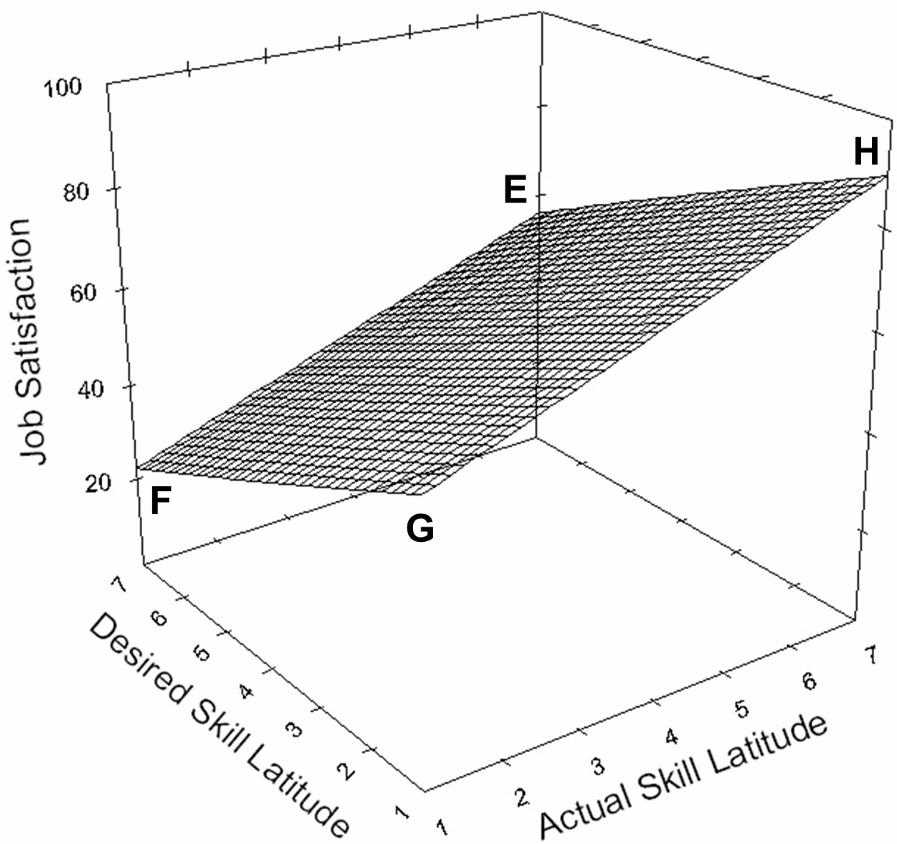 Figure: The Response Surface visually demonstrates how satisfaction varies across the entire plane of possibilities.
Key Insights from IT Professionals
The study analyzed "Skill Latitude" (the variety and autonomy of skills used) among 120 developers. The findings were revealing:
- The "High-Fit" Advantage: Satisfaction was highest when both the desire for skill latitude and the actual latitude were high. A "match" at a low level (wanting little, getting little) resulted in significantly lower satisfaction than a "match" at a high level.
- Increased Explanatory Power: For job satisfaction, the unconstrained model explained significantly more variance than the traditional difference score approach.
- Variable Outcomes: Interestingly, for Turnover Intentions, the traditional difference score was occasionally sufficient, suggesting that while satisfaction is a complex 3D surface, the decision to leave might be more directly tied to the simple size of the gap.
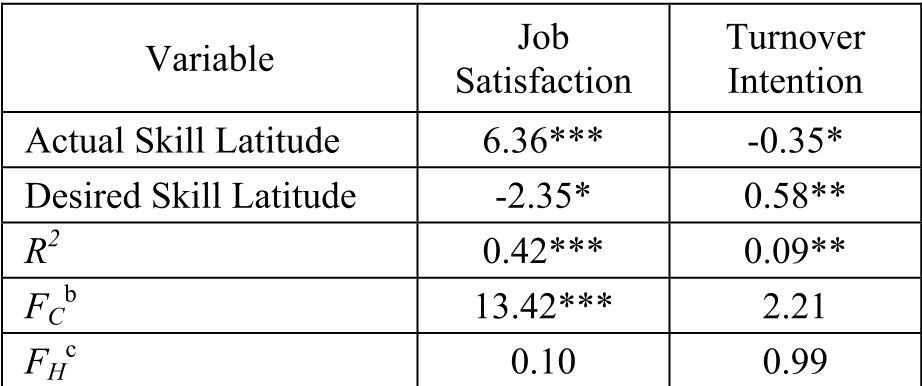 Table: Comparison shows the unconstrained model (FC value) significantly outperforming the constrained difference score model for Satisfaction.
Critical Analysis & Conclusion
This paper serves as a methodological "wake-up call" for the IS discipline. By relying on difference scores, researchers have likely been oversimplifying the psychological state of the IT workforce for years.
Takeaway for Practitioners: When assessing employee fulfillment or service quality, do not just look at the "gap." Look at the magnitudes. Improving a job to match a high-achiever’s expectations is far more valuable for retention and satisfaction than simply meeting the low-bar expectations of a disengaged worker.
Limitations: The current study is a "research in progress" with a limited sample size (n=120) from only two firms. Furthermore, while it tested linear components, the full power of RSM—which involves testing quadratic (curved) terms—was mentioned but not fully explored in this specific dataset's results.
Future Outlook
As the IT profession evolves with remote work and AI integration, the "expectations" of developers are shifting rapidly. Future research must use these high-resolution statistical tools to understand how alignment in these new dimensions (like AI-human collaboration) impacts the sustainability of the IT career path.