
PS-Sub: Decoupling Location Privacy from Trusted Servers in Spatial Crowdsourcing
A differentially private method for crowdsourcing data submission
This paper introduces PS-Sub, a differentially private data submission algorithm for spatial crowdsourcing (SC). It allows workers to submit sanitized location data to servers using Laplace and Exponential mechanisms, achieving robust location privacy without requiring a trusted third party.
TL;DR
Spatial Crowdsourcing (SC) is a double-edged sword: it enables efficient task allocation (like Uber or food delivery) but exposes workers' precise movements. This paper proposes PS-Sub, a differentially private framework that allows workers to submit "noisy" versions of their preferred locations. By replacing real coordinates with points from a public Task Location Space (TLS), it eliminates the need for a trusted third party while keeping travel costs acceptable.
The "Trust" Crisis in Crowdsourcing
In traditional SC systems, workers must trust the server implicitly. However, if that server is compromised—or if a government demands data access—a worker's entire life routine is exposed. Previous research has explored Differential Privacy (DP), but often relied on a Trusted Third Party (TTP) to add noise. The core motivation of this work is to answer: How can we protect workers if we don't trust the server or any intermediary?
Methodology: The Three Pillars of PS-Sub
The authors propose a localized approach where the worker's device performs the privatization before any data hits the network.
1. Count Randomization (Laplace Mechanism)
The system first identifies a worker's frequently visited location set. To hide the exact magnitude of their activity, the size of this set is perturbed by adding noise sampled from a Laplace distribution:
2. Differentially Private Clustering
Rather than simply submitting data, the algorithm uses an Exponential Mechanism to assign points in the public Task Location Space (TLS) to the worker's real locations. This ensures that the probability of a task location being assigned to a cluster decreases exponentially with its distance from the worker's true center.
 Above: Performance analysis of ASR vs. Privacy Budget (ε).
3. Location Substitution
Finally, the "Substitution" phase replaces the worker's true points in the noisy set with representative points sampled from the clusters. Because these substitution points are chosen from the public TLS, the server cannot distinguish whether a submitted coordinate is a worker's actual routine spot or merely a nearby task-relevant location.
Experimental Results: The Utility Trade-off
The researchers tested PS-Sub using the Gowalla dataset, focusing on two main metrics:
- Acceptance Success Ratio (ASR): How many tasks are successfully matched?
- Increased Relative travel cost (IRA): How much further does a worker have to travel because of the "noise"?
Key Insights:
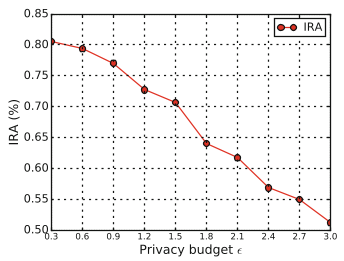
- The Privacy Budget (ε) Impact: As increases (lower privacy), the ASR improves significantly (as seen in Figure 1a). This is because the "noisy" locations are closer to the real ones, leading to more accurate task matching.
- Sensitive Radius (): Workers can define a "comfort zone." A larger radius provides more privacy but results in a higher IRA (Increased Relative Average travel cost), meaning workers have to travel further for tasks.
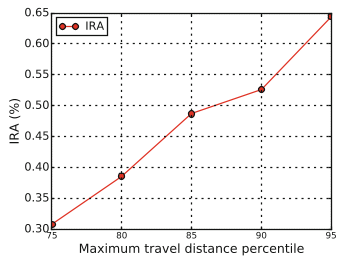 Above: IRA increases as the privacy budget or sensitive radius grows, representing the "cost" of privacy.
Critical Analysis & Conclusion
The merit of PS-Sub lies in its architectural simplicity. By shifting the privacy-preserving logic to the worker's side (Local DP) and using public task locations as a reference, it solves the privacy dilemma without complex cryptographic overhead.
Limitations: While the method protects individual location coordinates, it may still be susceptible to temporal correlations (e.g., if a worker's locations are submitted in a sequence that reveals a path). Future work should address trajectory-based privacy rather than just point-based privacy.
Takeaway: For developers of location-based platforms, this research offers a blueprint for building "Privacy-by-Design" systems that respect user anonymity while maintaining high utility for commercial service delivery.