
PS-Sub: Shielding Worker Privacy in Spatial Crowdsourcing without Trusted Intermediaries
A differentially private method for crowdsourcing data submission
The paper introduces PS-Sub, a novel differentially private algorithm for spatial crowdsourcing (SC) that enables workers to submit location data without a trusted third party. By combining Laplace and exponential mechanisms, the method achieves -Differential Privacy while maintaining a high Accepted Task Rate (ASR).
TL;DR
Spatial Crowdsourcing (SC) platforms like Uber or TaskRabbit often demand precise worker locations, posing a massive privacy risk. This paper presents PS-Sub, a differentially private framework that allows workers to obfuscate their locations before submission. By substituting private coordinates with points from a public "Task Location Space," it eliminates the need for a trusted third party while keeping task assignment efficiency high.
The Core Problem: The Paradox of Location Privacy
In SC, the server needs to know where you are to give you a task. However, sharing your exact GPS coordinates is a goldmine for adversaries. They can predict your home, your religion, or your routine. Most existing solutions suggest using a "Trusted Third Party" (TTP), but in the real world, who can you actually trust?
The authors argue that we need a mechanism where the worker can locally perturb their data so that even a malicious server cannot reconstruct their true movement patterns.
Methodology: The PS-Sub Framework
The authors propose a clever 3-step pipeline to transition from raw location data to privacy-preserving submissions.
1. Noisy Location Selection
First, the worker's set of frequently visited locations is randomized. The size of this set is modified using the Laplace Mechanism to prevent an attacker from identifying a worker based on the unique number of locations they frequent.
2. Differentially Private Clustering
The system uses a Task Location Space (TLS)—a public set of all possible task locations. Each of the worker's real locations is treated as a cluster centroid. Using the Exponential Mechanism, TLS points are assigned to these clusters. This ensures that the assignment is probabilistic rather than deterministic.

3. Smart Substitution
The worker does not submit their actual location. Instead, for every real location, the algorithm samples a "substitute" point from the TLS cluster using a probability distribution biased toward closer points. This provides -Differential Privacy, ensuring that the presence or absence of a specific real-world location doesn't significantly change the output.
Experimental Validation
Using the Gowalla real-world dataset, the authors measured two critical metrics:
- ASR (Accepted Task Rate): How many tasks can still be completed?
- IRA (Incurred Ratio of ADT): How much extra travel distance does the privacy noise add for the worker?
Key Insights from Results:
- The Privacy-Utility Trade-off: As the privacy budget increases (meaning less privacy), the ASR improves significantly. This is expected, as more accurate data leads to better task matching.
- Impact of Sensitive Radius (): A larger sensitive radius (the area the worker wants to hide in) results in a lower ASR and a higher IRA. This represents the "cost" of higher security.
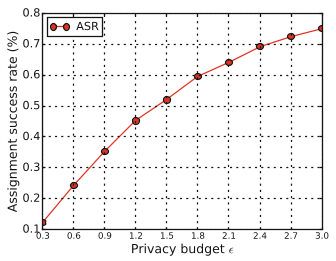 Figure: The relationship between Privacy Budget (), Sensitive Radius (), and Task Acceptance (ASR).
Critical Analysis & Future Outlook
The beauty of PS-Sub lies in its independence. By leveraging the TLS, it grounds the privacy mechanism in the context of the tasks themselves, rather than just adding random geographic noise which might land a worker in the middle of an ocean.
Limitations: The method assumes a static TLS is published in advance. In highly dynamic environments where task locations shift rapidly, the TLS might need frequent updates, which could open new side-channel attacks.
Takeaway: For developers of decentralized platforms or privacy-first apps, PS-Sub provides a blueprint for "Privacy by Design." It proves that we don't have to sacrifice our data to get the job done.
Conclusion
PS-Sub successfully demonstrates that location privacy in spatial crowdsourcing is not a zero-sum game. Through meticulous application of Differential Privacy mechanisms, we can protect individuals while maintaining the utility of the crowd.