
DRA: Securing the "Invisible Hand" in Distributed Spatial Crowdsourcing
Differentially Private Resource Auction in Distributed Spatial Crowdsourcing
This paper introduces a Differentially private Resource Auction (DRA) mechanism specifically designed for Distributed Spatial Crowdsourcing (DSC). It addresses the resource competition among requesters for limited Edge Cloud (EC) resources using a secure combinatorial auction that prioritizes social welfare while protecting sensitive bid data.
TL;DR
As Spatial Crowdsourcing (SC) moves from the cloud to the edge to reduce latency, the competition for limited Edge Cloud (EC) resources has become a bottleneck. This paper proposes DRA (Differentially private Resource Auction), the first mechanism to solve distributed combinatorial resource allocation while protecting bid privacy against untrusted auctioneers. It achieves this by mixing differential privacy with a greedy optimization strategy, ensuring high social welfare without exposing sensitive requester valuations.
Background: The Shift to Distributed Spatial Crowdsourcing (DSC)
Traditional SC platforms (like Uber or Waze) suffer from the "Centralization Tax"—latency and high bandwidth costs. Distributed Spatial Crowdsourcing (DSC) leverages Edge Computing to deploy services closer to users. However, edge resources are finite. Requesters must compete for EC bundles (processing, storage). This creates a Combinatorial Auction problem: a service is only viable if it secures resources from a specific bundle of edge nodes simultaneously.
The Privacy Paradox
In an auction, a requester’s bid reveals their valuation and strategic interests. Prior works relied on:
- Cryptography (HE/MPC): Secure but computationally "heavy," making them slow for real-time edge deployment.
- Trusted Third Parties (TTP): Risky. If the auctioneer is "semi-honest" (curious but follows protocol), your commercial secrets are gone.
The Insight: Can we design an auction where the auctioneer never sees the true bid, yet still makes efficient allocation decisions?
Methodology: Bid Confusion & Expected Auctions
The DRA mechanism utilizes a multi-step workflow to decouple bid accuracy from privacy:
1. The Bid Confusion Strategy
Instead of sending a true bid , requesters use an Exponential Mechanism to generate a "confused bid" .
- Physical Intuition: The probability of sending a specific confused bid is proportional to how close it is to the true bid, regulated by a privacy budget .
- Anonymity: Requesters use anonymous communication to send encrypted bids to ECs, which then shuffle and forward them to the auctioneer, preventing the auctioneer from linking bids to specific bundles initially.
2. Secure Winning Bid Selection
Since the auctioneer only sees noisy data, it calculates the Expected Bid based on the known confusion function.
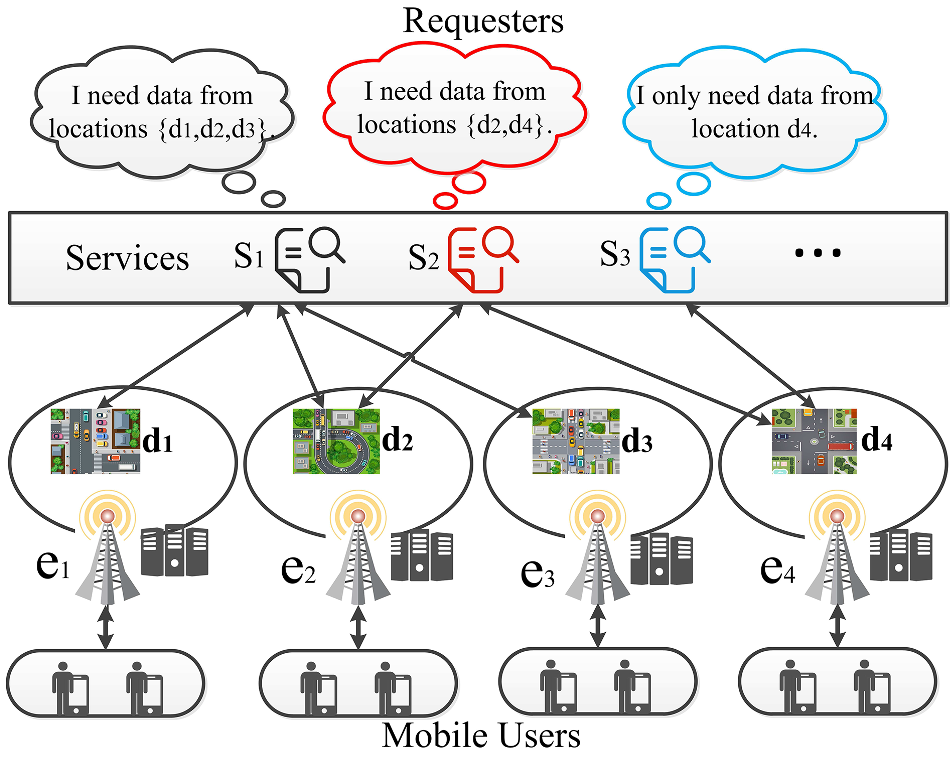 The DSC System Architecture: Requesters compete for resources across distributed Edge Clouds.
The problem is NP-hard, so the authors employ a Greedy Selection Algorithm (Algorithm 1). It ranks bundles by a "Grade" (Expected Bid minus average EC cost) and allocates resources iteratively until capacities are reached.
Experimental Results: Welfare vs. Privacy
The authors tested DRA against SOTA benchmarks like LIN-M and LOG-M.
- Social Welfare: DRA achieves higher social welfare because it utilizes expected bid values for selection rather than the randomized selection methods used in prior DP-based auctions.
- Privacy Leakage: Using KL-divergence as a metric (Figure 5), DRA shows controllable privacy loss that scales linearly with the budget , whereas TTP-based methods have "infinite" leakage if the platform is compromised.
- Efficiency: Even at a scale of 250 services, the auction concludes in under 6 seconds—well within the requirements for dynamic resource provisioning.
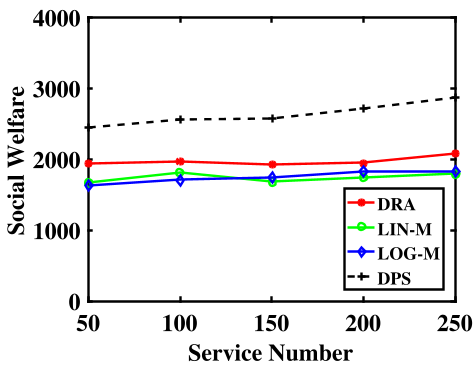 Social Welfare comparison: DRA maintains superior performance across varying numbers of services and ECs.
Critical Analysis & Conclusion
The core strength of DRA is its adversarial resilience. By proving -differential privacy and -truthfulness, the authors provide a mathematical guarantee that requesters are incentivized to bid truthfully and their secrets are safe.
Limitations:
- The current model assumes a static unit cost for EC resources (). In real-world scenarios, EC costs might fluctuate based on power consumption or local demand.
- The γ-truthfulness is "in expectation," meaning that while it's theoretically sound on average, high-variance scenarios could still lead to strategic manipulation in rare cases.
Takeaway: DRA provides a blueprint for "Zero-Trust" resource markets at the network edge, proving that privacy and efficiency are not a zero-sum game.