
Harmonizing Privacy and Performance: Scalable Multimedia Retrieval at the Edge
4599_Differentially-Private and Trustworthy Online Social Multimedia Big Data Retrieval in Edge Computing.
This paper introduces T-DPTDO and DT-DPTDO, novel distributed online learning frameworks for social multimedia retrieval in Edge Computing. The methods utilize a tree-based Contextual Multi-Armed Bandit (CMAB) approach integrated with Differential Privacy and trust mechanisms to optimize personalized content recommendations while securing user data and excluding malicious edge nodes.
TL;DR
The explosion of multimedia data at the network edge creates a paradox: we need personalization to filter content, but personalization requires sensitive user data. This paper presents T-DPTDO, a distributed online learning framework that uses hierarchical clustering and differential privacy to provide high-accuracy recommendations (200% better than standard MAB) while keeping user contexts and node secrets strictly private.
Motivation: The Edge Computing Bottleneck
As mobile users consume more high-definition content, backbone networks are becoming overloaded. Moving content to Edge Nodes (ENs) is the solution, but it introduces three major headaches:
- Big Data Complexity: How do you pick the "best" video from millions of options in real-time?
- The Privacy Paradox: Sharing user preferences between edge nodes helps learning speed but risks leaking private lifestyles.
- The Trust Deficit: Edge nodes are often decentralized and potentially untrustworthy or malicious.
Methodology: The T-DPTDO Framework
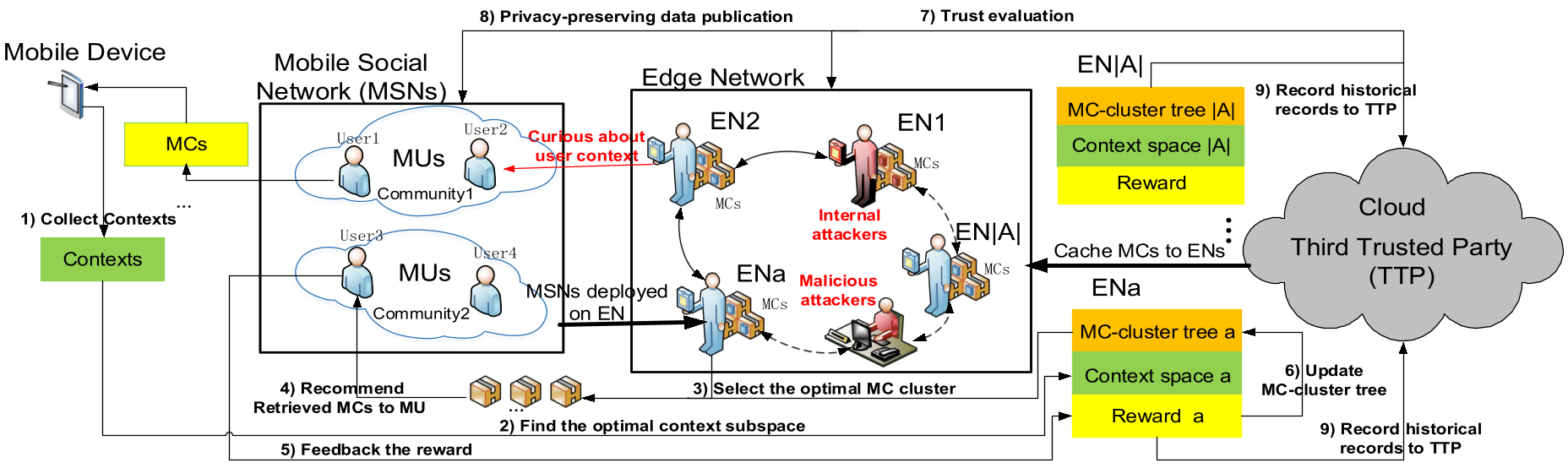
To solve these, the authors treat the edge node as a Contextual Online Learner.
1. Scaling with MC-Cluster Trees
Instead of evaluating every single image or video, the system builds an MC-Cluster Tree. It groups content hierarchically (top-down), allowing the algorithm to zoom in on promising "clusters" of content rather than individual items.
2. Privacy-Preserving Mechanics
The framework employs two main "shields":
- Exponential Mechanism (EM): When a node recommends a video, it doesn't always pick the absolute best one. It picks based on a probability distribution, ensuring an attacker can't reverse-engineer the user's context from the recommendation.
- Tree-based Noise Aggregation (TNA): When nodes share data to help each other learn, they add Laplace noise. By using a binary tree structure for noise, they reduce the total distortion from to , keeping the data useful for learning.
3. Trust Evaluation
A decay-based trust mechanism monitors ENs. If a node provides low-quality streaming to save bandwidth, its trust score drops, and it's eventually excluded from the collaborative network.
Experimental Battleground
The authors tested their system against a subset of the YFCC100M dataset (100 million media objects).
Key Breakthroughs:
- Context Matters: T-DPTDO achieved a 200% performance gain over context-free algorithms like UCB1. This proves that knowing who is watching (age, location, social profile) is vital.
- Connectivity vs. Regret: In "Fully Connected" networks, the system learns much faster than in "Star" or "Circular" networks because information flows more freely.
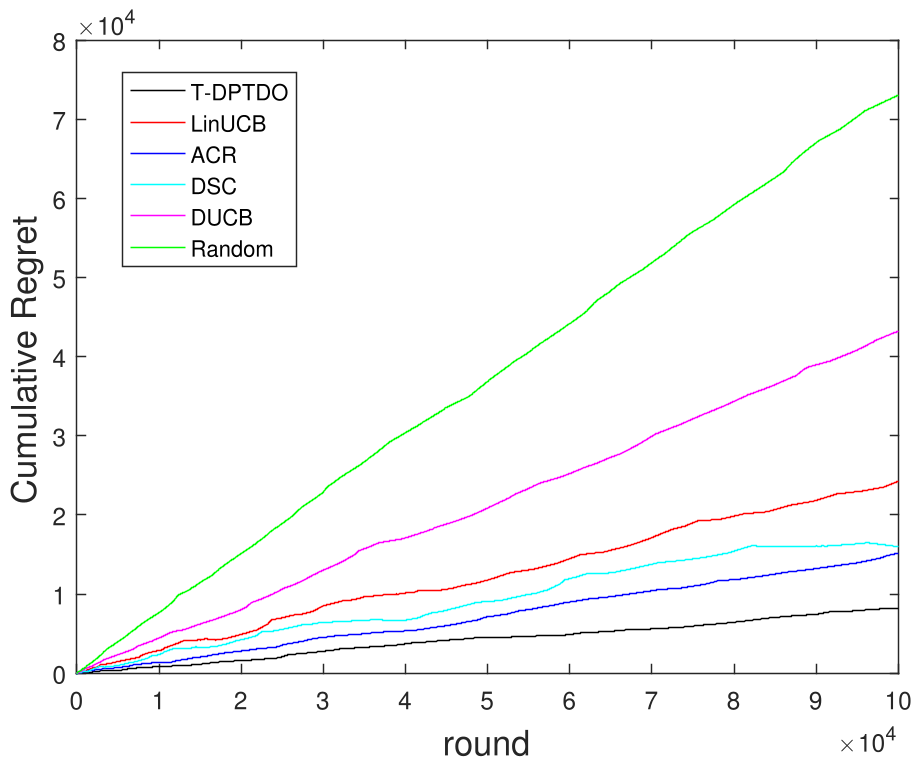
- The Privacy Cost: As shown in the table below, higher privacy (lower ) slightly reduces accuracy, but even with high privacy, the system remains competitive.
| Algorithm | (Privacy) | Final Accuracy |
|---|---|---|
| DT-DPTDO | 2.0 (Low) | 99.01% |
| DT-DPTDO | 0.01 (High) | 61.14% |
Critical Insight: Why This Matters
The real innovation here isn't just the math—it's the social intimacy factor. By partitioning user contexts based on both friendship and community interests, the researchers effectively captured how information spreads in the real world. Their "Dominator-centered" approach (DT-DPTDO) specifically targetted network topology to optimize learning, showing that in sparse networks, having a few "super-nodes" (Dominators) coordinate the learning process is the most efficient way to scale.
Conclusion & Future Outlook
T-DPTDO proves that we don't have to choose between big data utility and user privacy. By using hierarchical trees and smart noise aggregation, we can have a recommendation engine that is both fast and "honest-but-curious" proof. Future work could likely extend this to Federated Learning, where the models themselves are shared rather than just the rewards.